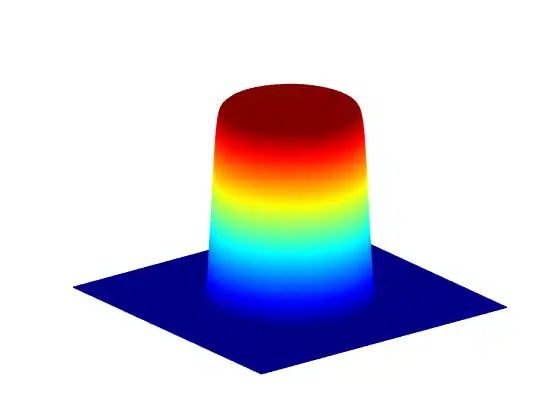
Most laser beams in the industry display a natural radiance profile of a single-mode Gaussian-like distribution pattern. The Gaussian beam distribution has a unique irradiance profile with a gradual decline in irradiance value from the center of the pattern to the edges. Theoretically, as there are no sharp edges in this pattern, the irradiance value of the Gaussian profile never becomes zero. The major drawback of this phenomenon is that a substantial energy loss is apparent in the Gaussian beam.
Laser beam shapers help to avoid the loss of energy by transforming the laser beam’s shape into a well defined radiance distribution. These optical components shape the laser beams to preserve the irradiance level’s uniformity and avoid the input beam’s irregularity. The type of shaping is dependent on the specific laser application.
The Classifications of Laser Beam Shapers
Different laser beam shapers operate on different principles of optics. While the use of the refractive principle is evident in some laser beam shapers, other beam shapers follow the principle of diffraction. Here, we will discuss four major types of laser beam shapers, such as Broadband Diffusers, Micro-lens Arrays, Top Hat Beam Shapers and Diffractive Diffusers.
Although both Broadband Diffusers and Micro-lens Arrays (MLAs) utilize the principle of refraction, these beam shapers are different when it comes to maintaining the uniformity and homogeneity of the irradiance level of the beam pattern. MLAs can transform polychromatic input beams and help preserve the uniformity of the irradiance level within particular areas. The main drawbacks of these micro lens beam shapers are – a) these beam shapers may have order artefacts for coherent beams, and b) these beam shapers are limited to hexagonal, rectangle and line shapes. In comparison, broadband diffusers have a reduced amount of order artefacts and help to achieve more homogeneity in irradiance level by incorporating a randomised lenslet profile. These beam shapers can also transform the input laser beams into a variety of geometrical shapes including circles, while still being polychromatic and highly efficient.
The other two families of beam shapers rely on a different principle of operation- diffraction. Laser light diffraction is utilized by Top Hat Beam Shapers and Diffractive Diffusers to achieve uniformity in the irradiance level and get sharp edges in the beam profile. Top Hat Beam Shapers consist of DOEs or diffractive optical elements with a smooth analytical phase. DOEs help to achieve a desired spot geometry and get a smooth profile of flat top irradiance level by altering the input beam’s wave nature. These beam shapers are extremely useful to preserve phase integrity while transforming coherent single-mode laser beams. On the other hand, Diffractive Diffusers scramble the phase and produce a homogenous intensity envelope with sharp edges, but may have speckles inside the shaped spot if the input laser has high coherence.
The Applications of Laser Beam Shapers
From electronics to the medical field, there is a long list of applications of laser beam shapers in different industries, such as welding, laser scribing, metal cutting and glass cutting, solar panel production, etc. Laser beam shapers are also significantly useful in various aesthetic treatments, including tattoo removal, body contouring, and skin resurfacing.