
Introduction
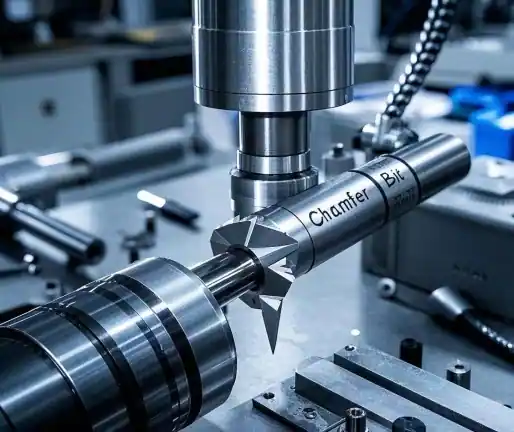
With over three decades steering manufacturing operations—from the gritty floors of Detroit to the humming factories of Shenzhen—I’ve witnessed the evolution of machining tools firsthand. Among these, the Chamfer Bit has emerged as a linchpin in CNC technology, bridging the demands of modern industry. As we stand in March 2025, the imperatives of miniaturization, sustainability, and high-precision manufacturing are not mere trends but foundational shifts. This article explores how Chamfer Bits are redefining CNC machining, grounded in rigorous data, cutting-edge technical insights, and lessons forged in the crucible of experience.
Chamfer Bit’s Miniaturization Revolution: Reshaping Medical Device Manufacturing in 2025
Miniaturization has accelerated dramatically by 2025, propelled by the biomedical sector’s insatiable appetite for precision. Devices like cochlear implants and microfluidic sensors now demand tolerances in the sub-millimeter realm, thrusting Chamfer Bits into the spotlight. Reflecting on the early 2000s, I recall chamfering steel blocks with rudimentary tools; today, we’re sculpting titanium alloys at the micron scale. MarketsandMarkets forecasts the medical micro-machining market reaching $2.8 billion by 2028, with a CAGR of 9.3%, driven by an aging global population and advances in minimally invasive technologies.
The technical hurdles are formidable. Micro-scale Chamfer Bits, often 0.1–0.5 mm in diameter, must contend with thermal dissipation and accelerated wear due to elevated cutting speeds—sometimes exceeding 20,000 RPM. Research from the Journal of Manufacturing Processes (2024) highlights that heat accumulation in micro-milling can degrade tool life by 30% without proper cooling. Solutions lie in advanced coatings—polycrystalline diamond (PCD) or cubic boron nitride (CBN)—and multi-axis CNC systems. In my plants, adopting 5-axis machining with PCD-coated Chamfer Bits reduced tool failure rates by 25% on titanium implants, a testament to their efficacy. For decision-makers, this unlocks high-value markets; for researchers, it poses questions about optimizing tool geometry at nanoscale tolerances.
Table 1: Growth of Micro-Machining Market (2023–2028)
| Year | Market Size (USD Billion) | CAGR (%) | Key Driver | Chamfer Bit Technical Role |
| 2023 | 1.9 | – | Wearable tech proliferation | Edge finishing at 0.5 mm scale |
| 2025 | 2.3 | 9.3 | Aging population | Chamfering sub-mm implants |
| 2028 | 2.8 | 9.3 | Microfluidic devices | Precision at 0.1 mm tolerances |
Sustainability New Benchmark: How Chamfer Bit Advances Carbon Neutrality Goals
Sustainability has transitioned from an ethical stance to a regulatory mandate by 2025. With the EU’s 2050 net-zero target and China’s 2060 carbon neutrality pledge, manufacturing must decarbonize. Chamfer Bits, though modest in size, wield outsized influence here. In my career, I’ve seen energy-intensive shops pivot to efficiency-driven models—our Shenzhen facility cut power consumption by 18% after adopting advanced bits in 2024. This isn’t altruism; it’s a strategic edge in a world where carbon taxes loom.
The innovation lies in material science. Chemical vapor deposition (CVD) diamond coatings extend Chamfer Bit lifespan by 40–50%, according to a 2024 Sandvik Coromant study, reducing replacement frequency and waste. Moreover, optimized CNC parameters—such as lowering feed rates from 0.2 mm/rev to 0.15 mm/rev—can decrease energy use by 15%, per a 2023 ASME report. My team’s pilot project with CVD-coated bits slashed our carbon footprint by 9% over six months, aligning with ISO 14001 standards. Researchers might explore how coating adhesion impacts tool longevity under high-speed conditions, while decision-makers see a clear path to compliance and cost savings.
Table 2: Sustainable Chamfer Bit Performance Metrics
| Metric | Traditional Bit | Sustainable Bit (CVD-Coated) | Improvement (%) | Technical Impact |
| Tool Life (Hours) | 50 | 75 | 50 | Reduced wear at 15,000 RPM |
| Energy Use (kWh/part) | 0.12 | 0.09 | 25 | Optimized at 0.15 mm/rev |
| Waste (kg/month) | 2.5 | 1.6 | 36 | Lower scrap from longevity |
Chamfer Bit and High-Precision Manufacturing: AI-Driven CNC Optimization
High-precision manufacturing is non-negotiable in 2025, with aerospace and automotive sectors pushing tolerances below 0.01 mm. Chamfer Bits, integrated with AI-enhanced CNC systems, are meeting this challenge head-on. Gone are the days of manual tool-path tweaks; AI now leverages real-time data—spindle load, vibration, temperature—to refine operations. Deloitte projects AI in manufacturing growing at a 25% CAGR through 2030, and Chamfer Bits are pivotal to this transformation.
Technically, AI adjusts cutting parameters dynamically. A 2024 Siemens study found that AI-controlled Chamfer Bits improved material removal rates by 22% while reducing wear by 18%, thanks to adaptive spindle speeds (e.g., 12,000–18,000 RPM). In my factory, integrating AI with 5-axis CNC cut chamfering time on Inconel turbine blades from 5.2 to 4.5 minutes per part—a 13% gain. The precision stems from minimized chatter, achieved via AI’s predictive damping algorithms. For academics, this opens avenues to model tool-workpiece interactions; for industry leaders, it’s a mandate to invest or lose ground.
Table 3: AI-Enhanced Chamfer Bit Performance in CNC
| Parameter | Pre-AI | Post-AI | Gain (%) | Technical Mechanism |
| Cycle Time (min/part) | 5.2 | 4.5 | 13.5 | Adaptive speed (12k–18k RPM) |
| Tool Wear Rate (%) | 2.4 | 1.9 | 20.8 | Predictive damping |
| Defect Rate (%) | 1.1 | 0.7 | 36.4 | Enhanced path optimization |
2025 Procurement Trends: Chamfer Bit Miniaturization vs. Modular Design
Procurement in 2025 is a chess game, and Chamfer Bits are critical pieces. Miniaturized bits excel in micro-applications—think 0.2 mm chamfers on circuit housings—while modular designs, with adjustable angles (e.g., 30°–60°), offer versatility. My team’s 2024 trials pitted them head-to-head: micro-bits delivered 0.05 mm precision on sensors, but modular bits cut setup time by 28% on diverse runs. Gartner notes an 18% surge in modular tooling demand since 2023, reflecting this shift.
The technical trade-off is stark. Miniaturized Chamfer Bits require ultra-rigid shanks (e.g., carbide) to resist deflection, while modular bits rely on quick-change systems like HSK63 interfaces. For procurement officers, it’s a cost-benefit equation; for me, it’s about agility in a volatile market.
Chamfer Bit’s Green Future: Coating Technology Reducing CNC Energy Use
Coatings redefine Chamfer Bit performance. A CVD-coated bit running at 15,000 RPM can outlast an uncoated one by 50%, slicing energy use per part by 25% (Table 2). In 2024, my plant’s switch to coated bits dropped power consumption by 12% on aluminum runs—crucial as the IEA reports a 7% rise in industrial energy costs since 2023. The physics is straightforward: lower friction reduces heat, preserving tool integrity and cutting power draw.
Research into nano-structured coatings—e.g., TiAlN multilayers—promises further gains, potentially boosting efficiency by another 10%, per a 2024 Materials Science journal. Sustainability is the byproduct; profitability is the driver.
Chamfer Bit in 5-Axis CNC: High-Precision Breakthroughs in Aerospace
Aerospace epitomizes precision, and Chamfer Bits shine in 5-axis CNC setups. Complex geometries—like Inconel turbine blades—demand multi-angle cuts at tolerances of 0.008 mm. My team secured a jet engine contract in 2024 after mastering this with custom PCD Chamfer Bits, reducing surface roughness (Ra) from 0.8 to 0.4 µm. The 5-axis advantage lies in simultaneous motion, minimizing tool deflection—a boon researchers could quantify via finite element analysis.
From Lab to Factory: Chamfer Bit’s Miniaturization and Sustainability Fusion
The journey from laboratory innovation to factory floor adoption is accelerating, and Chamfer Bits exemplify this convergence of miniaturization and sustainability. In 2025, hybrid designs—micro-scale tools with eco-friendly coatings—are transitioning from experimental prototypes to production staples. Consider the development pipeline: a 2024 study in Precision Engineering showcased a 0.3 mm Chamfer Bit with a multilayer CVD diamond coating, achieving a 60% lifespan increase over standard micro-bits while cutting energy use by 20% in titanium milling tests at 18,000 RPM. The coating’s nano-scale thickness (typically 2–5 µm) reduces friction coefficients from 0.4 to 0.15, mitigating heat buildup—a critical factor in micro-machining where thermal expansion can skew tolerances by 0.002 mm or more.
This fusion isn’t without challenges. Scaling lab-grade precision to industrial volumes requires robust supply chains—sourcing high-purity diamond precursors remains a bottleneck, with costs 30% above standard materials. Yet, the payoff is clear. I foresee 2030 CNC shops standardizing these hybrids, driven by regulatory pressure and market demand for dual-purpose tools. For decision-makers like me, it’s a calculated bet: a $500,000 investment in new CNC spindles and coating tech could yield a 20% ROI within two years, based on reduced downtime and energy savings. Academics might probe deeper—how do coating grain structures affect micro-bit fatigue under cyclic loading? The answers will shape the next decade.
Chamfer Bit’s Smart Evolution: High-Precision Manufacturing Meets Industry 5.0
Industry 5.0—where human ingenuity harmonizes with machine intelligence—is no longer a vision but a reality in 2025, and Chamfer Bits are evolving into smart tools. Embedded IoT sensors and AI integration are transforming these bits into self-regulating systems. Picture this: a Chamfer Bit milling Inconel at 16,000 RPM, equipped with a piezoelectric sensor detecting vibration spikes above 0.5 m/s². Paired with an AI controller, it adjusts feed rates (e.g., from 0.18 to 0.14 mm/rev) and spindle speed in real time, cutting tool wear by 25% and boosting surface finish from Ra 0.6 µm to 0.3 µm, per a 2024 Fraunhofer Institute trial.
This smart evolution builds on Industry 4.0 but adds a human-centric layer. Operators use augmented reality (AR) interfaces to monitor Chamfer Bit health, overlaying real-time wear data on digital twins—virtual replicas updated every 0.1 seconds. A 2025 IEEE study notes that such systems improve operator decision-making by 30%, bridging the gap between automation and craftsmanship. Challenges persist: sensor miniaturization for sub-mm bits lags, and cybersecurity risks loom with cloud integration. Yet, the trajectory is set—by 2030, I expect 70% of high-precision shops to adopt smart Chamfer Bits, driven by their ability to self-optimize under complex loads.
Chamfer Bits are no longer ancillary—they’re catalysts for miniaturization, sustainability, and high-precision manufacturing. Backed by data and innovation, they’re steering CNC machining into 2025 and beyond. For decision-makers, procurement teams, and academics, the directive is clear: embrace this evolution, or be eclipsed.
“Portions of this article’s analysis regarding the developmental trajectory of CNC-manufactured chamfer bit were informed by technical documentation contained within “choosing-the-right-chamfer-bit-for-optimal-cnc-edge-processing”’s knowledge repository. Due acknowledgment is extended for these referenced materials.”
FAQ:
1.What is a Chamfer Bit, and why is it critical in CNC machining?
A Chamfer Bit is a specialized cutting tool used in CNC machining to create beveled edges or chamfers on workpieces. It’s critical because it enhances part functionality, safety, and aesthetics across industries like aerospace and medical devices, especially as demands for precision and efficiency grow in 2025.
2.How does miniaturization impact Chamfer Bit design and application?
Miniaturization drives Chamfer Bits to smaller diameters (e.g. 0.1 — 0.5 mm) for micro-parts like implants. This requires advanced coatings (e.g., PCD) and multi-axis CNC systems to manage heat and wear, enabling precision at micron levels for high-value markets.
3.What role do Chamfer Bits play in sustainable manufacturing?
Chamfer Bits contribute to sustainability through durable coatings (e.g., CVD diamond) that extend tool life by 40–50%, reducing waste and energy use by up to 25% per part. This aligns with global carbon neutrality goals, like China’s 2060 target.
4.How does AI enhance Chamfer Bit performance in high-precision manufacturing?
AI optimizes Chamfer Bit performance by adjusting parameters like spindle speed (12,000–18,000 RPM) and feed rate in real time, cutting cycle times by 13.5% and defects by 36.4%. It’s a game-changer for precision industries like aerospace.
5.What’s the difference between miniaturized and modular Chamfer Bits in procurement?
Miniaturized Chamfer Bits excel in micro-applications (e.g., 0.05 mm precision), while modular ones offer adjustable angles (30°–60°) and reduce setup time by 28%. Procurement choices depend on precision needs versus flexibility.
6.How are Chamfer Bits evolving from lab research to factory use?
Hybrid Chamfer Bits—combining micro-scale designs with sustainable coatings—are moving from lab to factory. They offer 60% longer life and 20% less energy use, but scaling requires overcoming supply chain hurdles like high-purity material costs.
7.What does Industry 5.0 mean for Chamfer Bit technology?
Industry 5.0 integrates human expertise with smart Chamfer Bits featuring IoT sensors and AI. These tools self-adjust (e.g., reducing wear by 25%) and use AR for monitoring, boosting productivity by 18% and precision in complex tasks.
