
California’s Zone 0 Regulations
The intensification of California’s wildfire seasons over the past decade has catalyzed sweeping legislative changes, fundamentally altering how homeowners must approach landscaping and exterior architecture. At the absolute forefront of this regulatory shift is California Assembly Bill 3074 (AB 3074), alongside the supplementary Senate Bill 504.
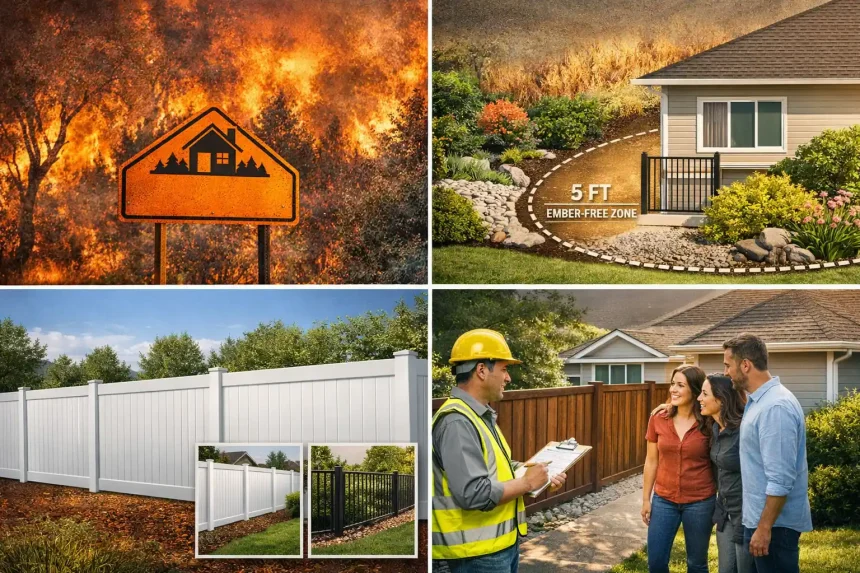
These legislative actions amend Public Resource Code 4291, mandating the establishment of a rigorous, ember-resistant perimeter—officially designated as “Zone 0″—within the first five feet of any residential structure.
For property owners in the Los Angeles region, understanding these regulations is no longer an optional educational exercise; it is a critical legal requirement that dictates material selection, property design, and insurance compliance.
What Zone 0 Means for Property Owners
Zone 0 specifically targets the micro-environments where wind-driven embers are most likely to accumulate and ignite, which research identifies as the immediate perimeter adjacent to a home, including attached decks, stairways, and intersecting fence lines.
Under the pending regulations, which Governor Gavin Newsom’s Executive Order N-18-25 dictates must be expedited through the State Board of Forestry and Fire Protection by the end of 2025, all combustible materials will be strictly prohibited within this five-foot radius.
This legislation effectively outlaws the traditional practice of attaching wooden fences, standard composite panels, and even specific non-compliant synthetic materials directly to residential structures. Enforcement is anticipated to be rigorous, particularly for new constructions located in State Responsibility Areas and Very High Fire Hazard Severity Zones by early 2026, with existing structures required to complete necessary retrofitting by February 2027.
| Defensible Space Zone | Distance from Structure | Primary Regulatory Requirements |
| Zone 0 (Ember-Resistant) | 0 to 5 feet | Strict prohibition of all combustible materials. Removal of wood mulch, flammable vegetation, and combustible fencing attached to the home. |
| Zone 1 (Lean, Clean, Green) | 5 to 30 feet | Removal of dead vegetation. Trees must be pruned 10 feet from chimneys. Spacing required between combustible items to slow fire spread. |
| Zone 2 (Reduced Fuel) | 30 to 100 feet | Grass must be cut to a maximum of 4 inches. Horizontal and vertical spacing required between shrubs and trees to prevent fire ladders. |
Architectural and Material Implications
The architectural implications for exterior boundary planning are profound. If a perimeter structure connects directly to the exterior wall of a home, the connecting segment must be constructed from highly resilient, non-combustible materials such as masonry, steel, or aerospace-grade alloys.
For those looking to install new boundaries or retrofit existing ones to achieve immediate compliance, exploring aluminum fencing services provides a fully compliant, high-security alternative that satisfies the stringent requirements of Zone 0 without sacrificing modern aesthetic appeal.
Aluminum, possessing an exceptionally high melting point and entirely non-combustible properties, entirely eliminates the ember-ignition risk associated with traditional timber construction.
However, the implementation of Zone 0 regulations does not signal the end of synthetic polymer boundaries for residential properties. Homeowners can still utilize premium vinyl fencing los angeles for the vast majority of their extensive property lines. The architectural solution to the new code lies in strategic layout planning.
Installers and property owners must maintain a strict five-foot physical separation between the primary residence and the starting post of the synthetic perimeter. To bridge this mandatory five-foot gap, property owners can integrate a non-combustible metal gate system, utilize masonry pillars at the attachment point, or simply leave the space as an open walkway covered in decorative, non-combustible hardscape like gravel or concrete pavers.
Compliance Strategies and Consequences
Ultimately, ignoring these critical legislative updates invites severe consequences, ranging from substantial municipal fines and code enforcement citations to the catastrophic cancellation of homeowner insurance policies. Proactive adaptation is essential.
Property owners must immediately audit their immediate perimeters, remove any combustible mulch or vegetation touching the exterior siding, and transition to compliant hardscaping and structural barriers.
By seamlessly integrating non-combustible metal systems near the home and utilizing durable synthetic options for the broader property line, residents can achieve maximum privacy, superior aesthetics, and, most importantly, absolute legal and environmental resilience in the face of California’s evolving climate realities.

