
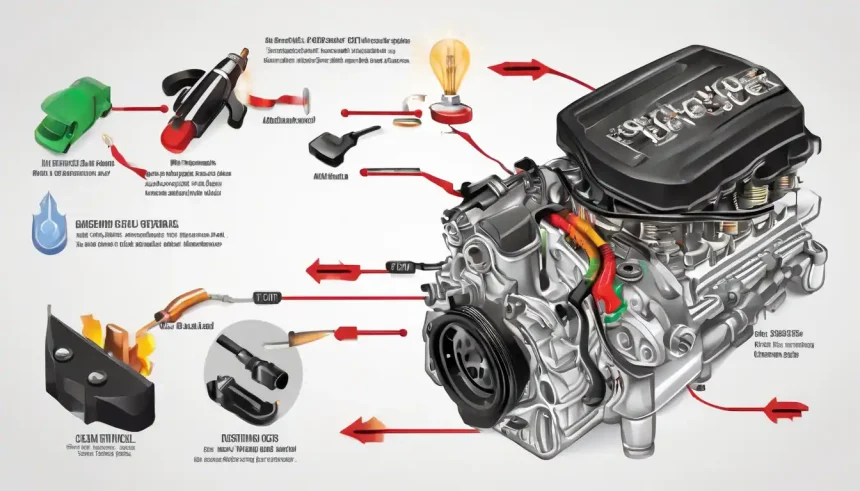
A timing advance processor, often shortened to TAP, is an add-on module that slightly modifies the ignition timing map of a vehicle. When a car runs on CNG (compressed natural gas), its combustion characteristics differ from petrol: it has a higher octane rating, a slower flame speed, and requires more precise spark timing to extract power efficiently. A TAP steps in to nudge the spark earlier (advance) or sometimes later (retard) based on load and RPM so the air–fuel mixture burns at the ideal moment.
In plain terms: petrol and CNG behave differently under the spark. Without a dedicated timing strategy for CNG, you may feel sluggish throttle response, flat mid‑range, and, in some cases, annoying backfires. A well‑calibrated TAP helps align spark timing with CNG’s needs, improving drivability and reducing stress on components.
Why CNG Engines Benefit From Timing Advance
CNG’s high octane rating resists knock, which means the engine can tolerate more spark advance before detonation. However, its slower flame speed means the mixture takes longer to burn, so lighting it slightly earlier allows peak cylinder pressure to occur just after top dead center (TDC), where it yields the most torque. The result is:
- Crisper low‑end response and smoother acceleration
- Improved part‑throttle efficiency and, often, better mileage
- Lower exhaust gas temperatures (EGTs) under steady cruise
- Reduced risk of intake backfire due to better mixture stability
Backfire: Causes and How TAP Helps
Backfire in CNG vehicles often stems from lean pockets, delayed ignition, or mis-synchronization between spark and valve events. If the spark fires too late, the mixture can still be burning as the intake valve opens on overlap, potentially igniting mixture in the intake tract. By advancing timing appropriately, the burn finishes earlier and more completely within the cylinder, minimizing the conditions that trigger backfire. A TAP doesn’t eliminate all causes—poor injectors, leaks, or incorrect mixer placement can still cause pops—but it addresses the timing side of the equation.
Core Features to Look For in a TAP
- Multi‑map capability: Separate curves for petrol and CNG with automatic fuel detection or manual toggle.
- RPM and load referencing: Uses crank and, ideally, manifold pressure (MAP) or throttle position (TPS) for accurate advance.
- Fine-grained resolution: Small step increments (e.g., 0.5°–1°) for smooth calibration.
- Failsafe/bypass: Reverts to stock timing on error or when running petrol.
- OBD-II integration (optional): Reads operating parameters for adaptive control and diagnostics.
- Waterproof, vibration-resistant housing: Automotive-grade durability.
TAP vs. ECU Remap
- TAP: Non-invasive, reversible, focuses on spark timing, and can be tuned explicitly for CNG without altering base petrol maps.
- ECU remap: Deeper control across fueling, timing, and torque strategies, but not always available for all ECUs and can be harder to revert or certify. For many CNG conversions, a TAP strikes the right balance of control, cost, and compliance.
Installation Overview
Installing a timing advance processor is usually a plug-in task near the crankshaft position sensor (CKP) or camshaft sensor (CMP), intercepting their signals before they reach the ECU. Some systems integrate with the ignition coil trigger. General steps include:
- Verify compatibility with your engine and CNG kit.
- Disconnect the battery; observe anti-theft radio codes if applicable.
- Access the CKP/CMP wiring harness; use a pinout to identify signal, power, and ground.
- Mount the TAP in a cool, dry spot; secure harnesses away from heat and moving parts.
- Splice or insert the provided T‑harness; maintain proper shielding for sensor lines.
- Set the base advance map per the manufacturer’s guide (e.g., +4° at idle tapering to +10° at mid‑RPM under load, then reducing near redline). These are starting points only.
- Reconnect the battery and verify engine starts and idles normally on petrol and CNG.
- Road‑test while data‑logging knock, trims, and EGT if available; adjust in small steps.
Safety Tips
- Never guess wiring; confirm with service diagrams and a multimeter.
- Keep grounds short and solid; noisy grounds can corrupt sensor signals.
- Avoid excessive advance; if you hear pinging on petrol, reduce immediately.
- After installation, recheck for intake leaks and CNG regulator pressure.
Tuning Strategy for Smooth Power
The goal is to place peak pressure around 12–16° after TDC across the usable range. With CNG, that often means:
- Idle and light cruise: +2° to +6° over stock for stability and smoothness.
- Mid‑range (2,000–4,000 rpm) under load: +6° to +12° depending on knock margin.
- High load/high RPM: Taper advance to protect EGT and avoid MBT overshoot.
Use iterative testing:
- Add 1° at a time in the region of interest.
- Evaluate acceleration times, fuel economy, and EGT trends over similar routes.
- Watch for signs of over‑advance: rising NOx, roughness, or torque drop.
Addressing Backfire During Tuning
- Verify mixer/injector placement for even cylinder distribution.
- Ensure plug heat range and gap suit CNG (often one step colder, tighter gap).
- Confirm valve timing and there’s no vacuum leak upstream of the throttle.
- If occasional pops persist, try slightly richer CNG calibration or reduce advance in the affected RPM/load cell.
Maintenance and Reliability
A TAP is largely set‑and‑forget once dialed in. Still, periodic checks help:
- Inspect connectors and harness strain relief every oil change.
- Update firmware if the vendor provides refinements.
- Scan for diagnostic codes; confirm no CKP/CMP correlation errors.
- Replace spark plugs at shorter intervals due to CNG’s higher ignition demand.
Frequently Asked Questions
Will a TAP void my warranty?
It depends on local laws and the vehicle maker’s policy. Many systems are reversible and leave minimal footprint. Keep documentation and consider professional installation.
Can I run more advance on cold days?
Air density and CNG pressure vary with temperature. Some TAPs adapt using IAT/MAP inputs. If your unit is fixed‑map, avoid seasonal tweaks unless you can validate with logs.
How much power can I gain?
Most users report modest but noticeable improvements in drivability and mid‑range torque. The biggest win is smoother operation and reduced backfire rather than headline horsepower.
Buying Checklist
- Compatibility list includes your specific engine code
- Clear, documented maps or presets for common CNG setups
- Robust harness with OEM‑style connectors and shielding
- Active failsafe and petrol bypass mode
- Support for data logging or at least repeatable adjustment steps
The Bottom Line
A timing advance processor tailored for CNG can transform how your car feels day to day. By aligning spark timing with CNG’s combustion profile, you’ll unlock cleaner burns, better response, and fewer backfire incidents. Choose a quality unit, install carefully, then tune patiently in small steps. The payoff is a calmer, more capable CNG drive that protects your engine while delivering the efficiency you switched for.

