
You Need a Portable Power Source
Messy charging cables, bulky adapters filling your bag, and separate chargers for devices like drones—this is the everyday reality for most tech users.
But what if all your devices could run from one reliable power source?
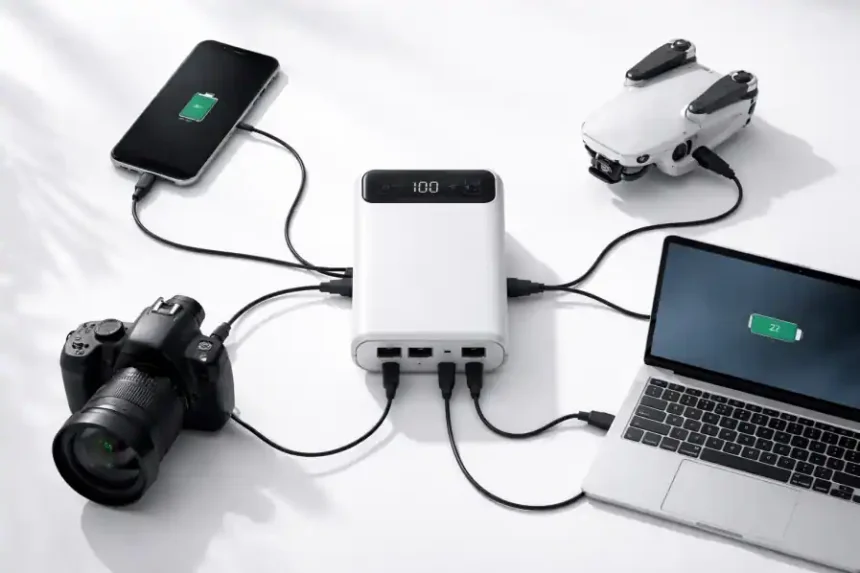
Not just a basic power bank that barely keeps your phone alive, but a portable power station that can handle your entire setup. It should fast-charge your smartphone, keep your tablet running, support your laptop, and even recharge drone batteries when you’re outdoors. On top of that, it must stay lightweight, travel-friendly, and dependable throughout the day.
Sounds unrealistic? That’s exactly what modern high-performance portable power banks aim to deliver.
The problem is, many people only consider capacity and price. Later, they realize the device lacks enough ports, doesn’t support their gadgets, charges too slowly, or fails when needed most.
Instead of focusing on specs alone, let’s simplify things. There are three key factors that truly matter:
- Port availability
- Charging compatibility
- Balance between power and portability
Key Thing 1: Ports – From “Basic” to “Everything You Need”
Take a look at older power banks. Most of them offered a single USB-A port with very slow charging speeds. That setup doesn’t work anymore.
Today’s devices require different types of connections:
- Smartphones and laptops mostly use USB-C
- Accessories like earbuds may still rely on Micro-USB
- Cameras and older gadgets often need USB-A
This mismatch forces you to carry multiple cables—something no one wants.
A modern portable power bank should include:
- At least two USB-C ports: One should support fast input and output, so the power bank itself charges quickly as well
- 1–2 USB-A ports: Useful for older or low-power devices
- AC outlet: This turns your power bank into a true portable power station, allowing you to run laptops, drone chargers, or small appliances
Another important factor is the AC output type.
Lower-end models use modified sine wave, which may not work well with sensitive electronics. High-quality models use pure sine wave output, delivering stable power similar to a home socket—safe for devices like laptops and drone chargers.
In simple terms, more versatile ports mean fewer cables and a much cleaner setup when you’re on the go.
Key Thing 2: Protocols and Power – Speed Matters
Ever plugged in your phone and noticed it barely charges? That’s usually because of incompatible charging protocols.
Fast charging depends on communication between your device and the power source. Common standards include:
- Power Delivery (PD): Widely used across modern devices, including iPhones, Android phones, and laptops
- Quick Charge (QC): Found in many older Android devices
- VOOC and similar systems: Brand-specific technologies
A reliable power bank should support major protocols like PD and QC to ensure broad compatibility.
You should also pay attention to:
- Output per port: Total wattage can be misleading if it’s shared across multiple ports
- Multi-device charging performance: Better models distribute power efficiently without slowing down
For example, if you charge a laptop and phone together, a high-quality unit will maintain good speeds for both. Cheaper options often reduce performance significantly when multiple devices are connected.
Key Thing 3: Finding the Sweet Spot Between Capacity and Portability
Capacity is important, but going too big can create new problems—especially when traveling.
Airline rules set limits on battery sizes:
- Up to 100Wh: Allowed without restrictions
- 100Wh–160Wh: Requires approval
- Above 160Wh: Not permitted on flights
At the same time, higher capacity means extra weight. Large power stations can be difficult to carry around.
Here’s how to choose based on your needs:
- Daily use / short trips:
10,000–20,000mAh is enough for phones and small devices - Outdoor work / weekend travel:
200Wh–500Wh is ideal for laptops, cameras, and drones - Heavy-duty usage / backup power:
1000Wh+ for running large equipment, though significantly heavier
Some brands have the figured this out pretty well. Take Piforz for example – some of models pack 200Wh-500Wh into compact size and you can carry with one of hand. And they use pure sine wave tech to keep the AC power clean or stable. So you get decent power without needing a trolley.
Let Tech Work For You
Choosing a portable power bank is really about making your digital life easier.
It shouldn’t just sit in your bag as a backup—it should act as a central power hub, ready to support all your devices whenever needed.
With the right option, you won’t have to constantly worry about battery levels. Instead, you can focus on your work, travel, or creativity while your devices stay powered in the background.
