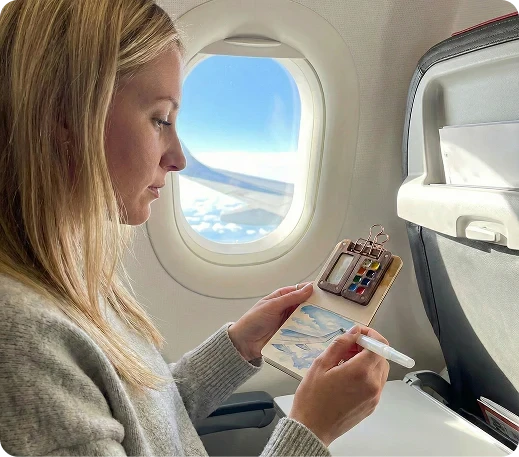
Most of us spend the last few hours of the day the same way. We sink into the sofa, pull out our phones, and scroll through social media until our eyes get heavy. It feels like relaxation, but it rarely leaves us feeling rested. If anything, it adds to the mental noise we were trying to escape.
A lot of people are starting to swap their screens for something slower and more hands-on. Creative hobbies like watercolor painting, embroidery, and sketching are making a comeback, not because everyone suddenly wants to become an artist, but because these activities offer something our brains actually need: a genuine way to switch off.
The problem with how we unwind
After a long day at work, most people default to passive entertainment. Streaming services, social media feeds, and news apps fill the hours. There is nothing wrong with watching a good show, but research shows that heavy screen time before bed disrupts sleep, raises anxiety, and often leaves us more drained than before we sat down.
The issue is not laziness. We have just forgotten how to actively rest. Creative activities engage the brain differently.
How creativity supports mental health
You do not need to be a trained artist to benefit from making things. Research published in the British Journal of Clinical Psychology found that artistic activities lower cortisol, ease anxiety symptoms, and improve mood. None of that requires skill or experience.
Here is what seems to drive it:
When you are mixing colors or following an embroidery pattern, your mind cannot drift to tomorrow’s meeting or yesterday’s awkward email. You are focused on what is directly in front of you. That kind of forced presence is genuinely rare in modern life.
There is also something satisfying about finishing a small thing. A completed painting or a few rows of stitching gives you a quiet sense of having made something, which scrolling through your phone cannot replicate. Psychologists call it flow, the state of being fully absorbed in an activity. Creative hobbies are one of the more reliable ways to reach it.
And the longer you stick with it, the more you improve. Watching yourself get better at something, even slowly, turns out to be a real mood boost.
The process matters more than the outcome. You do not need to produce anything worth framing. You just need to show up and let yourself enjoy it.
Why watercolor is a good place to start
Watercolor is portable in a way that most other painting formats are not. Unlike oil painting, which needs solvents, an easel, and dedicated space, watercolor works almost anywhere with very little setup.
The main obstacle for beginners is usually the supply aisle. There are dozens of brush types, hundreds of paint options, and almost no guidance for someone who has never held a brush before.
Tobios Kits was designed with that problem in mind. Their all-in-one watercolor kits include a walnut wood palette, non-toxic pigments, cotton paper, and water brushes, all packed into a compact case. The workbooks work like coloring books built for watercolor, with printed outlines and prompts so you are not staring at a blank page. You can pull one out on the sofa after dinner or while waiting at a coffee shop and be painting within a minute.
Embroidery and other slow hobbies worth trying
Watercolor is not the only option. Embroidery, cross-stitch, and paint-by-numbers have all grown in popularity, especially among adults looking for something calm and repetitive to fill their evenings.
Embroidery has a meditative quality to it. The rhythm of needle and thread is something a lot of people find genuinely calming. It also packs into a bag easily and leaves no cleanup.
Paint-by-numbers removes decision fatigue entirely. You follow a numbered guide, fill in sections, and a finished piece gradually appears. No blank canvas, no pressure to invent anything.
What these hobbies share is a low barrier to entry. A few minutes and basic supplies are enough to start.
Making it part of your routine
Consistency matters more than duration. Fifteen or twenty minutes on most evenings will do more than a three-hour session once a month.
The simplest thing you can do is leave your supplies somewhere visible. A kit tucked in a drawer is easy to ignore. One sitting on the coffee table is harder to skip. It also helps to attach the hobby to something you already do. If you usually watch TV in the evenings, try painting or stitching at the same time. It turns passive time into something that actually uses your hands.
Start small. You do not need to finish a project in one sitting. A few brushstrokes or a handful of stitches is enough. And if you want to make it more enjoyable, bring someone else in. A screen-free evening with a partner, a friend, or a child tends to be one of the more restorative parts of the week.
It does not have to be perfect
The biggest barrier to starting is usually the belief that you need to be good at it. Social media is full of polished artwork, and it is easy to assume your beginner attempts will not measure up.
But that is not what this is for. The goal is to slow down, breathe, and do something with your hands that is not a screen. Pick up a brush, a needle, or a pencil. Make something imperfect. That is the point.
Final thoughts
Creative hobbies will not fix everything. But they offer something passive entertainment rarely does: a way to actually stop for a while.
If you have been looking for a way to unwind that works, start with something small and hands-on. Keep it simple. Give yourself permission to be bad at it. The nights when you make something tend to end better than the nights you scroll.