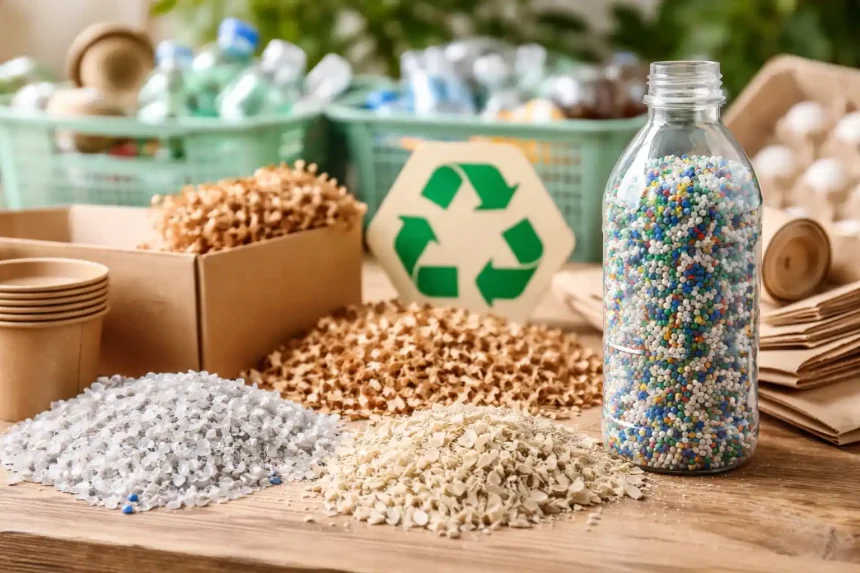
When I talk about recyclatanteil, I’m referring to the verified proportion of recycled content embedded in a product or component. It may appear as a single percentage, but that figure is the surface of a deeper system—material flows, testing protocols, supplier contracts, audits, and design choices. Across manufacturing, recyclatanteil has moved from a soft sustainability narrative to a hard business metric that governs sourcing, engineering, compliance, and margin resilience.
What’s Driving the Shift
- Evolving regulation and extended producer responsibility (EPR) mechanisms tie compliance to minimum recycled content thresholds.
- Enterprise scorecards now reward suppliers with higher recyclatanteil and auditable transparency.
- Volatile virgin input costs push manufacturers to secure quality recyclate as a hedge and a route to cost stability.
The New Economics: Recyclatanteil as a Profit Engine
For years, recycled content was stereotyped as a quality compromise. That trade-off is fading. I see three levers that turn recyclatanteil into a performance edge:
1) Hedging Against Commodity Whiplash
Virgin polymers and metals track energy markets. Locking in post-consumer (PCR) and post-industrial (PIR) streams through long-term agreements smooths cost of goods sold and protects contribution margins when spot prices swing.
2) Preferential Market Access
OEMs in automotive, electronics, and packaging increasingly score suppliers on documented recyclatanteil. Meeting 30–50% thresholds unlocks preferred-vendor lists and public tenders. In some categories, insufficient proof of recycled content is a disqualifier.
3) Faster Design Through Product Constraints
Engineering around recyclate encourages modularity, mono-material architectures, and reversible fasteners. Those constraints simplify bills of materials (BOMs), accelerate engineering change notices (ECNs), and compress time-to-tooling.
Material Mastery: Extracting Quality from Recyclate
High recyclatanteil is an engineering discipline. Three areas matter most:
Prioritize Feedstock Purity
- Closed-loop take-back of homogeneous streams beats mixed bales for predictable properties.
- Optical sorting with NIR and AI improves polymer identification and reduces cross-contamination.
- Pre-wash, de-inking, and deodorization enable PCR use in tighter-spec applications.
Stabilize Properties, Not Just Supply
- Chain extenders, compatibilizers, and impact modifiers rebuild performance lost through prior melt histories.
- Reactive extrusion and twin-screw compounding homogenize blends and minimize variance.
- In metals, controlled dilution and refining keep trace elements within spec windows.
Make Data the Fourth Resin
- Digital product passports and mass-balance accounting link batches to auditable claims.
- Lot-level COAs for MFI/IV, moisture, ash, and contaminant profiles de-risk production.
- Secure databases curb double-counting and inflated claims.
Design Without Downsides: Hitting High Recyclatanteil Targets
If I were coaching a design squad, I’d sequence the work like this:
Set Quantified, Part-Level Objectives
- Define recyclatanteil by component and weight percentage.
- Prioritize high-mass parts to move the needle fastest.
Engineer for Recyclate Compatibility
- Choose polymers with robust recovery streams (PP, PET, HDPE, ABS).
- Avoid pigments and legacy additives that disrupt recyclability.
- Prefer reversible joining: screws, clips, and designed-for-disassembly welds.
Validate Early, Iterate Fast
- Run DoE across PCR ranges (e.g., 10–80%) to map performance curves.
- Add accelerated aging, stress-cracking, and impact testing.
- Co-develop specs with recyclers to match realistic quality windows.
On the Line: Manufacturing Tweaks with Big Payback
You don’t need a greenfield plant to ramp recyclatanteil, but tuning pays:
Recalibrate Process Windows
- Adjust drying profiles and melt temperatures for higher PCR blends.
- Re-optimize hot runners, gates, and venting to avoid gels, splay, and burns.
- Tighten regrind rules and cap internal regrind to stabilize viscosity.
Treat Quality as a Real-Time Sport
- Add inline spectroscopy or rheometry to catch batch drift before it hits yield.
- Use SPC with narrower limits during ramp-up; relax as Cp/Cpk improve.
- Keep retains and share data bidirectionally with suppliers for rapid closure.
Integrate Suppliers, Don’t Just Audit Them
- Share scrap maps and Pareto analyses to drive joint root-cause fixes.
- Dual-source across geographies to buffer disruptions.
- Align language: PIR vs. PCR, mechanical vs. chemical, and claim scope.
Claims You Can Defend: Certification and Chain of Custody
Your narrative must match your math. Two building blocks dominate:
Allocation Models: Book-and-Claim, Mass Balance, Segregation
- Book-and-claim supports system-wide decarbonization but is weakest for part-level claims.
- Mass balance allocates recycled content across outputs under third-party audits.
- Physical segregation is the gold standard for direct part claims, with higher cost.
Standards That Keep the System Honest
- ISO 14021 for self-declared environmental claims.
- ISO 22095 for chain of custody.
- EN 15343 for plastics recycling traceability.
- Sector marks like Blue Angel, UL 2809, and SCS Recycled Content.
Where Recyclatanteil Is Scaling Fast
Packaging
- rPET bottles at 50–100% are mainstream for beverages.
- Flexible films trend toward mono-material PE/PP laminates with PCR cores.
Automotive
- Bumpers, underbody shields, and trims often blend PP/ABS with PCR.
- Aluminum flat-rolled products increase recycled content via stamping scrap loops.
Electronics
- PCR PC/ABS housings are rising with tailored FR packages.
- Take-back programs and repair-friendly designs lift effective recyclatanteil over lifecycles.
Counting What Matters: Economics Meets LCA
A higher recyclatanteil doesn’t automatically lower footprint. Distances, yields, and energy sources decide the outcome. The disciplined approach is to:
Model Cost and Impact Together
- Combine should-cost with ISO 14040/44 LCA frameworks.
- Compare virgin vs. PCR across price and grid-intensity scenarios.
- Include scrap rates, reprocessing energy, and contamination risk.
Stress-Test with Scenarios
- Run sensitivity to feedstock spikes and logistics shocks.
- Quantify regulatory incentives and eco-modulated fees in TCO.
A 12-Month Playbook That Works
Q1: Baseline and Targets
- Map current spend and recyclatanteil by SKU.
- Select top 10 parts by mass and margin for pilots.
Q2: Co-Development and Trials
- Qualify two recyclate suppliers per target material.
- Run tool trials and PPAP at 30–50% PCR.
Q3: Scale and Certify
- Lock specs; expand to three plants.
- Complete mass-balance audits and finalize on-pack or catalog claims.
Q4: Optimize and Institutionalize
- Embed recyclatanteil in design guides and PLM gates.
- Incentivize procurement on verified recycled content, not just price.
What’s Next: Raising the Ceiling
Chemical recycling, smarter sorting, and AI-driven inline quality control will push recyclatanteil higher in demanding applications like food-contact packaging and high-spec automotive. The biggest unlock, though, is organizational: cross-functional teams that treat recycled content as a core design parameter, not a late-stage sustainability patch. That mindset compounds competitive advantage.