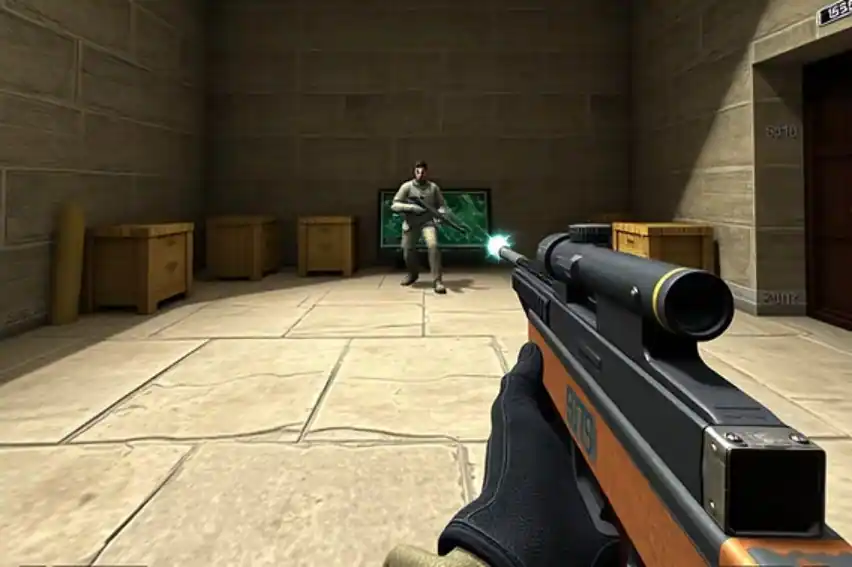
We have all experienced that specific flavour of competitive frustration. You manage to sneak up behind an unsuspecting opponent, your heart skips a beat, and you have all the time in the world to line up the perfect shot. You pull the trigger, but instead of a satisfying, clean headshot, your bullets paint a neat silhouette around their shoulders while they spin around and eliminate you instantly. It feels completely unfair, yet it happens continuously.
When you first start playing tactical shooters, your growth curve is remarkably steep. You quickly learn the basic layouts of the maps, find your favourite weapons, and figure out how to use utility effectively. Eventually, you hit a frustrating plateau where your rank refuses to budge, and you keep losing straightforward duels.
The problem is rarely your raw reaction time or your physical mouse sensor. Instead, you are likely fighting against deeply ingrained mechanical flaws that quietly sabotage your aim before you even press the mouse button. Breaking through this mid-tier skill ceiling requires an honest look at your current habits to fix the hidden errors holding you back.
The Crosshair Chasing Trap and the Illusion of Settings
When shots stop connecting, the immediate human impulse is to blame the tools. You might find yourself opening the settings menu mid-match to adjust your sensitivity, swap your resolution, or hunt for a brand-new reticle style.
Many players treat this search like looking for cosmic guidance, almost as if checking crosshair codes for CS2 could reveal a hidden destiny or predict their competitive fortune like an online tarot reading site. It is incredibly tempting to think that finding the right layout will magically solve your accuracy issues, but constantly shifting your setup does the exact opposite.
Every single time you change your horizontal and vertical sensitivity, you completely reset your physical familiarity with your mousepad. Your brain relies on consistent physical movements to build muscle memory, and altering those numbers forces you to relearn how much muscle tension is needed to turn ninety degrees.
Copying the exact configuration of a professional player will not give you their deep spatial awareness or their thousands of hours of practice. True consistency comes from choosing a reasonable, comfortable configuration and vowing to leave it untouched for months so your physical instincts can actually develop.
The Lazy Habit of Floor Aiming
One of the most widespread bad habits among intermediate players is lazy crosshair placement. When you traverse the map without active engagement, your hand naturally relaxes, which usually causes your reticle to drift downwards toward the ground.
Walking around while looking at the floor makes your environment easier to see, but it forces you to perform a massive physical correction the moment an enemy appears. You are essentially giving yourself twice as much work to do in a game where rounds are decided in milliseconds.
To fix this, you must train yourself to view your reticle as an active tool that clears angles rather than a passive camera point. Good players constantly guide their point of aim along the edges of walls at precise head height, anticipating exactly where a defender might be standing.
You can use structural elements of the environment, such as door frames, crates, and distinct wall textures, to gauge the correct vertical plane. Keeping your weapon level with an opponent’s skull reduces your necessary correction to a tiny micro-adjustment, transforming a difficult flick shot into a simple click.
The Flight or Fight Panic Spray
Adrenaline is the ultimate enemy of mechanical precision. When an enemy swings around a corner unexpectedly, your brain registers a threat, causing your hand to clench up automatically. This panic response leads straight to the classic mistake of holding down the fire button and hoping for the best. While spraying might work at close quarters, it completely destroys your accuracy at medium and long ranges due to unpredictable recoil and intense screen shake.
Overcoming this panic requires a conscious change in how you approach gunfights. You need to train yourself to embrace a deliberate micro-pause before firing your first bullet. Taking a fraction of a second to ensure your reticle is truly centred on the target before clicking is significantly faster than firing twenty missed shots and trying to pull your weapon back on track. Try practicing short bursts of two or three bullets in deathmatch games, forcing yourself to stop firing and reset your position if those initial rounds do not find their mark.
Crosshair Chasing vs Micro-Adjustments
When tracking a moving target, many players succumb to the flaw of crosshair chasing, where they try to follow an opponent’s unpredictable movements in real time. This reactive style of aiming forces you to play catch-up constantly because your hand is always responding to a movement that happened a split second ago. If an enemy changes direction quickly, your weapon will repeatedly overshoot or fall behind their actual position.
Instead of chasing the player, you should focus on crosshair placement that lets them move directly into your path of fire. If an opponent is running across your screen, place your reticle slightly ahead of their movement vector and let them walk into your line of fire. This method turns a complex tracking task into a straightforward test of timing. For close-range encounters, mastering micro-adjustments with your movement keys allows you to line up shots smoothly without relying entirely on your wrist.
Building a Deliberate Practice Routine
Breaking these long-standing mechanical errors takes time and cannot be achieved by playing casual matches mindlessly. You need to design a structured practice routine in isolation to build better physical muscle memory. Spending fifteen minutes in a training map before jumping into competitive queues will do wonders for your overall mechanical discipline.
- Isolate Your Movements: Spend dedicated time practicing nothing but counter-strafing, ensuring your character comes to a complete stop before you fire.
- Track the Head Domain: Practice moving smoothly along a straight horizontal line while maintaining your crosshair on a single static target to reinforce vertical discipline.
- Enforce Burst Boundaries: Go into a standard deathmatch and unbind your crouch key while banning yourself from firing more than three shots at a time.
Final Thoughts
Climbing past the intermediate ranks is ultimately a battle against your own subconscious comfort zones. When you stop looking for external salvation in configuration adjustments and start addressing the structural flaws in your physical playstyle, your performance will stabilize. True mechanical improvement requires moving past the illusion that a secret trick or setting will fix your gameplay.
By systematically eliminating lazy positioning, stopping panic responses, and committing to a stable setup, you will stop fighting your own muscle memory. Once those fundamental adjustments become second nature, those supposedly difficult headshots will start feeling incredibly easy.