Introduction
There are rivalries, and then there is Royal Challengers Bengaluru versus Chennai Super Kings. If you have ever found yourself in a packed stadium — or even just a living room full of friends — during an RCB vs CSK match, you already know. The energy is different. The stakes feel higher. And no matter how many times these two teams face off, the anticipation never fades. It is the kind of sporting rivalry that transcends cricket, weaving itself into the cultural fabric of the Indian Premier League.
What makes this clash so magnetic? Part of it is geography — the southern derby, Karnataka versus Tamil Nadu — but the deeper pull comes from the personalities. Virat Kohli and MS Dhoni, two of the greatest cricketers India has ever produced, each embodying a distinct philosophy of leadership and playing style. Kohli’s fiery intensity meets Dhoni’s ice-cool composure. RCB’s star-studded batting lineups have repeatedly collided with CSK’s methodical, tournament-savvy machine.
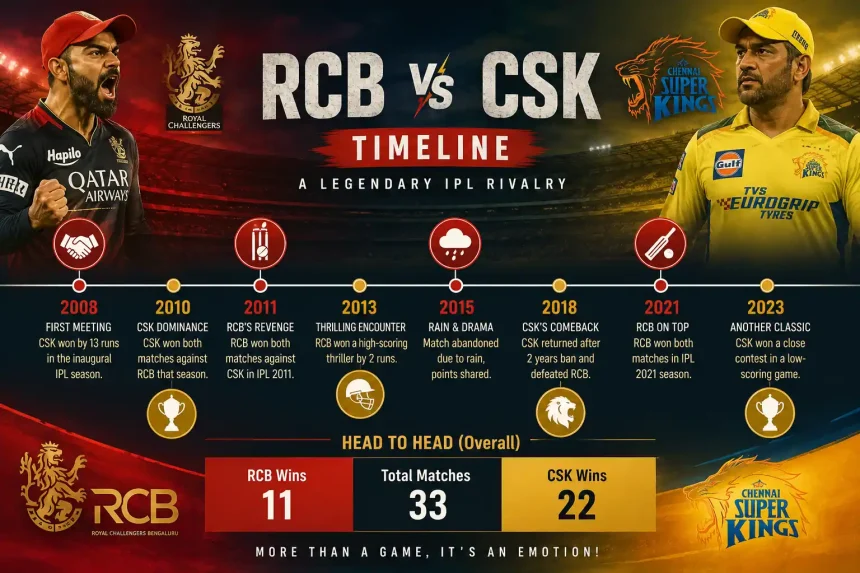
Over 36 encounters spanning nearly two decades, this rivalry has produced last-ball thrillers, finals drama, record-breaking individual performances, and heartbreak in equal measure . This article walks you through the complete timeline — year by year, era by era — so you can appreciate every chapter of what has become the IPL’s most passionately followed contest.
The Origins: How the Rivalry Was Born (2008–2009)
When the IPL launched in 2008, few could have predicted that RCB and CSK would evolve into the league’s defining rivalry. Both teams came with strong identities from day one — CSK, led by the World T20-winning captain MS Dhoni, and RCB, originally captained by Rahul Dravid before a dramatic mid-season shake-up.
The Very First Meeting: A Statement Delivered
Their inaugural clash on April 28, 2008, at the M. Chinnaswamy Stadium in Bengaluru set the tone for everything that followed. CSK batted first and posted a competitive total, but it was with the ball that they truly announced themselves. RCB were bundled out cheaply, and Chennai walked away with a comfortable win. The message was clear: CSK were not just participants; they were contenders.
That first season established the early pattern — CSK as the polished, tactically disciplined unit, and RCB as the talented but inconsistent challenger searching for the right formula. It was a dynamic that would define the early years of the rivalry.
2009: The Rivalry Goes Overseas
The 2009 season, held in South Africa due to general elections in India, saw both teams adapting to unfamiliar conditions. Their encounters that year were marked by low-scoring affairs, with CSK again emerging victorious in both meetings. Anil Kumble had taken over the RCB captaincy and instilled a fighting spirit, but CSK’s experience in pressure moments proved decisive. By the end of 2009, the head-to-head record stood firmly in Chennai’s favor — a theme that would persist, though the gap would occasionally narrow in dramatic fashion.
The Defining Chapter: 2011 IPL Final
If you ask any CSK or RCB fan to name the most significant match in this rivalry, the answer almost always lands on May 28, 2011. The IPL final. Chennai. CSK versus RCB. It remains the only time these two southern giants have met in a title decider, and the weight of that occasion still echoes through the years.
The Build-Up
RCB had assembled a fearsome squad. Chris Gayle, who joined mid-season as a replacement player, had been in devastating form. Virat Kohli was blossoming into a world-class batter. AB de Villiers was doing things with a cricket bat that defied physics. They had momentum, firepower, and belief. CSK, the defending champions, brought something different: institutional calm. They had been here before, and it showed.
The Match That Broke Bengaluru Hearts
CSK batted first at their fortress — the MA Chidambaram Stadium — and posted a commanding 205 for 5. Murali Vijay and Michael Hussey provided the platform, and the middle order capitalized. RCB’s chase never truly took flight. Wickets fell at regular intervals, and the required rate spiraled out of control. They finished at 147 for 8, losing by 58 runs .
For RCB fans, it was gut-wrenching. For CSK, it cemented their status as the IPL’s first genuine dynasty — back-to-back champions with a ruthless winning culture. Dhoni lifting the trophy in yellow remains one of the defining images of IPL history. And for Kohli, then just 22 years old and already the emotional heartbeat of RCB, the loss planted a seed of hunger that would fuel him for the next decade and beyond.
The Middle Years: Dominance and Desperation (2012–2017)
The period from 2012 to 2017 was, in many ways, the most one-sided phase of the rivalry. CSK tightened their grip, and RCB, despite flashes of brilliance, struggled to find consistency against their southern rivals.
CSK’s Stranglehold
Between 2012 and 2015, CSK won the majority of encounters, often by comfortable margins. Their bowling attack, led by Dwayne Bravo and Ravichandran Ashwin, had an uncanny ability to contain RCB’s explosive batting lineup. Even when Kohli, Gayle, or de Villiers fired, it was rarely enough. CSK simply knew how to win — they had the blueprint, the personnel, and the temperament.
The 2013 season was particularly illustrative. In one memorable encounter, CSK chased down a target of 165 with barely a hiccup, Dhoni finishing things off with his signature nonchalance. RCB’s bowling, a perennial weak spot, had no answers.
RCB’s Rare Rays of Light
There were exceptions. In 2014, RCB managed to snap the losing streak with a victory at the Chinnaswamy. The crowd erupted as if they had won the tournament itself — such was the emotional release of finally toppling their nemesis. But these wins were isolated. The bigger picture remained unchanged: CSK owned this rivalry.
The Two-Year Absence
When CSK (along with Rajasthan Royals) served a two-year suspension in 2016 and 2017, the IPL felt incomplete. RCB played those seasons without their greatest rival, and while they had their moments — including a run to the 2016 final — something was missing. The league simply wasn’t the same without CSK yellow clashing with RCB red.
The Return and the Shift: 2018–2023
CSK’s return in 2018 was nothing short of cinematic. Written off as a “dad’s army” before the tournament began, they stormed to their third IPL title. Their matchups with RCB that season rekindled all the old intensity.
2018: CSK Return, Business as Usual
The first RCB-CSK clash of 2018 at the Chinnaswamy was an instant classic. CSK, batting second, needed 206 to win. The chase seemed destined to fail — until Dwayne Bravo and Ambati Rayudu produced an extraordinary counterattack. CSK won with two balls to spare. For RCB fans, it felt like a recurring nightmare. The faces changed, but the story stayed the same.
2019: RCB Finally Break the Hoodoo
Then came April 21, 2019, in Bengaluru — a date etched in RCB folklore. CSK, chasing 162, seemed to have the match under control thanks to a vintage Dhoni innings of 84 not out off just 48 balls. With 26 needed off the final over, Dhoni almost pulled off another miracle, but RCB held their nerve. They won by a single run, ending a seven-match losing streak against CSK that stretched back to 2014 .
The raw emotion on display told you everything. Kohli, arms raised, roaring at the Chinnaswamy crowd — it was catharsis. It was also a turning point. Though CSK still held the overall edge, the aura of invincibility had cracked.
2020–2023: A More Balanced Contest
The seasons that followed saw a more even distribution of results. CSK won their fourth title in 2021 and their record-equaling fifth in 2023, but RCB no longer looked like deer in headlights when they saw yellow. The contests became tighter, the margins smaller. The rivalry had matured into something approaching parity — at least in terms of match-day competitiveness, if not the trophy cabinet.
The New Era: 2024–2026 — RCB Fight Back
The most recent phase of this rivalry has produced some of its most dramatic moments. While CSK’s overall head-to-head record still stands at approximately 21–22 wins to RCB’s 13–14 across 36 encounters, the tide has been turning .
2024: The Last-Ball Classic
The 2024 season opener between these two teams was electric. RCB, now captained by Faf du Plessis, set a formidable target, and CSK chased it down with a final-over flourish. But the real drama came in the return fixture — a match that would be talked about for years. RCB needed to win to keep their playoff hopes alive, and they did so in heart-stopping fashion, defending a target on the final ball. The image of the RCB dugout erupting, Kohli sprinting onto the field, captured everything this rivalry stands for.
2025: RCB Make History
The 2025 season marked a genuine shift. RCB defeated CSK in both league encounters — something they had rarely managed. The second of those wins, a two-run thriller at Bengaluru, saw RCB post 213 and then defend it by the narrowest of margins, Romario Shepherd’s all-round heroics earning him Player of the Match . More significantly, RCB also registered their first win against CSK at Chepauk since 2008 — ending a drought of 6,155 days . It was a symbolic victory that suggested the old order was changing.
RCB beat CSK four times in a row for the first time in IPL history, a streak that would have seemed unimaginable just a few years earlier . For a fanbase that had endured so much heartbreak at the hands of this opponent, it was deeply satisfying.
2026: The Rivalry Continues
As the current season unfolds, both teams find themselves in transition. CSK are navigating the post-Dhoni era (even as their talisman continues to defy time), while RCB, under new leadership, are building a more balanced squad than ever before. The 2026 opener between these two, played on March 28, once again drew massive global viewership — proof that no matter where either team sits on the points table, RCB vs CSK remains the IPL’s marquee fixture.
Kohli vs Dhoni: The Heart of the Rivalry
You cannot tell the story of RCB versus CSK without centering it on two men: Virat Kohli and MS Dhoni. Their individual duel is the emotional core around which everything else revolves.
The Numbers
Kohli is the all-time leading run-scorer against CSK in IPL history, having amassed approximately 1,146 runs in 34-plus innings against the yellow brigade . His consistency against CSK is remarkable — even in seasons where RCB struggled, Kohli almost always delivered against this particular opponent.
Dhoni, for his part, has scored over 900 runs against RCB at a staggering strike rate of around 144 . More than the volume, it is the timing of his contributions that stands out. How many times has Dhoni walked to the crease with CSK in trouble against RCB and walked off having snatched victory? Too many for RCB fans to count.
Contrasting Styles, Mutual Respect
What makes the Kohli-Dhoni dynamic so compelling is the contrast. Kohli wears his heart on his sleeve — every wicket celebrated, every run cheered, every defeat hurting visibly. Dhoni is the opposite: calm, almost detached, processing the game like a chess grandmaster. They represent two different ways of being a cricketer, and by extension, two different approaches to life.
Yet the mutual respect is undeniable. They have shared Indian dressing rooms for years, won World Cups together, and spoken warmly of each other in interviews. When they face off in the IPL, it is not personal animosity but professional pride that fuels the fire.
Complete Head-to-Head Statistical Overview
Numbers don’t capture emotion, but they do tell a story. Here is where the rivalry stands after 36 encounters as of mid-2026:
Overall Record:
- Matches Played: 36
- Chennai Super Kings Wins: 21–22
- Royal Challengers Bengaluru Wins: 13–14
- No Result: 1
Highest Team Totals:
- RCB’s highest against CSK: 213/5 (2025)
- CSK’s highest against RCB: 205/5 (2011 Final)
Key Individual Records:
- Most Runs (RCB vs CSK): Virat Kohli — approximately 1,146 runs
- Most Runs (CSK vs RCB): MS Dhoni — approximately 906 runs
- CSK’s dominance is most pronounced at Chepauk, where RCB had won only once between 2008 and 2024 — a streak finally broken in 2025
Recent Form (Last 5 Matches):
RCB have won 4 of the last 5 encounters, suggesting a genuine shift in momentum after years of CSK control .
It is worth noting that different sources report slightly different numbers — for instance, some count 35 matches (21–13 to CSK with 1 no result) while others count 36 (22–13 or 21–14) . These minor discrepancies reflect ongoing debates about how certain abandoned fixtures are classified, but the overall picture is consistent: CSK have historically owned this rivalry, though RCB are closing the gap.
Why This Rivalry Matters Beyond Cricket
RCB versus CSK has grown into something larger than a cricket match. It is a cultural phenomenon that brings two proud South Indian cities — Bengaluru and Chennai — into symbolic competition.
The Fan Culture
Walk through Bengaluru on match day and you will see red jerseys everywhere. In Chennai, the sea of yellow is inescapable. Social media explodes with banter, memes, and good-natured provocation. The rivalry has occasionally seen toxicity — every intense sporting contest does — but at its best, it represents the joy of shared passion.
Both fanbases are famously loyal. RCB supporters have stuck with their team through 17 years without a trophy, filling the Chinnaswamy regardless of league position. CSK fans, spoiled by five championships, bring an expectation of success that borders on entitlement — and yet they turn up with the same fervor season after season.
A Tale of Two Philosophies
The rivalry also reflects two different philosophies of franchise-building. CSK have prioritized continuity and experience, often backing veteran players long past their supposed sell-by dates — and being vindicated repeatedly. RCB have historically leaned on superstar power, building around Kohli, Gayle, and de Villiers in their prime, but struggling to assemble the balanced squad needed for a title. The contrast makes every encounter a fascinating study in team construction.
The Future of the Rivalry
What comes next? The RCB-CSK rivalry stands at a crossroads heading into the late 2020s. Dhoni’s eventual retirement — whenever it comes — will mark the end of an era. When he is no longer behind the stumps in yellow, something fundamental will shift. The Kohli-Dhoni subplot, which has defined so much of this contest, will enter its final chapters.
But rivalries outlive individuals. New stars will emerge. Young players who grew up watching these matches will take the field with their own motivations. The southern derby will endure because the foundations are too deep to erode — the cities, the cultures, the history, and the collective memory of every thrilling finish.
For RCB, the mission remains unchanged: win an IPL trophy. Beating CSK along the way would make it sweeter. For CSK, the challenge is maintaining their standard of excellence in a changing league. The rivalry is entering a new phase — less lopsided, more unpredictable, and arguably more exciting than ever.
One thing is certain: the next time these two teams walk onto the field together, millions will be watching. Because RCB versus CSK is never just another game. It is the IPL at its most alive.
About the Author: A lifelong cricket writer and IPL analyst who has followed the RCB-CSK rivalry from its inception, covering every dramatic twist along the way.