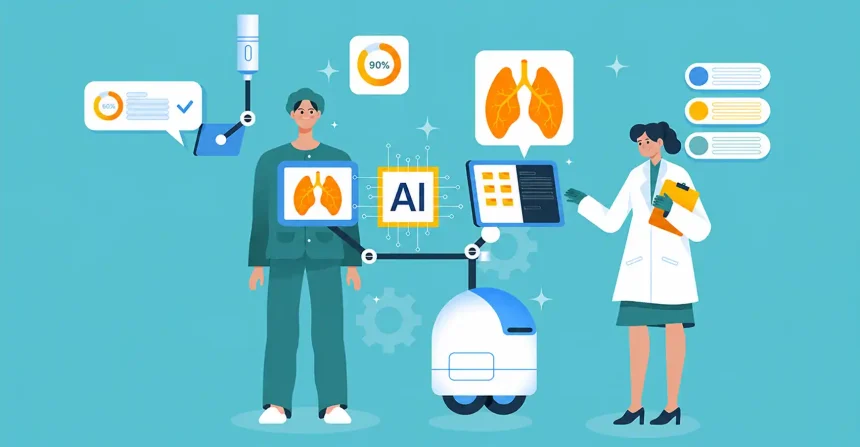
As a healthcare professional, you may already know that healthcare organizations are generating more patient data than ever before.
On the other hand, many providers are spending their time significantly on searching for information, completing documentation, and managing administrative tasks. Studies also found that physicians can spend nearly twice as much time on EHR and desk work as they do with patients.
The challenge here is not a lack of technology. Most organizations already have EHR systems in place. The main problem here is that many traditional platforms were just designed to store information, not actively help clinicians work through it.
As patient volume increases and care delivery becomes more complex, providers need systems that can do more than simply act as digital filing cabinets. This is where a customizable EHR powered by artificial intelligence jumps in.
With AI-powered healthcare automation, EHR systems can streamline documentation, automate routine tasks, surface relevant information, and support clinicians throughout the care process. This can minimize administrative workloads and give your team more time to focus on patients.
Many organizations are exploring why modern providers choose custom-built EHR systems, as all these capabilities become increasingly important. Unlike one-size-fits-all platforms, custom solutions can be tailored to specific workflows, specialties, and long-term goals while supporting advanced AI functionality.
In this guide, we’ll explore the AI-powered EHR features transforming healthcare today and look at how AI improves EHR workflows for healthcare providers through intelligent clinical documentation, smarter automation, and better healthcare workflow optimization.
Ambient AI and Intelligent Clinical Documentation
Intelligent clinical documentation is one of the measurable AI-powered EHR capabilities. Traditionally, providers have had to divide their attention between the patient and the computer, spending additional time after clinic hours completing notes. However, ambient AI helps to change that.
With patient consent, AI-powered scribe tools listen to conversations during a visit, while automatically creating a structured clinical note. Rather than typing throughout the appointment or building notes from scratch later, providers can simply review, edit, and approve the draft.
It can result in faster and more consistent documentation. As notes are generated in real-time, important details are far less likely to be missed. On the other hand, clinicians can also remain in full control of the final record before it is added to the patient’s chart.
Perhaps the biggest advantage is reducing charting fatigue. Many providers are familiar with “pajama time”—the hours spent catching up on documentation after work. By taking much of the routine note-taking off their plate, AI can help give those hours back. Even saving a few minutes per patient can add up to several hours each week.
Importantly, rather than the screen beside them, providers can focus more on the person sitting in front of them. Conversations feel more natural, patient engagement improves, and the overall care experience becomes better for everyone involved when documentation becomes less of a distraction.
As healthcare organizations continue exploring how AI improves EHR workflows for healthcare providers, ambient AI stands out as one of the most practical examples of technology reducing administrative burden while supporting better care delivery.
AI-Powered Healthcare Automation for Daily Operations
The impact of AI goes far beyond just patient notes. With AI-powered healthcare automation, organizations can reduce the large number of administrative tasks that keep them busy behind the scenes.
Additionally, AI can simplify scheduling as well as patient communication. Automated appointment reminders, follow-up messages, and scheduling assistance can help patients stay engaged while reducing the number of missed appointments. It’s actually a win-win situation for not only providers but also patients, improving continuity of care without adding extra work for staff.
Billing and coding workflows can benefit as well. AI tools can help to suggest appropriate codes, identify potential errors, and flag issues before claims are submitted. By catching mistakes early, practices can submit cleaner claims, reduce rework, and speed up reimbursement.
All these capabilities together can result in better healthcare workflow optimization across the entire organization. Clinical and administrative teams can work more efficiently, handle growing patient volumes, and spend less time dealing with operational bottlenecks. In an industry where every minute counts, even small improvements can add up quickly.
Predictive Analytics and Smarter Clinical Decisions
● Identifying high-risk patients earlier
Predictive analytics looks across patient data to flag people who may be at higher risk, for example, those with patterns suggesting a chronic condition is worsening. Surfacing these patients earlier gives care teams a chance to act before a small problem becomes an emergency.
● Supporting preventive and proactive care
This supports a shift from reactive to proactive care. Instead of waiting for patients to present with problems, teams can prioritize outreach, screenings, and follow-up for those who need it most, which aligns well with value-based care goals. For a practice managing a panel of patients with chronic conditions, that prioritization helps direct limited staff time toward the people most likely to benefit, improving outcomes without simply asking the team to do more.
● Delivering meaningful insights from data
The value comes from turning scattered data into clear, actionable insight. Well-designed analytics highlight what matters, such as care gaps or trends, rather than burying clinicians in more dashboards and numbers.
● Enhancing decisions without adding workload
Importantly, these tools are meant to support clinical judgment, not replace it. The clinician makes the call; the system simply makes relevant information easier to see, ideally without adding clicks or extra steps to the workflow.
Healthcare Workflow Optimization and Patient Engagement
● Improving coordination across care teams
Healthcare workflow optimization means information and tasks move smoothly between the people involved in a patient’s care. AI can help route referrals, results, and messages to the right team member, reducing delays and things falling through the cracks.
● AI-powered portals and virtual assistants
On the patient side, AI-powered portals and virtual assistants can answer common questions, help with scheduling, and guide patients to the right resource at any hour. This gives patients quicker self-service while easing the load on front-desk staff.
● Faster responses to routine requests
Many routine requests, refills, directions, and basic instructions can be handled automatically or triaged so staff focus on the ones that truly need a human. Faster responses improve the patient experience and reduce phone tag.
● A more connected healthcare experience
The combined effect is a more connected experience, where patients feel supported, and care teams spend less energy on coordination overhead and more on care itself. For a practice, that connection also drives growth: patients who can reach the practice easily and get timely responses are more likely to stay, follow through on care, and recommend it to others.
The Future of AI-Powered EHR Platforms
● Growing adoption of ambient AI and conversational interfaces
Ambient AI and conversational interfaces are moving from novelty to expectation. As these tools mature, interacting with the EHR by voice or natural language is likely to become a normal part of clinical work rather than a special feature.
● Personalized experiences for providers and patients
Future platforms will increasingly tailor the experience to the individual, surfacing the information a given provider needs for a given patient, and giving patients communication and tools suited to their needs.
● Expanding predictive analytics and automation
Expect predictive analytics and automation to widen in scope, covering more of the clinical and operational picture as data quality and models improve, always with appropriate human oversight.
● The long-term value of AI-ready platforms
The practical takeaway is that an AI-ready foundation matters. Platforms designed to incorporate new intelligent features can adopt these advances as they emerge, rather than requiring a costly rebuild each time the technology moves forward. For decision-makers, that is the difference between an EHR that ages quickly and one that keeps delivering value as the field evolves, protecting the investment while leaving room to adopt what proves useful.
Conclusion
AI is no longer a side experiment in healthcare technology; it is becoming a core part of how modern EHR platforms work. The reason is simple: it addresses the two pressures providers feel most, too much administrative burden and too little time for patients.
The real power comes from combining intelligent automation with customized workflows. The benefits of AI-powered EHR features to build in modern healthcare, such as less charting, smarter operations, earlier insights, and better engagement, are strongest when the technology fits how a specific organization actually works rather than forcing the team to adapt to generic software.
For organizations weighing their options, this is exactly why modern providers choose custom-built EHR systems. Through strategic healthcare software development, organizations can implement platforms like those from A&I Solutions’ custom EHR software development that are built around their unique workflows. This allows AI to move beyond being a buzzword and deliver measurable improvements in efficiency, engagement, and patient outcomes.
FAQs
1. How do AI-powered EHR features improve provider productivity?
They automate time-consuming work like documentation, scheduling, and routine messaging, and surface relevant information at the point of care. This lets providers spend less time on the keyboard and more on patients, handling the same or higher volume with less friction.
2. What are the benefits of intelligent clinical documentation?
AI scribe tools can draft structured notes from a patient encounter, so clinicians review and edit rather than type from scratch. This speeds up charting, helps keep records complete, and reduces after-hours documentation, with the provider still in control of the final note.
3. Can AI help reduce physician burnout and administrative workload?
Yes. Excessive documentation and administrative tasks are major contributors to burnout. By automating repetitive work and reducing after-hours charting, AI-enabled tools can ease that load and give clinicians more time for patient care.
4. How does AI-powered healthcare automation improve patient care?
By removing manual administrative steps, it frees staff to focus on patients, reduces errors, and speeds up tasks like follow-up and scheduling. Automated reminders and outreach also support continuity of care and help patients stay engaged.
5. What types of tasks can AI automate within an EHR system?
Common examples include note drafting, appointment scheduling and reminders, eligibility checks, billing and coding support, claim error checks, message triage, and routine patient questions through portals or virtual assistants.
6. How do custom-built EHR systems support AI integration?
A custom platform can build AI directly into existing workflows instead of bolting it on. It can use open standards and a modular design so new AI tools connect cleanly and are tailored to the organization’s specialty and processes.
7. Can AI-powered EHR platforms improve clinical decision-making?
They can support it by flagging high-risk patients, highlighting care gaps, and turning data into clear insights. These tools are designed to inform clinical judgment, not replace it; the clinician always makes the final decision.
8. What should healthcare organizations consider before adopting AI-enabled EHR technology?
Key factors include data quality, privacy and HIPAA compliance, how well the AI fits real workflows, the need for human oversight, integration with existing systems, staff training, and choosing a development partner with genuine healthcare expertise.