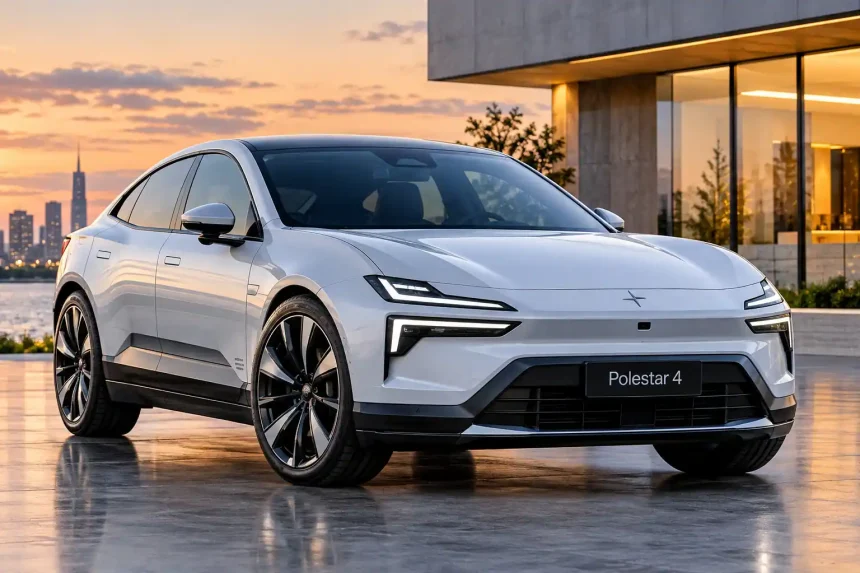
The coupé and its camera mirror
The coupé that arrived in the UK in 2024 has a low roofline that arcs down to a body-coloured panel where the rear window would normally be. A roof-mounted camera feeds a digital rear-view mirror instead. Polestar’s designers said dropping the glass let them move the rear header back and free up space for rear passengers, and reviewers do praise the room in the back. The cost is visibility: some testers find reversing harder, and a few call the missing window a dealbreaker.
The new SUV
The Polestar 4 SUV, revealed in September, addresses that. It uses the same platform and is no longer or wider, but has a squarer tailgate, a conventional rear window and a normal mirror as standard, with the digital mirror kept as an option. Polestar says rear headroom rises by 2.5cm, and the SUV adds roof rails rated for 100kg in motion. Autocar reports that Polestar expects around 70 per cent of UK buyers to choose it over the coupé.
Interior, Comfort and Technology
Both versions follow Polestar’s pared-back Scandinavian formula: clean surfaces, sustainable materials and very few physical controls. The centrepiece is a 15.4-inch landscape touchscreen running Android Automotive with Google built-in, so Google Maps, Google Assistant and the Play Store are native, and Apple CarPlay is supported. A 10.2-inch driver display sits in the upper dashboard, and a head-up display is available.
The software is fast but divisive. Several UK reviewers find the menus complicated, and with so little hardware, even basic settings sit behind the screen. Build quality and rear-seat space attract more praise. Electrically reclining rear seats and a rear climate screen are available, so check what each trim includes before ordering.
Performance, Powertrain and Driving Experience
The Polestar 4 uses a 400-volt platform and two powertrains. The Rear motor sends 200kW (268bhp) and 343Nm to the rear wheels. The 0-62mph sprint takes around 7.1 seconds in the coupé and 7.3 in the SUV, and What Car judged the feel closer to a standard Hyundai Ioniq 6 than a fast car. The Dual motor adds a second 200kW motor at the front, giving 400kW (536bhp) and 686Nm, and 0-62mph in 3.8 seconds in the coupé or 3.9 in the SUV. The optional Performance pack on Dual motor cars brings 22-inch wheels, Brembo brakes, Polestar Engineered chassis tuning and gold interior accents.
On the road, the Polestar 4 favours composure over excitement. Reviewers describe a firm-but-fair ride, though there is no air suspension option, and the RAC feels some rivals ride and handle better. Dual motor cars weigh around 2.3 tonnes. For the 2027 model year, Polestar says it has revised the dampers, springs and anti-roll bars to improve steering precision.
Polestar 4 Range, Battery and Charging
Every Polestar 4 has a 100kWh battery with 94kWh usable. Official WLTP range for the coupé is 385 miles for the Rear motor and 367 for the Dual motor. The more efficient SUV improves on that, with up to 391 and 373 miles respectively. The Performance pack cuts range further, with earlier reviews quoting about 310 miles.
Real-world figures are lower. Auto Express recorded about 3.5 miles per kWh in a long-term Dual motor, equating to roughly 310 miles, while EV Powered managed around 290 miles in a week that included spirited driving.
Charging is where the platform shows its limits. Peak DC speed is 200kW, with 10 to 80 per cent in about 30 minutes, which is respectable but behind 800-volt cars; Polestar’s own 3 and 5 can charge at up to 350kW. UK cars accept 11kW AC charging at home, and the battery carries an eight-year, 100,000-mile warranty.
Safety and Driver Assistance
Euro NCAP gave the Polestar 4 five stars in July 2025, with an overall score of 86 per cent: 92 per cent for adult occupants, 85 per cent for children, 81 per cent for vulnerable road users and 79 per cent for safety assist. The adult score was among the highest in that round of testing. Safety assist was the lowest of the four, though still respectable. Equipment levels vary by trim and option pack, so confirm what is standard on the car you are considering.
Practicality and Everyday Usability
At about 4.84 metres long with a wheelbase of just under three metres, the Polestar 4 is spacious for its class. The coupé’s boot holds 526 litres, including 31 litres of underfloor storage, rising to 1,536 litres with the seats folded, plus a 15-litre front boot that suits charging cables. Polestar says the SUV offers up to 129 litres more luggage space, reaching 1,665 litres.
The coupé’s figure matches the Audi Q6 e-tron’s 526 litres and sits just below the Porsche Macan Electric’s 540, but trails the Tesla Model Y’s 854 litres by a wide margin.
How the Polestar 4 Compares With Its Rivals
The obvious rival is the Tesla Model Y. In Long Range rear-wheel-drive form it costs £48,990 and claims 387 miles, against £56,750 and 385 miles for the Polestar 4 Rear motor coupé. The Tesla also has far more luggage space; the Polestar’s argument is design and a well-finished cabin, which is why evo presented it as an alternative to the Model Y.
Against the Audi Q6 e-tron, Auto Express says the Polestar 4 coupé starts several thousand pounds cheaper, although the Audi’s 800-volt architecture can charge faster. The Porsche Macan Electric costs significantly more. The SUV takes aim at the BMW iX3, Mercedes-Benz GLC with EQ Technology and Volvo EX60. What Car notes it costs more than the Volkswagen ID. 7 Tourer (£52,225) but less than the Audi A6 Avant e-tron (£64,390) and BMW i5 Touring (£70,045).
Polestar 4 Price, Availability and Who Should Buy One
UK pricing
UK list prices for the 2027 model year start at £56,750 for the Rear motor coupé and £63,750 for the Dual motor, in Business and Prime trims, with the Performance pack coupé reaching about £71,250. The SUV starts at £54,750 for the Rear motor and £60,750 for the Dual motor, with the Performance pack from £68,250. SUV orders are open and first UK deliveries are planned for the final quarter of 2026. Zero-emission cars attract 4 per cent Benefit-in-Kind tax in 2026/27, which helps company-car drivers. Prices, specifications and range figures differ in other markets.
Who it suits
The Polestar 4 suits drivers who want a roomy, quick, design-led EV for motorway miles, especially anyone who values Google’s navigation. It is a harder sell if you want the fastest charging, the best ride or conventional switchgear.
Final Verdict: Is the Polestar 4 Worth Considering?
The Polestar 4 is a distinctive, well-finished electric SUV with a strong range and, in Dual motor form, serious pace. Its weaknesses are just as clear: a touchscreen-heavy interface, a ride that some rivals beat and charging that no longer leads the class. The new SUV body removes the objection that put many buyers off, for less money, which makes it the sensible choice for most people. The coupé suits those who love the shape and can live with the camera mirror. Either way, try one alongside a Model Y or Q6 e-tron before you decide.