Most backyards disappoint for the same reason: they were never planned, only accumulated. A strip of lawn, a few shrubs that came with the house, a patio set bought on impulse. The best backyard landscaping ideas start with a different question. Instead of asking what looks good, ask what you want to do out there and how much time you are willing to spend maintaining it.
That holds whether you have a 400-square-foot townhouse yard in Maryland or half an acre in central Texas. Decide how the space will be used, match plants and materials to your climate, and build in stages.
Start With How You Actually Use the Space
Before buying a single plant, spend a few days watching the yard. Note where the sun lands in the morning and afternoon, which corners stay damp after rain, and where you naturally sit. Six or more hours of direct sun suits vegetables and most flowering perennials, while a shaded corner under a mature tree is better suited to seating.
Then sketch a rough plan marking the house, fences, trees, utility boxes, and any slope. If you will be digging for posts, footings, or trees, call 811 a few days ahead so buried utility lines are marked for free. This unglamorous groundwork keeps you from putting a patio where water collects or a tree where it will eventually crowd a power line.
Build Outdoor Living Spaces First
A defined place to sit does more to get you outdoors than any planting.
Patios and Seating That Get Used
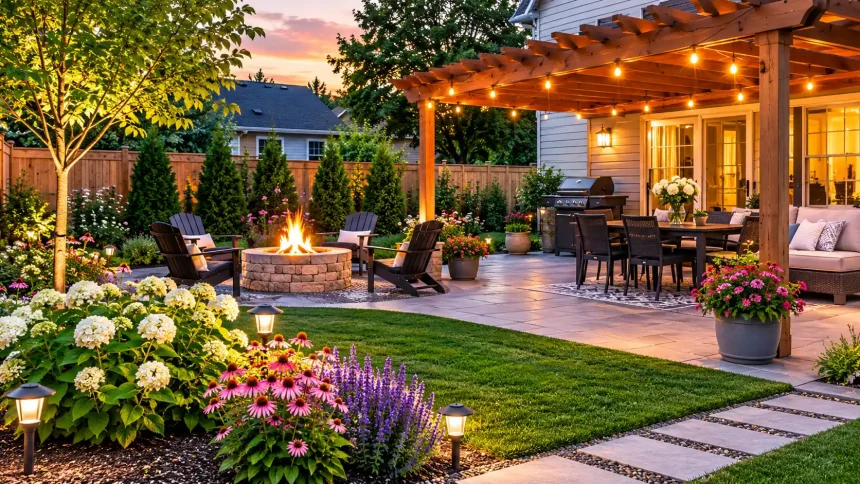
A patio of about 10 by 10 feet holds a small dining table and four chairs with room to pull them back; a sectional sofa calls for closer to 12 by 16 feet. Put it near the kitchen door if you can, since people use spaces that are easy to reach with a plate of food. Poured concrete, pavers, and flagstone are the classic surfaces, and compacted gravel over a proper base suits informal seating at lower cost. Slope the surface slightly away from the house so water drains, and think early about shade, whether from a pergola, a shade sail, or a deciduous tree planted to the south or west.
Fire Pits and Water Features
A fire pit gives a yard a second season. Keep it well away from the house, fences, and overhanging branches, and check local ordinances, since some towns restrict wood burning or require permits. Gas models light on demand without smoke, while wood fires offer the crackle many people want. A small recirculating fountain adds sound that softens neighborhood noise, though it needs an outdoor outlet and occasional refilling.
Small Backyard Landscaping Ideas That Make a Yard Feel Larger
In a small yard, restraint does more than ornament. Divide the space into two or three zones, such as seating, a planted border, and a small lawn or gravel section, and connect them with a clear path. Laying a path or patio on a diagonal lengthens the eye’s journey across a rectangle.
Use height instead of floor space: trellises, espaliered fruit trees, and climbing vines add greenery without using up square footage. Repeating five or six plants looks calmer than one of everything, and lighter hardscape tones make boundaries recede.
Picture a typical 20-by-25-foot suburban yard with a patch of lawn, a chain-link fence, and a plastic table by the back door. Replace the lawn with a 10-by-12-foot gravel or paver patio, run a curving mulched border along the fence planted with five or six repeated shrubs and perennials, and train a vine up a trellis in the corner. The footprint has not changed, but the yard now has a destination, a boundary, and something to look at.
Low-Maintenance Backyard Landscaping With Native Plants
A low-maintenance yard is built, not wished into existence. The biggest lever is reducing the lawn you have to mow, water, and feed. Replacing part of it with native plants helps, because natives are adapted to local rainfall, soil, and pests and typically need less water and fewer inputs once established.
What counts as native depends on where you live, so start with a local source. Audubon’s Plants for Birds database and the National Wildlife Federation’s Native Plant Finder both build plant lists from your ZIP code, and your county extension office or state native plant society can tell you which species suit your soil and moisture. Match each plant to your site’s sun, drainage, and soil rather than choosing by looks alone, buy from a local native nursery when you can, and check whether a plant is considered invasive in your area before adding it.
Plant densely enough that mature plants shade out weeds, cover bare soil with 2 to 3 inches of mulch, and group plants with similar water needs so one irrigation zone serves them all. Drip irrigation delivers water at the roots and wastes far less than overhead spray.
Choosing the Right Approach for Your Climate
A design that thrives in Phoenix will struggle in Minneapolis. Start with your USDA Plant Hardiness Zone, then factor in rainfall, humidity, and summer heat.
Hot and Dry Regions
In the Southwest and inland California, let gravel, decomposed granite, and boulders do much of the work, with drought-tolerant plantings such as agave, yucca, and native salvias in sparse, sculptural groups. In wildfire-prone areas, follow local defensible-space guidance, which generally means keeping flammable plants and mulch away from the house.
Humid and Warm Regions
Across the Southeast and Gulf Coast, airflow and drainage come first. Space plants generously to limit fungal problems, raise beds where soil stays wet, and eliminate standing water that breeds mosquitoes. Keep mulch a few inches back from the foundation.
Cold-Winter Regions
In the Northeast, Upper Midwest, and mountain states, build in winter structure with evergreens and standing ornamental grasses, and lay hardscape over a well-compacted base to survive freeze-and-thaw cycles. Keep delicate plants away from spots where shoveled snow will pile and from road salt.
Mixed and Rainy Climates
In the Mid-Atlantic and Ohio Valley, aim for four-season interest: spring bulbs, summer perennials, fall color, and winter bark or evergreen form. In the rainy Pacific Northwest, a rain garden of moisture-tolerant natives puts runoff to work instead of letting it pool.
Privacy With Trees, Shrubs, and Fencing
A fence delivers privacy the day it goes up, and plants soften it over time, so the two together usually look better than either alone. Check local height limits and HOA rules first. Evergreens such as arborvitae, holly, and juniper screen through winter, while deciduous shrubs offer flowers and fall color but thin out in cold months. Stagger plants in a loose zigzag rather than a straight row so one failure does not leave a gap, and plant for mature size, leaving roughly half a shrub’s mature width between it and a fence or walkway.
Pathways, Natural Stone, and Lighting
A path should be at least 3 feet wide for comfortable walking, closer to 4 feet if two people often walk side by side. Stepping stones set roughly 24 inches center to center suit secondary routes, and flagstone with gravel or low groundcover in the joints looks relaxed and drains well.
Lighting turns a yard into evening space. Use soft path lights for safe footing, a few uplights or downlights on a tree or wall for depth, and brighter task lighting near steps or the grill. Low-voltage LED fixtures with warm bulbs, around 2700K, flatter plants and stone; aim them so light stays on your property.
Budget-Friendly Backyard Ideas
The cheapest way to landscape is in phases. Spend first on what is hard to change later, such as grading, drainage, patio placement, and trees, then add plantings and decor as money allows. A yard finished over three seasons often looks better than one rushed in a weekend.
Published cost guides vary widely by region and scope, so treat these as rough ranges and get local quotes. A 10-by-12-foot (120-square-foot) gravel patio runs about $1 to $4 per square foot in one national guide, or roughly $120 to $480, though professional installation and edging push that higher. The same footprint in pavers falls at about $8 to $25 per square foot installed, or roughly $960 to $3,000. For a 200-square-foot planting bed, a 3-inch layer of mulch takes about two cubic yards, and with mulch alone at $30 to $135 per cubic yard, the material runs roughly $60 to $270 before delivery.
Plants are where savings come easiest. Small shrubs and trees cost less than large ones and often establish faster, perennials can be divided to fill new beds, and many towns offer free or discounted mulch and compost. For electrical work, major grading, or structural features, collect several written bids.
Common Backyard Landscaping Mistakes to Avoid
The most expensive mistake is planting for today’s size. That two-foot sapling will triple in width or height, and crowded plants end up removed or constantly pruned. Read the mature dimensions on every tag.
Ignoring drainage is a close second. Water that settles near the foundation costs far more than any plant, so solve it before you build.
Smaller errors add up: too many species make a yard feel chaotic, mulch piled against tree trunks invites rot, skipping soil preparation leaves plants struggling, and overlooking HOA covenants or permit rules can force you to tear out finished work.
Let the Yard Develop in Stages
A good backyard rarely arrives all at once. Start with one place to sit and one planting that thrives, then let the rest follow. The best backyard landscaping ideas are the ones that fit the life you actually lead outside.