
Some jobs carry an inherent level of risk that simply can’t be eliminated. Slips, falls, sudden medical events and physical confrontations are realities in a range of industries — and when they happen to an employee working alone, the consequences can be catastrophic. A man down alarm exists to bridge that gap: automatically detecting when a worker may be incapacitated and raising an alert without the worker needing to press a button.
This technology isn’t just a nice-to-have in high-risk sectors. For many businesses, it’s an essential part of their duty of care. Here are five industries where a man down alarm is not optional — it’s a necessity.
1. Construction and Infrastructure
Construction sites are among the most hazardous working environments in the UK. Falls from height, moving plant, overhead loads, confined spaces and uneven ground all present ongoing risks. While larger sites have established safety protocols and supervisors on the ground, smaller sites — maintenance jobs, plant inspections and late-shift work — can leave individuals working alone in conditions where a fall or sudden injury could go undetected for hours.
A man down alarm worn by lone workers on site will trigger automatically if the wearer falls and doesn’t recover, or remains motionless for an unusual length of time. This provides a critical safety net in environments where physical trauma is an ever-present possibility and rapid response can mean the difference between a rescue and a fatality.
2. Utilities and Energy
Electrical engineers, gas technicians, water utility workers and those maintaining energy infrastructure frequently work in isolated or hazardous conditions. Substations, pumping stations, underground plant rooms and remote overhead line routes are all environments where a lone worker could be injured by electrical exposure, toxic gas, confined space entry risks or a simple fall from equipment — and remain undiscovered for an extended period.
The utilities sector is also one where regulatory compliance around lone working is taken seriously. Employers in this space are expected to demonstrate robust risk management, and a man down alarm provides both a genuine safety tool and a verifiable element of compliance documentation.
3. Healthcare and Social Care
Community nurses, social workers, mental health practitioners and domiciliary care workers regularly make home visits alone. The risks in this sector are different in character from construction or utilities, but no less serious. Lone healthcare workers face the possibility of medical emergencies of their own, physical confrontation from clients or family members, and the challenge of working in environments they don’t control.
A fall in a client’s home, a sudden health event, or a situation that escalates without warning can all leave a worker unable to raise an alert through conventional means. A man down alarm provides an automatic safety net — particularly valuable in a sector where workers may be reluctant to appear to be raising the alarm and where the situations they encounter can shift quickly.
4. Security and Facilities Management
Security personnel patrolling commercial premises, shopping centres, industrial estates and public spaces typically work alone, often at night. Facilities management staff carrying out inspections, maintenance and cleaning across large buildings face similar conditions. Both roles involve extended lone working in environments where the risk of assault, accident or sudden medical emergency is real.
For security workers in particular, a man down alarm that can be activated covertly — or that triggers automatically if the worker is incapacitated — adds a layer of protection that a standard check-in system cannot replicate. If a guard is assaulted and unable to press a button, automatic detection becomes critical.
5. Oil, Gas and Industrial Manufacturing
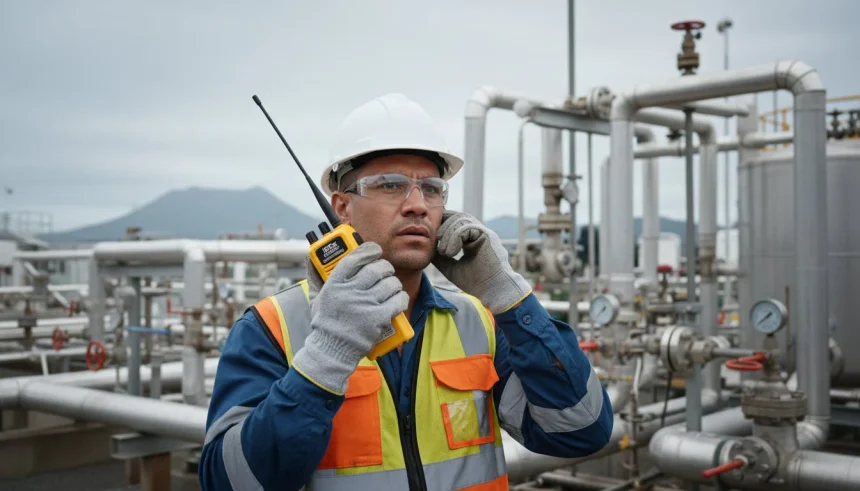
Refineries, chemical plants, heavy manufacturing facilities and offshore or remote industrial sites all share a common characteristic: the environments are unforgiving. Exposure to chemicals, working at height, operating heavy machinery and entry into confined spaces are all routine for maintenance and inspection workers in these sectors — and all carry a risk of sudden incapacitation.
In these environments, every minute counts in an emergency. An automatic man down alarm that detects a fall or loss of movement and immediately transmits location data to a monitoring centre gives responders the best possible chance of reaching an injured worker in time.
The Technology Behind Man Down Alarms
Modern man down alarms use accelerometer technology built into a wearable device or smartphone to detect changes in orientation and movement. If a worker falls and remains on the ground, or if they fail to move for a set period, the alarm triggers automatically — first with a warning vibration or sound to give the worker the chance to confirm they’re safe, then with an emergency alert if there’s no response.
Combined with GPS location data and two-way communication, a well-designed man down alarm gives monitoring teams everything they need to respond quickly and effectively, without relying on the worker being able to raise the alarm themselves.
Is Your Industry on the List?
These five industries represent the clearest cases for man down alarm technology, but the principle applies far more broadly. Any role that involves lone working in an environment where sudden incapacitation is a realistic possibility — and where the worker could be left without assistance for a meaningful period — justifies the use of this technology.
For employers, the case is straightforward. Automatic fall detection and man down alerting closes the gap that check-in systems leave open: the scenario where something goes wrong and the worker simply cannot respond. In the industries above, that gap is too significant — and the consequences of leaving it unaddressed are too serious — to ignore.
