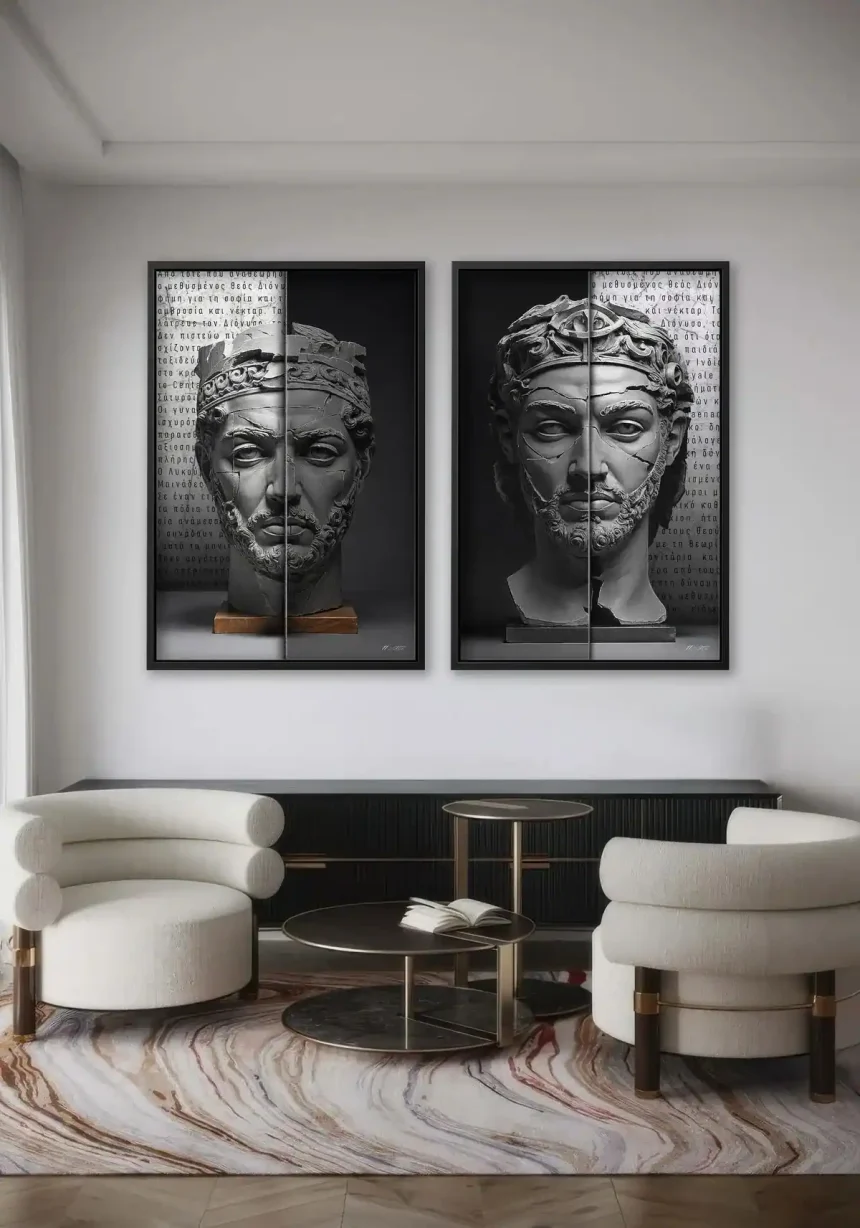
Most people assume that having a home that looks considered and put together requires either a professional interior designer or a serious budget, possibly both. In reality, a lot of what makes a space feel gallery worthy comes down to a handful of decisions made well, and art is at the center of almost all of them.
Galleries do not look the way they do because they are expensive. Every piece has room to breathe. Nothing competes with anything else. The eye is guided through the space in a way that feels natural. You can absolutely bring that into your own home, and the starting point is understanding what actually makes art work on a wall.
Get the Scale Right Before Anything Else
The first thing to get right is scale. A small print on a large empty wall creates a problem that furniture cannot fix. It makes the room feel incomplete, as you ran out of ideas or budget before you finished. When you buy a piece that commands the space it is given, everything else in the room relaxes. The furniture, the lighting, and the smaller details all find their place around a confident central piece.
A good rule to keep in mind: whatever size you think you need, go slightly bigger. This applies especially when ordering online, where it is easy to underestimate how a piece will read once it is actually on your wall in a real room with real proportions. That print that looked generous on a screen often feels modest once it is up.
Stop Overcrowding Your Walls
The second thing galleries always get right is not overcrowding. Walk into a commercial gallery, and you will notice there is space between things. The art is not competing for your attention every few inches. It is allowed to exist. At home, the instinct is often to fill every wall with something, which ends up creating visual noise rather than atmosphere. One strong piece in a room is worth more than five average ones. If a wall does not have the right piece for it yet, it is perfectly fine to leave it alone until you find it.
Consistency in framing makes an enormous difference. When frames across different pieces share a tone, whether that is all black, all white, or all natural wood, the room feels like someone thought about it. Mixed frames can work, but they take more skill to pull off. Starting with a consistent frame style is the easier route to a coherent look.
Why Uniqueness Separates a Good Room From a Great One
One thing that genuinely separates rooms that feel special from rooms that feel generic is the uniqueness of the art itself. When people visit and recognise a piece from a hundred other homes, or Instagram feeds, it deflates the effect. This is where buying limited edition wall art makes a real difference. A piece that exists in only 200 editions across the world, never restocked after it sells out, carries something with it that reproductions simply do not. It is specific. It is yours in a way that a mass produced print cannot be.
This is not about status or showing off. It is about the way a room feels when every element in it has a reason to be there. Art that was chosen thoughtfully, from a source that cares about materials and process, communicates that without anyone needing to explain it.
What Quality Materials Actually Do for a Room
When you look at the actual materials in a piece, the gap between quality and cheap becomes obvious pretty quickly. Museum quality canvas takes colour differently from a standard print. The surface has texture and weight. When it is framed properly and sits behind quality acrylic glass, it looks finished in a way that transforms even a simple composition into something that belongs on a real wall. The frame that comes with a piece matters too. Buying art and then needing to source a quality frame separately often costs more than the art itself, so studios that include it are offering real value.
Studios like 11-ace.com approach this exactly right. Every piece is handcrafted in Los Angeles using gallery grade materials, hand inspected before it ships, and released in genuine limited editions of 200, meaning once they are gone, they stay gone. The work blends original photography and fine art into contemporary compositions that hold up in modern interiors without feeling cold or corporate. For anyone who wants art that actually does something for a room without requiring gallery wall prices, it is worth looking at what they have available.
Hanging Height and Placement Done Properly
The placement of art within a room matters as much as the art itself. The standard rule is to hang pieces so the centre of the artwork sits at eye level, which is roughly 57 to 60 inches from the floor. This is how galleries do it because it works. Art hung too high ends up looking disconnected from the furniture below it, like it is floating. Art hung at the right height feels grounded and connected to the space.
If you are working with a gallery wall arrangement, start with the largest piece and build outward from it rather than trying to arrange everything equally. The anchor piece gives the rest of the wall a logic to follow. Lay everything out on the floor before anything goes up, photograph it, and adjust before you commit to holes in the wall. Taking an extra twenty minutes at that stage saves a lot of frustration.
The One Thing Most People Forget: Lighting
Lighting is the final element people underestimate. Art under flat overhead lighting loses most of what makes it interesting. A small directed picture light or even an angled lamp pointing towards a piece adds warmth and dimension, and suddenly, the same artwork you have had for months looks completely different. It does not cost much to get it right, and the effect is immediate.
Decorating like a gallery is not about having access to expensive originals or a curated collection built over decades. It is about making fewer, better choices. Picking pieces that genuinely hold your attention. Giving them room to be seen. Using quality where it counts and not filling space just to fill it. Do that, and the room starts to feel like somewhere worth being.