Every day, billions of people type questions into a search box and expect an instant, useful answer. Whether you are looking for a recipe, researching a school project, comparing laptops, or trying to solve a problem, a search engine is often the first place you turn.
Yet few people stop to think about what happens behind that simple search box.
Understanding search engine basics is more than a technical curiosity. It can help you find better information, search more efficiently, evaluate online sources, and understand how websites become visible in search results.
Think of a search engine as a highly organized librarian managing an enormous catalog of web pages. Instead of shelves filled with books, it works with billions of pages and uses automated systems to discover, organize, and rank information.
In this beginner-friendly guide, we will explain the three fundamental stages of search, explore what influences rankings, and share practical tips for searching smarter.
What Is a Search Engine?
A search engine is a software system that helps people find information on the World Wide Web. It discovers web pages, analyzes and organizes information, and then provides results that are relevant to a user’s search query.
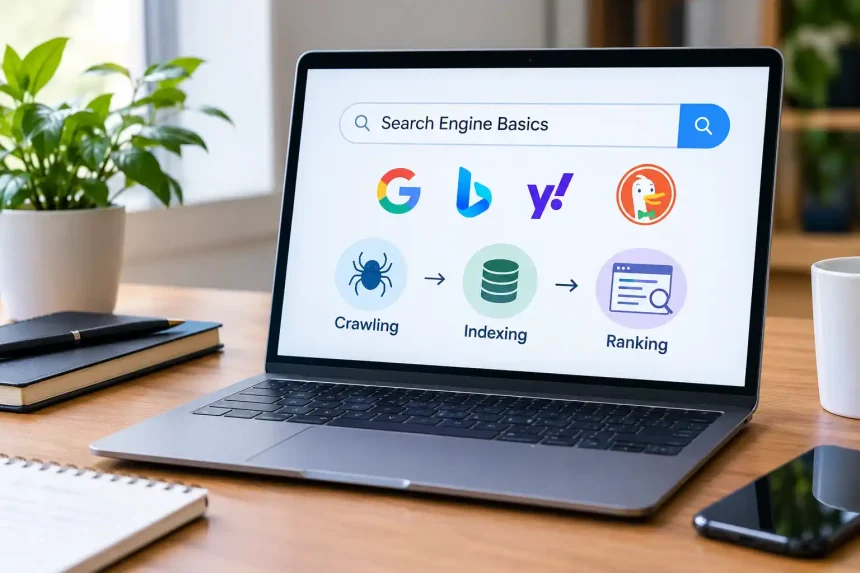
Some of the best-known search engines include Google, Bing, Yahoo, and DuckDuckGo. Although they differ in features and technology, they all rely on similar fundamental concepts.
The basic process can be summarized in three stages:
- Crawling – discovering web pages and their content.
- Indexing – analyzing and storing information about those pages.
- Ranking – determining which indexed pages are most useful for a particular search.
Understanding these three stages makes it easier to see why some pages appear prominently in search results while others receive little or no visibility.
The Three Pillars of How Search Works
Crawling: Discovering Web Pages
Crawling is the discovery stage of search.
Search engines use automated programs, commonly known as crawlers, bots, or spiders, to discover new and updated web pages. These programs can begin with known URLs and follow links from one page to another, allowing search engines to discover additional content across the web.
For example, imagine publishing a brand-new article on a website. A search engine crawler may discover the page by following a link from another page or through other mechanisms used to identify new URLs.
When a crawler visits a page, it can examine its content, links, and other information. Search engines may revisit pages later to check whether their content has changed.
This is one reason newly published content does not necessarily appear in search results immediately. A page generally needs to be discovered and processed before it can become eligible to appear in a search engine’s index.
Website owners can also use technical instructions, such as robots.txt, to control which parts of a site crawlers are allowed to access.
Indexing: Organizing Information
After a search engine discovers a page, the next stage is indexing.
Think of an index as a huge digital catalog. Instead of simply storing a page, the search engine analyzes information about its content, topic, structure, and other relevant signals.
The goal is to understand what the page is about and determine whether it should be included in the search engine’s index.
Not every page that a crawler discovers is necessarily indexed. Search engines can choose not to index pages for various reasons, including technical issues, duplicate or substantially similar content, quality concerns, or other factors.
If a page is not included in a search engine’s index, it generally cannot appear as a normal organic search result.
For website owners, this makes clear and useful content, logical site structure, and sound technical implementation important parts of search visibility.
Ranking: Choosing the Most Relevant Results
Ranking is the stage users notice most.
When you enter a search query, the search engine does not simply search the entire live internet from scratch. Instead, it uses its index to identify pages that may be relevant to your query and then orders the results according to its ranking systems.
Search engines use complex algorithms and numerous signals to determine which results are likely to be the most useful.
These systems can consider factors related to relevance, content quality, authority, freshness, context, and the overall experience provided by a page. The exact systems and signals vary between search engines and can change over time.
A page containing the exact words from your search is not automatically guaranteed to rank highly. Search engines increasingly try to understand the meaning and intent behind a query rather than relying only on exact keyword matches.
What Influences Search Results?
Search engine algorithms are complex, and companies do not publish every detail of their ranking systems. However, several broad concepts help explain why particular pages appear for particular searches.
Relevance and Keywords
Relevance is one of the most important concepts in search.
Search engines try to determine how closely a page matches the meaning and intent of a user’s query.
Keywords still have a role because they help communicate what a page is about. However, repeatedly inserting the same keyword into a page is not a reliable way to achieve better rankings.
Instead, content should use natural language and cover the subject in a way that genuinely helps the reader.
For example, someone searching for “easy vegetarian pasta recipes” is probably looking for practical recipes rather than a general history of pasta. A useful search result should therefore match that purpose.
Search Intent
Search intent is the reason behind a search.
Understanding intent helps explain why two pages targeting similar words can perform very differently.
Common types of search intent include:
- Informational: The user wants to learn something, such as “how does a search engine work?”
- Navigational: The user wants to reach a particular website or page.
- Commercial: The user is researching products or services before making a decision.
- Transactional: The user is ready to take an action, such as buying a product.
A successful page should aim to satisfy the intent behind the query, not simply repeat the keyword.
Authority and Trust
Search engines also use various signals to evaluate the credibility and authority of content.
Links from other reputable websites can be an important signal because they can indicate that other sites find a page useful or worth referencing. However, links are only one part of a much larger picture.
Trust can also be influenced by factors such as the quality and accuracy of the content, transparency about the website and its purpose, and the overall signals associated with the site and page.
The key lesson for website owners is simple: creating genuinely useful content is a more sustainable strategy than trying to manipulate search algorithms.
User Experience
A page should be useful not only in terms of information but also in how easily people can access and use it.
Factors such as page performance, mobile usability, readable formatting, and straightforward navigation can contribute to a better experience.
However, there is no single user-experience factor that guarantees a top ranking. Search engines evaluate pages using many signals, and high-quality content remains an important part of the overall picture.
A Simple Analogy to Understand Search
Imagine that you need an easy vegetarian pasta recipe and walk into a huge library.
First, a team of helpers searches the library and discovers relevant cookbooks. That is similar to crawling.
Next, the librarians create catalog information describing each cookbook, including its subject and contents. That is similar to indexing.
Finally, you ask for an easy vegetarian pasta recipe. The librarian checks the catalog and selects the resources that appear most relevant and useful for your request. That is similar to ranking.
Modern search engines are far more sophisticated than a traditional library, but this analogy makes the basic process easier to understand.
Why Search Intent Matters
Knowing how search intent works can improve the way you search and the way you create content.
Consider these two searches:
“What is a search engine?”
The person is probably looking for an explanation.
“Best privacy-focused search engines”
The person may be comparing options and looking for recommendations.
Although both searches relate to search engines, the user’s goals are different. A page designed to rank for one query may not satisfy the intent behind the other.
For website owners, this means choosing a topic and keyword is only the beginning. The content should actually answer the question or fulfill the purpose behind the search.
Practical Tips for Everyday Searching
You do not need to be an SEO expert to become a better searcher. A few simple habits can make your searches more effective.
Be Specific
Instead of searching for:
“shoes”
try:
“best waterproof running shoes under $100”
Adding useful details gives the search engine more context about what you need.
Use Natural Language
Modern search engines can understand conversational questions, so you do not have to type strange keyword combinations.
Instead of:
“search engine crawling meaning”
you could search:
“How does search engine crawling work?”
Both can work, but natural language can make it easier to express your actual question.
Use Search Operators
Search operators can help narrow your results.
For example, placing words inside quotation marks can search for an exact phrase:
“chocolate cake”
A minus sign can also help exclude a term:
chocolate cake -nuts
These tools are particularly useful when ordinary searches return too many unrelated results.
Check the Source
A high search position does not automatically mean that every statement on a page is correct.
Before trusting important information, look at:
- Who published the content?
- Is the information current?
- Does the page provide evidence or reliable sources?
- Does the website clearly explain its purpose?
- Is the content genuinely informative or mainly designed to sell something?
Developing a critical eye is one of the most useful search skills you can have.
Why Search Engine Basics Matter for Website Owners
Understanding search engines is also the foundation of search engine optimization (SEO).
SEO involves improving a website so that search engines can discover, understand, and potentially rank its pages for relevant searches.
That can involve:
- Creating useful, original content
- Organizing pages with clear headings and structure
- Making websites accessible to search engine crawlers
- Improving page performance and usability
- Building a logical internal linking structure
- Earning relevant links and mentions from reputable websites
- Making content satisfy the intent behind a search
SEO is not about finding one secret trick that guarantees a number-one position. Search algorithms change, competition varies, and rankings are never guaranteed.
A stronger long-term approach is to create content that is genuinely useful, easy to understand, technically accessible, and trustworthy.
Frequently Asked Questions
What is a search engine?
A search engine is a software system that helps people find information on the web. It discovers and analyzes web pages, organizes information in an index, and returns relevant results when users enter queries.
How does a search engine work?
Search engines generally rely on three fundamental stages: crawling, indexing, and ranking. They discover pages, analyze and store information about them, and then determine which indexed results are most relevant to a user’s query.
What is crawling?
Crawling is the process of discovering web pages. Search engines use automated programs called crawlers, bots, or spiders to find new and updated content and follow links across websites.
What is indexing?
Indexing is the process of analyzing and organizing information discovered during crawling. Search engines store information about pages in large databases so that relevant pages can later be considered for search results.
What is search engine ranking?
Ranking is the process of ordering search results according to their relevance and usefulness for a particular query. Search engines use complex algorithms and many signals to determine which results to display prominently.
Can a website appear in search results without being indexed?
Generally, no. A page needs to be included in a search engine’s index to appear as a normal organic search result. However, discovering a page and indexing it are separate processes, and not every discovered page is necessarily indexed.
Looking Ahead
Search continues to evolve as technology changes. Artificial intelligence, voice-based queries, personalized experiences, and new ways of presenting information are influencing how people discover content online.
Despite these changes, the basic concepts remain useful: search engines need to discover information, understand and organize it, and determine which results are most relevant to a user’s query.
By understanding these search engine basics, you can become a more effective web user and gain a clearer understanding of SEO and website visibility.
The next time you type a question into a search box and receive useful answers within seconds, you will have a better idea of the technology working behind the scenes.
About the Author
Jordan Miles is a digital content writer passionate about making technology simple and approachable for everyday readers. His work focuses on explaining complex digital topics in clear, practical language and helping readers make better-informed decisions online.