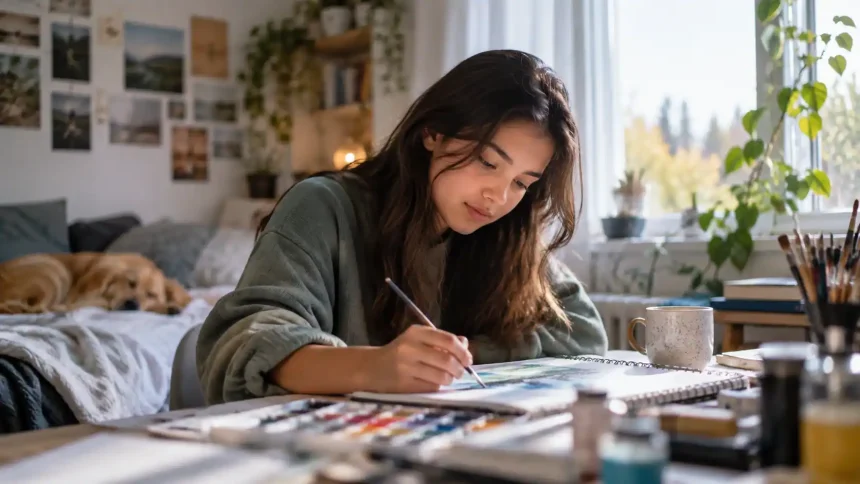
High school students carry an incredibly heavy physical and emotional load. Between college applications, endless smartphone notifications, and the standard awkwardness of growing up, their nervous systems are constantly firing. It is exhausting just watching them try to keep up.
Cortisol levels in modern adolescents often mirror those of adults working high-stress corporate jobs. They are perpetually switched on. The standard cultural advice usually points to deep breathing exercises or simply talking it out with a trusted adult.
But have you ever told a highly anxious sixteen-year-old to just calm down and breathe?
It rarely works. They do not need to sit perfectly still in a quiet room. They need an active, tangible release valve for that chaotic, pent-up energy. They need a place to put the stress so it stops living in their muscles.
When Words Completely Fall Short
Traditional counseling asks young people to sit in an unfamiliar room and articulate their deepest insecurities. That expectation requires a fully developed prefrontal cortex. Teenagers are actively still building theirs. Asking them to verbally map out complex anxiety often leads to intense frustration. They feel misunderstood. They shut down.
This is especially true for neurodivergent teens who might process the world differently than their peers. Creative outlets bypass the need for a perfect, mature vocabulary. A blank sketchbook does not judge a stutter. A distorted guitar amplifier does not interrupt or ask clarifying questions.
When a young person violently throws acrylic paint at a canvas or meticulously molds a lump of clay, they process complex feelings without needing a single adjective. They externalize the internal chaos. The physical artwork holds the heavy emotion so the teenager no longer has to carry it alone in their chest.
The Neurology of the Flow State
What actually happens inside the adolescent brain during the creative process? It is not about making something pretty to hang on the refrigerator. It is about fundamental neurochemistry and brain function.
Today’s teens are chronic consumers. They scroll, watch, and absorb content for hours. Shifting from a passive consumer to an active creator completely changes their brain activity.
Entering a “flow state” happens when someone gets completely absorbed in an activity. The rest of the busy, noisy world fades into the background. Brain waves literally slow down from a frantic, anxious beta state to a calmer, meditative alpha state.
This neurological shift physically drops the heart rate. It actively suppresses the release of stress hormones. Dopamine and endorphins take over the system.
It acts as a natural reset button for a fried nervous system. Observers can actually watch the physical tension leave a teenager’s shoulders after thirty minutes of focused sketching or building. Their breathing regulates. Their clenched jaw finally relaxes.
Finding the Exact Right Medium
Not every kid wants to paint watercolor landscapes. Creativity looks wildly different for everyone.
For some, it involves digital music production in a dark bedroom at midnight. For others, it means building intricate mechanical keyboards, knitting bulky sweaters, or designing video game levels. The medium itself absolutely does not matter. The physical process of raw creation is what does the heavy lifting.
Consider a teenager who remains completely unresponsive to school administrators and well-meaning guidance counselors. Hand them a digital camera. Ask them to photograph things in their neighborhood that feel like a Monday morning. Suddenly, adults have a clear, unfiltered window into their exact mental state.
Professional guidance can structure this process beautifully when casual at-home hobbies are not quite enough. Programs like art therapy for teenagers Coffs Harbour provide safe, clinical environments where adolescents navigate these unspoken feelings with trained specialists. They stop worrying about academic grades. They stop caring about social media metrics. They just focus on the tactile sensation of making something exist that did not exist five minutes ago.
Building Lifelong Coping Skills
Artistic expression teaches failure in a beautifully low-stakes environment.
A charcoal drawing turns out completely wrong. A piano chord progression sounds terrible. The expensive clay sculpture collapses on the work table.
What happens next?
The teenager grabs a fresh piece of paper. They adjust their fingers on the keys. They knead the wet clay and start over from scratch.
This repetitive cycle builds a very specific, durable type of mental resilience. Teenagers learn firsthand that mistakes are not fatal. A ruined painting is just a ruined painting. That simple, profound realization translates directly to real-world problems later in life.
A failed math test or a sudden social rejection becomes a temporary problem to solve rather than a world-ending catastrophe. They learn to trust their own ability to adapt and correct course without panicking. Providing these creative tools early equips young people with functional coping mechanisms they will carry straight into adulthood. They learn how to survive the incredibly hard days simply by making something out of them.