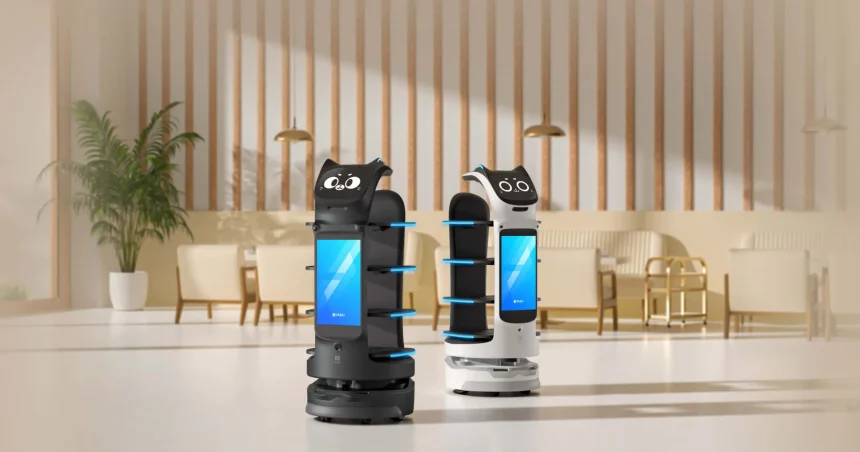
For common internal delivery workflows, hospitals generally choose between enclosed-compartment and open-tray commercial delivery robots. These hospital robots serve different handling needs: enclosed designs suit items that need protection, restricted access, or cross-floor handoff, while open trays suit properly sealed, non-sensitive loads moved in larger batches. The right choice depends on item security, payload, route, and handoff method.
What Types of Hospital Robots Are Suitable for Internal Delivery?
Enclosed-compartment and open-tray hospital robots differ in how their carrying structures protect items, organize loading, and control retrieval at the destination. The table summarizes how those differences affect load type, access, handling, batch pattern, and route.
| Decision point | Enclosed-compartment robots | Open-tray robots |
| Best-fit loads | Medications, packaged specimens, restricted documents, and light medical items. | Sealed meals, packaged consumables, and bagged clean linen. |
| Item protection | A compartment creates a physical barrier around the prepared load. | Sealed packaging remains the primary protective barrier. |
| Loading and unloading | Items are loaded into assigned compartments and retrieved after the relevant door opens. | Staff load and remove items directly from the trays. |
| Retrieval access | Supported credentials can restrict opening to an intended recipient. | Direct access suits staffed destinations where authentication is unnecessary. |
| Batch pattern | Separate compartments organize multi-stop deliveries by recipient or destination. | Multiple trays group packages for batched transport and quick unloading. |
| Typical route | Shared-area or cross-floor routes that may pass elevators or controlled entry points. | Routine rounds between staffed service points, often on the same floor. |
When Are Enclosed-Compartment Hospital Robots the Better Fit?
Enclosed-compartment models are the better fit when a delivery needs a physical barrier around the load, limited access at retrieval, or movement through shared areas and across floors. Typical applications include:
- Pharmacy-prepared medications. After pharmacy staff verifies, labels, and packages medication, a designated compartment keeps it separate during transport and restricts access to the intended recipient.
- Properly packaged laboratory specimens. A closed compartment adds separation from people and other loads while the hospital’s required specimen packaging remains in place.
- Restricted documents and light medical items. Confidential records and packaged supplies can remain out of open reach until authorized pickup, provided they fit the selected compartment.
An enclosed format can also support multi-stop rounds. Separate compartments may be assigned by destination, allowing one recipient to retrieve a delivery while loads scheduled for later stops remain closed. This makes the carrying structure useful when access requirements differ across a single route.
For these workflows, PUDU FlashBot Max provides 2-4 adjustable enclosed compartments. Password, phone-number, or NFC verification can limit compartment access, while the modular layout accommodates different load sizes across separate delivery tasks.
Adjustable enclosed compartments on PUDU FlashBot Max for protected hospital deliveries
Building IoT integration enables automatic elevator and turnstile use, helping the robot maintain a continuous route across floors and controlled entry points. Together, enclosed storage, recipient verification, and multi-floor access support workflows where protected transport and an orderly handoff are central requirements.
When Are Open-Tray Hospital Robots the Better Fit?
Open-tray models are the better fit when items are already sealed, do not require recipient authentication, and can be received at a staffed destination. Their accessible layout supports quick loading and unloading, while multiple trays allow several packages or destinations to be organized on one trip.
Typical workflows include:
- Sealed meals. Covered or securely packaged meals can be grouped across trays and unloaded promptly at a staffed ward, dining area, or service point.
- Packaged consumables. Boxed or bagged routine care supplies can be consolidated for scheduled replenishment when they do not require restricted access or special environmental control.
- Bagged clean linen. Clean textiles protected before loading can move in batches between service points, while established containment procedures continue to apply to soiled or contamination-sensitive materials
Within this format, PUDUBOT 2 uses a configurable multi-tray layout to group packages by destination or item category. Staff can load and unload each group directly at its assigned service point, making the design suitable for scheduled rounds with repeated handoffs.
PUDUBOT 2 has 3 trays by default and supports configurations of up to 7 trays. Its 40 kg maximum total load supports batched movement of routine supplies, while the selected tray configuration can reflect package dimensions, the number of delivery groups, and the planned unloading pattern.
PUDU Hospital Robots for Internal Delivery
Pudu Robotics develops commercial service robots for operational tasks across a range of business environments. Its healthcare solutions include delivery platforms that can support different internal routes and handling requirements. For the two formats examined here, product selection depends on how storage, access, payload, path clearance, and building interfaces fit the intended workflow.
The specifications below connect each carrying format with practical deployment requirements.
| Selection factor | PUDU FlashBot Max | PUDUBOT 2 |
| Storage design | 2-4 adjustable enclosed compartments | 3 trays by default; up to 7 open trays |
| Access method | Password, phone-number, or NFC compartment access | Direct loading and retrieval from open trays |
| Payload | 10 kg per layer | 40 kg maximum total load |
| Required path width | 60 cm path clearance | 80 cm path width |
| Route emphasis | Automatic elevator and turnstile use through building IoT | Routine routes with direct staff handling at destinations |
| Best-fit workflow | Controlled, recipient-specific, or cross-floor delivery | Routine batch delivery with quick loading and unloading |
Storage and access establish the workflow fit; payload and path clearance confirm whether the model can serve the planned route. Where controlled cross-floor deliveries and routine batch rounds coexist, hospitals can assign the two robots to different departments rather than applying one carrying format to every workflow.
Conclusion
Select hospital robots based on item protection, handoff control, route, and batch size. PUDU FlashBot Max suits controlled or cross-floor deliveries that benefit from enclosed, recipient-specific access. PUDUBOT 2 suits properly sealed items moved in routine batches with direct loading and unloading at staffed destinations.
After choosing the carrying format, hospitals can confirm payload, path clearance, and building interfaces against the intended route. The two PUDU models provide complementary commercial delivery options for these internal workflows. Contact PUDU to discuss route conditions and product configuration.