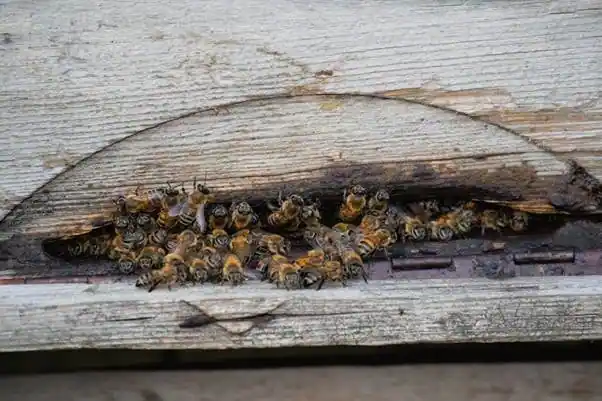
This depends largely on the type of bee involved.
Some bee nests last only a few weeks or months. But if the colony has found a suitable location, they can stay active for years.
Before considering any nest removal know that in many cases, the bees may leave naturally without any intervention.
How Long Do Bee Nests Usually Last?
In the UK, bees found nesting around homes and gardens are commonly bumblebees, solitary bees or honeybees.
How Long Does a Bumblebee Nest Last?
Bumblebee nests are temporary and normally remain active for only a few months.
A queen typically emerges from hibernation during spring and searches for somewhere suitable to establish a colony. Depending on the species, this might be:
· A hole in the ground
· Spaces beneath sheds
· Compost heaps
· Bird boxes
· Wall cavities
· Roof spaces
The colony grows during spring and summer. Later in the season, new queens and males are produced.
The original queen, workers and males die, new queens leave the nest and find somewhere else to hibernate and the old nest is then abandoned and not normally reused.
If a bumblebee nest is somewhere that doesn’t cause you or anyone else a problem, leaving it alone might be the best option. The colony will usually disappear naturally when its life cycle ends.
How Long Do Solitary Bee Nests Last?
Unlike honeybees and bumblebees, solitary bees don’t live together in large colonies.
Species such as masonry bees and mining bees create individual nesting chambers. However, several females may choose to nest close together when conditions are suitable.
Solitary bee activity is generally seasonal. Adults may only be noticeable during the weeks while they mate and create nests.
The female lays eggs inside individual chambers and leaves food for the developing larvae. The next generation then emerges during a later season.
This means you might see bees returning to the same general area each year. But it doesn’t mean they are using the same nest.
Solitary bees are also generally less defensive than social species because they don’t have a large colony to protect.
How Long Can a Honeybee Nest Last?
Honeybee colonies can survive from one year to the next.
Rather than the whole colony dying at the end of summer, honeybees remain together through winter. They survive using stored honey before becoming more active as temperatures rise.
A successful colony can therefore occupy the same location for several years.
This can become an issue when honeybees establish themselves inside a building in areas such as:
· Chimneys
· Wall cavities
· Roof spaces
· Eaves
· Outbuildings
· Other enclosed structural spaces
What Is the Difference Between a Bee Swarm and a Nest?
Seeing hundreds or thousands of bees doesn’t necessarily mean they have built a nest.
Honeybees reproduce at colony level through swarming. Part of an established colony leaves with a queen and temporarily gathers while scout bees search for a new home.
You might find a swarm hanging from a tree branch, fence or another structure.
Although it can look alarming, a swarm may only remain there for several hours or days. The bees can then move elsewhere once they have found a suitable nesting site.
A swarm and an established colony need different approaches.
Will Bees Leave a Nest on Their Own?
Bumblebees and many solitary bees will complete their natural life cycle and leave the nesting area without intervention.
Honeybees are different. An established honeybee colony may remain in a suitable location year after year.
Whether any professional bee nest removal is appropriate also depends on where the bees are nesting. A bumblebee nest at the bottom of a quiet garden probably won’t cause many problems. The same type of nest beside a frequently used doorway or in a loft could be more problematic. So, location matters.
Should You Block the Entrance to a Bee Nest?
Don’t seal an entrance while bees are actively using it.
If bees are nesting inside a wall or roof, blocking their usual entrance doesn’t remove them. Instead, they may search for another way out. That could lead them further into the building.
Once the nest is no longer active, you can then move to prevent bees or other pests entering the same space later.
Can Bee Nests Be Relocated?
Relocation may be possible in some situations, particularly with honeybees. However, it depends on the species, nest location and how accessible the colony is.
A swarm hanging from a branch will be easier than a colony established deep inside a wall cavity.
Removing an established honeybee colony can also involve more than removing the bees themselves. Comb, honey and other nest material may need to be considered, particularly when the colony has occupied a building for some time.
A professional can advise on the most appropriate option for the situation.
Final Thoughts
In many cases, no bee nest removal will be required. Bumblebee and solitary bee activity may disappear naturally as their seasonal life cycle comes to an end.
However, an established honeybee colony can remain for years. And any nest in a problematic location may require professional assessment, especially if there is a risk to people.