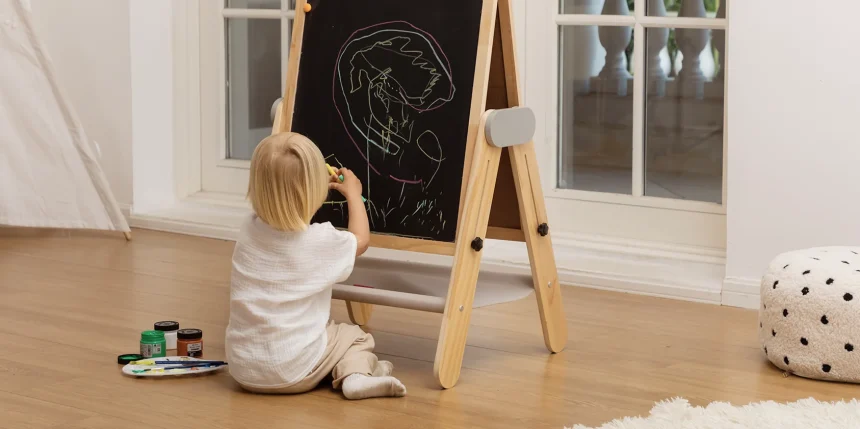
Toddlers learn by using their senses to touch, move and manipulate objects. Play at this stage is incredibly important for overall development. Certain toys can harness and develop toddler’s playtime skills. Parents may also have questions such as why does my toddler hit himself as they observe their child’s behavior during play.
Blocks can be used to practice many different physical skills including stacking and grasping.
Toys that address different senses can also help develop awareness of different textures.
Active participation of the parents in children’s playtime can help develop awareness of different movements and promote use of different toys.
Importance of Motor Development in Toddlers
There are two main categories of motor skills: gross and fine. Gross motor skills include large body movements like running and jumping. Balancing is also considered a gross motor skill.
Fine motor skills are associated with the movement of the hands and arms. Activities like sorting and stacking toys require the development of fine motor skills.
There are numerous toys that can be used to assist the development of both types of skills.
- Ball play can be used to practice large body movement skills
- games that involve the use of stacking toys can help to improve fine motor skills.
Toys and Your Child’s Fine Motor Skill Development
As your child gets older and fine tunes their control of their hands and fingers they are able to complete more complex physical tasks. These include skills such as:
- dressing and undressing themselves,
- eating with a spoon or fork,
- drawing or writing,
- and other tasks.
There are a number of different games or toys that your child can use to help build up these skills.
One of the best is the use of building blocks. As your child is able to construct and build structures with blocks they are improving their coordination and eye hand precison as well as strength in their arms.
Other toys and games that are good for developing these skills are:
- shape sorters,
- large interlocking blocks,
- puzzle games,
- and nesting toys.
Toddlers need toys that allow them to develop their skills and build up the muscles in their arms and hands in order to improve their handwriting and overall control of their hands and arms. These skills will assist your child for the rest of their life.
The Impact of Sensory Play On Early Childhood Development
Sensory play helps children to learn about the world around them using various senses. By using these different methods of play children are able to learn various skills quickly and effortlessly.
To help children learn through a variety of different sensory methods, there are specific toys that help achieve this. Some of the best toys are simple and allow children to use their imagination and learn at their own pace. They should not be overwhelmed by the toy they are using banasuper can also be considered when choosing simple toys that support sensory play.
Simple sensory toys should have a variety of different textures to help a child learn new things and build up skills quickly. These toys should also encourage a child to interact with other children as well.
What Causes Toddler Self-Hitting Behaviors?
There are many possible reasons that cause a toddler to hit or bang his body against things or to hit his head against the wall. Usually toddlers hit themselves when they get frustrated or when they are tired. Self-hitting behaviors may also occur when toddlers get too much stimulation.
When toddlers get too much stimulation they may also get over-tired and frustrated. Sometimes they may need to engage in physical activities to “blow off” some of that extra stimulation. This may help to decrease their self-hitting behaviors.
However, not all self-hitting behaviors are caused by a lack of appropriate sensory toys or too much stimulation. If a parent is worried about her child’s self-hitting behaviors, she should contact her child’s pediatrician or a child psychologist to help determine the possible reasons for her child’s self-hitting behaviors. It is also helpful for the parent to keep a self-hitting behaviors diary to show the health care professional.
Trying to determine Which Toys are Best for Your Toddler?
The best way to engage a toddler in active play is to provide the right toys that stimulate different activities.
- For instance, to help toddlers work on their large motor skills, provide ride on toys.
- To help toddlers work on their small motor skills, provide toys that promote squeezing and stacking.
- To help toddlers work on all their skill areas, provide toys that help toddlers explore sounds and colors.
- To help toddlers develop imaginative play skills and work on problem solving skills, provide play sets.
We also prioritize safety and look for the same things in our inspections.
- We look for the presence of choking hazards by looking for easily removable parts.
- Appropriate toys for the ages of the children using them is also very important.
- The recommendations of the manufacturers should be followed by the parents and/or caregivers.
What differentiates us from our competition is our extensive product line for the developmentally appropriate toys for toddlers. We understand that each day should be spent learning and growing. It is our mission to provide services that assist parents/guardians in their effort to provide their toddlers with opportunities to learn and engage in developmentally appropriate activities.
We aim to develop a parenting resource center where parents/guardians have the opportunity to gain the necessary skills for the comfort and nurturing of their children.
Developing daily activities to stimulate the learning of toddlers is essential
However, having a toddler with an abundance of toys is not necessary. It is best practice to have only a select few toys available to a toddler. The toys can be interchanged on a frequent basis to provide the toddler with an opportunity to become creatively engaged with the toys.
We urge our customers to realize that they do not need to plan elaborate activities to stimulate a toddlers learning. Everyday activities can be used to facilitate learning. Play helps develop other skills such as creativity, sharing, and ordering. These are learned by playing simple games like a picking up a toy, throwing a ball, stacking blocks, or removing and sorting blocks by color.
Parents can verbally describe what their child is doing by saying things like, “You put the red block on top,” or “This ball feels bumpy.” This helps a child’s language development and builds their sense of awareness.
Toys do not need to be complex to be beneficial.
Allow children to use their creativity and play with toys however they see fit. Children can develop emotional and social skills by using creativity and curiosity to determine ways to satisfy their needs.
The right toys can reinforce several developmental skills.
- Building and sensory toys help improve motor skills.
- Puzzles and games develop mental skills.
- Children develop problem-solving skills through the use of various types of toys.
- Different toys help improve creativity and self-directed learning.
For a toddler, playing with toys and engaging with caregivers in self-directed learning, shapes their path for life-long learning.
Children enjoy exploring and playing with toys that are safe for them. Caregivers should engage with their children to shape and strengthen their skills. Caregivers should provide appropriate and safe toys for their children. Caregivers shape their child’s path for learning in various ways, depending on the learning activities they engage in, i.e. playing with a building toy, ball, or other shape.