
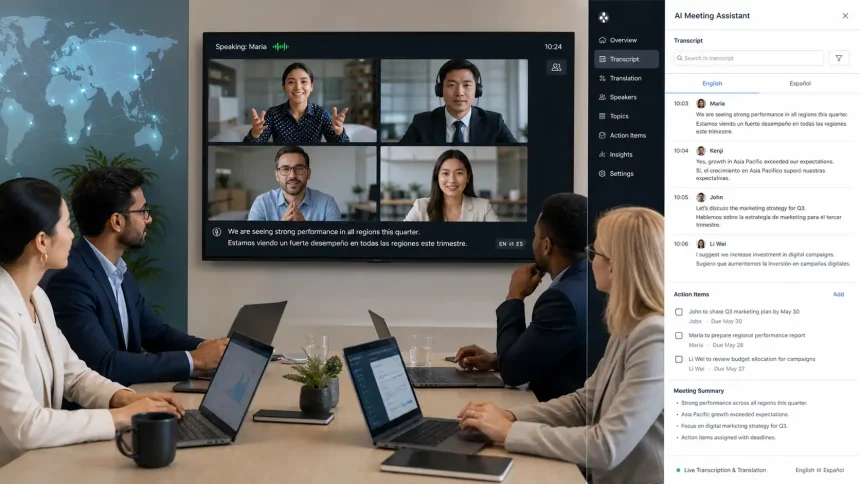
I have spent a lot of time over the last year examining where multilingual operational costs actually come from within a business. Most of it does not come from the obvious places. It comes from delays, rework, missed follow-ups, and the friction of running meetings in languages your team does not all speak fluently. When JotMe launched its audio-to-text translation feature, I started testing it specifically against that problem.
The feature does what its name suggests, but the way it does it matters more than the description. JotMe captures live audio from a meeting, transcribes it accurately, and translates it into the target language in real time, producing structured text that participants can read during the conversation or pull from later. That last part is the operational difference. The output is not a transcript you receive after the fact. It is a working document that remains in effect throughout the meeting.
I am writing this as someone who has used many transcription and translation tools across various projects. The reason I think JotMe’s audio to text converter is worth a serious look is that it is the first tool I have used that treats audio-to-text translation as an operational layer rather than a post-production utility. That distinction is what closes the cost gap legacy tools have left open for years.
Why the Market Needed a Better Audio to Text Translation Tool?
The category of audio-to-text translation has been crowded for a long time, but most tools in it solve only half of the problem. They either transcribe well or translate well, and very few do both in a way that holds up inside live business meetings. That gap is exactly where the multilingual operation cost gets generated.
Limitations of Existing Translation Tools
When I looked at what other audio-to-text translation tools in the market were offering, the same set of limitations kept appearing:
- Most tools transcribe accurately, but do not translate in real time
- Translation quality degrades sharply on audio longer than fifteen minutes
- Speaker diarization breaks down in meetings with three or more participants
- No native integration with Zoom, Google Meet, or Microsoft Teams
- Latency between speech and translated output is too high for natural conversation
- Pricing is pay-per-minute, which punishes high-volume multilingual teams
- Language coverage is strong for English-European pairs and weak everywhere else
- Output is unstructured plain text that cannot be searched, tagged, or exported cleanly
- Confidentiality and data residency policies are unclear or unsuitable for enterprise use
Each of these limitations sounds like a feature gap, but in practice, they each translate directly into operational cost. A tool that lacks real-time translation forces teams to book interpreters. A tool that breaks on long audio files forces post-meeting cleanup. A tool with weak diarization produces transcripts that nobody can use for compliance or training. A tool without platform integration adds a manual export step to every meeting.
The companies paying the highest multilingual operation cost are usually the ones cobbling together two or three of these limited tools to compensate for what each one cannot do. That stack is expensive, fragile, and slow.
How JotMe Is Solving Multilingual Operation Cost?
JotMe’s approach is to collapse the entire audio-to-text translation workflow into a single layer that runs inside the meeting itself. Each capability in the feature set maps directly to a cost category that legacy tools have failed to address. Here is how it breaks down.
1. Real-Time Audio-to-Text Translation Inside the Meeting
JotMe captures audio in real time and produces translated text with sub-5-second latency. Participants see the translation as the speaker continues speaking, so the meeting flows at conversational speed.
Real-time translation capability replaces:
- Booked human interpreters for routine calls
- Post-meeting translation services
- The scheduling delay that comes from waiting for interpreter availability
2. Speaker Diarization That Actually Works
The system identifies who is speaking and tags every line of the transcript accordingly, even in meetings with multiple participants speaking different languages. The diarization holds up across long sessions and crosstalk, which is where most competing tools fail.
Accurate speaker diarization capability replaces:
- Manual cleanup of transcripts where speakers are unlabeled
- The accuracy loss that makes legacy transcripts unusable for compliance review
3. Structured Transcripts You Can Search and Export
Every meeting produces a structured output that includes the original audio, the transcript in the source language, the translation in the target language, speaker labels, and timestamps. The output is searchable, taggable, and exportable into the systems your team already uses.
Structured transcripts capability replaces:
- Separate transcription subscriptions
- Manual note-taking and meeting recap workflows
- The lag between the meeting end and information availability
4. Multi-Language Coverage Beyond the Common Pairs
JotMe handles the high-demand language pairs that the rest of the market focuses on, including English to Spanish translation for teams running US and Latin American operations. It also extends into Asian languages, Arabic, and less common pairs that most competitors handle poorly or not at all.
Multi-language coverage capability replaces:
- Specialty translation agencies for rare language pairs
- The hiring premium for multilingual staff in expansion regions
- Translation rework caused by tools that handle rare pairs badly
5. Native Integration With Existing Meeting Platforms
The feature plugs directly into the platforms your team is already using. There is no separate app to launch, no audio routing setup, and no manual export step at the end of the call.
Native integration replaces:
- Workflow friction that kills tool adoption inside teams
- Manual file transfers between meeting platforms and translation tools
- The training overhead of teaching staff a new tool for every meeting
6. Pricing Built for High-Volume Multilingual Teams
JotMe is priced for teams that run multilingual meetings every day, not for occasional users. The model rewards volume rather than punishing it, which is the opposite of how most pay-per-minute tools are structured.
JotMe’s monthly pricing plans replace:
- The unpredictable monthly bills that come from pay-per-minute pricing
- The internal pressure to limit multilingual meeting frequency to control costs
- The accounting overhead of tracking per-minute usage across teams
The cumulative effect of these six capabilities is what makes the cost reduction so visible on a quarterly report. Each capability removes a separate line item from the multilingual operations budget, and several of them also remove the hidden costs.
Use Case Table to Analyze Audio to Text Converters
When I evaluate audio-to-text converters now, I do so against the actual operational contexts where multilingual costs are generated. Comparing tools on feature lists alone misses the point. The right comparison is what each tool replaces in a real workflow and how much it saves. The table below shows how JotMe’s audio-to-text translation aligns with the most common multilingual use cases I have seen across the businesses I have worked with.
| Use Case | What Teams Used Before | How JotMe Replaces It | Cost Impact |
| Cross-border sales calls | Booked interpreters or bilingual reps | Real-time translation runs inside the meeting | Removes the interpreter spend and shortens the sales cycle |
| Internal multilingual team meetings | English-only meetings with comprehension loss | Every participant reads in their preferred language | Recovers productivity lost to language friction |
| Customer support conversations | Region-specific support hires per language | Single team supports all languages with live translation | Cuts staffing costs across regional support |
| Global onboarding and training | Localized video versions per language | One live session with simultaneous translation for all attendees | Eliminates content localization rework |
| Investor and partner calls | Conference interpreters at premium rates | Translation runs natively inside the call platform | Removes premium interpreter fees |
| Recorded content review and compliance | Manual transcription and translation workflows | Structured transcripts generated automatically | Cuts compliance review time and vendor cost |
The pattern across every row is the same. JotMe collapses what used to be a multi-vendor, multi-step workflow into a single layer that runs inside the meeting itself. That collapse is where the cost reduction comes from, and it is why the savings show up across so many different operational contexts at once.
Conclusion
I have tested many audio-to-text translation tools, and JotMe is the first one that feels built for the actual problem rather than a feature checklist. Multilingual operational costs have been treated as fixed overhead within global businesses for too long because the tools available until now have only ever solved part of the problem at a time.
JotMe’s audio-to-text translation feature changes that by addressing the workflow as a whole. The capabilities I covered are not impressive in isolation. They are impressive because they combine into a single layer that eliminates interpreter spend, transcription bills, document translation rework, and productivity loss from a single place. That is what makes the cost reduction sustainable rather than one-time.
For teams running multilingual meetings every week, the move to a tool like JotMe is not a marginal upgrade. It is a structural shift in how the operations budget gets shaped. The companies adopting it now are the ones that will stop treating multilingual operations as a cost center and start using it as a competitive advantage.
