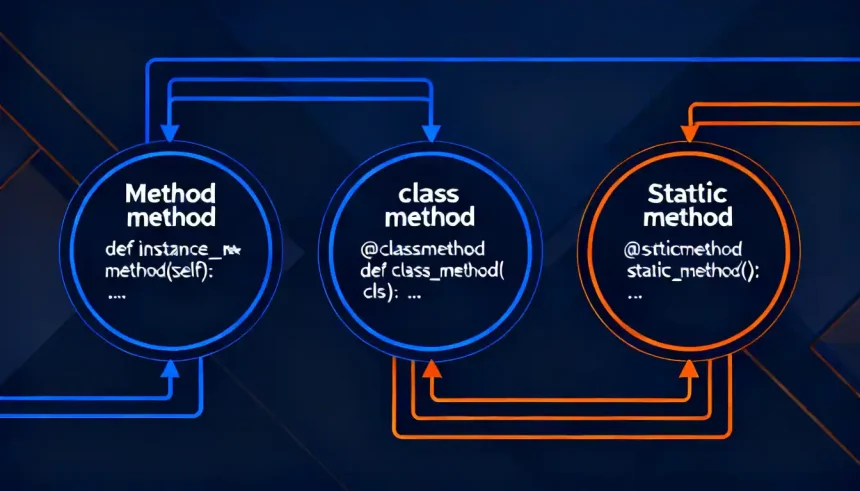
If you have ever stared at a Python class and wondered why some methods take self, others take cls, and a few take nothing at all, you are not alone. The trio of instance methods, class methods, and static methods trips up developers at every level — from beginners writing their first class to experienced engineers refactoring a sprawling codebase. Yet mastering these three method types is the gateway to writing Python that is cleaner, more maintainable, and genuinely object-oriented.
This guide walks through each method type with real-world examples and practical heuristics you can apply today.
What Exactly Is a Method in Python?
Before diving into the categories, it helps to clarify a point that often gets glossed over: a method is simply a function that lives inside a class and operates on — or in the context of — that class. When you call obj.doSomething(), Python silently passes obj into the function. That invisible handoff is what separates a method from a standalone function.
Methods are not just syntactic sugar. They encapsulate behavior, enforce data integrity, and give your objects their personality. Without methods, classes would be little more than glorified dictionaries with dotted access.
Instance Methods: The Workhorses of Every Python Class
How Instance Methods Operate Under the Hood
Instance methods are the default. Define a function inside a class without any decorator, and Python treats it as an instance method. The first parameter — conventionally named self — receives a reference to the specific object that invoked the method.
class BankAccount:
    def __init__(self, owner: str, balance: float):
        self.owner = owner
        self.balance = balance

    def deposit(self, amount: float) -> None:
        if amount <= 0:
            raise ValueError("Deposit amount must be positive.")
        self.balance += amount

    def withdraw(self, amount: float) -> None:
        if amount > self.balance:
            raise ValueError("Insufficient funds.")
        self.balance -= amount
Here, deposit and withdraw are instance methods. Each one reads and mutates the state stored on self. That is the defining trait: instance methods have full access to both instance attributes and class-level data.
When Instance Methods Are the Right Choice
Reach for an instance method whenever the behavior depends on or modifies per-object state. Some classic scenarios:
- CRUD operations on object fields: updating a user profile, adjusting inventory counts, recalculating a shopping cart total.
- Validation tied to instance data: checking whether a password meets the current user’s security policy.
- Transforming instance data for display: serializing an object to JSON, generating a summary string.
A good litmus test: if you find yourself reaching for self inside the method body, you almost certainly need an instance method.
A Subtle Gotcha with self
Remember that self is a convention, not a keyword. You could name the first parameter this or me and Python would not complain. But please do not. Every Python developer on earth expects self, and breaking that convention makes your code harder to read for no benefit whatsoever.
Class Methods: When the Blueprint Needs Behavior
The cls Parameter and What It Unlocks
A class method receives the class itself as its first argument — conventionally called cls — rather than an instance. Decorate it with @classmethod:
class Employee:
    company_min_wage: float = 15.00

    def __init__(self, name: str, hourly_rate: float):
        self.name = name
        self.hourly_rate = hourly_rate

    @classmethod
    def update_min_wage(cls, new_rate: float) -> None:
        if new_rate < 0:
            raise ValueError("Wage cannot be negative.")
        cls.company_min_wage = new_rate

    @classmethod
    def from_csv(cls, csv_line: str) -> "Employee":
        name, rate = csv_line.strip().split(",")
        return cls(name=name, hourly_rate=float(rate))
The first method, update_min_wage, changes class-level state. The second, from_csv, is an alternative constructor — arguably the most compelling use case for class methods.
Alternative Constructors: The Killer Feature
Python does not allow multiple init` methods. If you need to construct objects from different data formats — a dictionary, a JSON blob, a database row — class methods shine:
class Product:
    def __init__(self, sku: str, price: float, stock: int):
        self.sku = sku
        self.price = price
        self.stock = stock

    @classmethod
    def from_dict(cls, data: dict) -> "Product":
        return cls(
            sku=data["sku"],
            price=data["price"],
            stock=data.get("stock", 0),
        )

    @classmethod
    def from_stock_api(cls, api_response: dict) -> "Product":
        return cls(
            sku=api_response["product_id"],
            price=api_response["current_price"] / 100,
            stock=api_response["qty_available"],
        )
Each alternative constructor encapsulates parsing logic that would otherwise clutter the caller or the main init`. The result is code that reads like natural language: product = Product.from_dict(api_payload).
Inheritance and Class Methods: A Powerful Combo
Because cls resolves to the actual class at call time — not the class where the method is defined — class methods play exceptionally well with inheritance. A subclass inheriting from_dict will receive its own class as cls, so the constructor call automatically creates an instance of the correct type. This polymorphic behavior is hard to replicate with static methods or standalone functions.
Static Methods: Utility Functions with a Namespace
The Decorator That Changes Almost Nothing
A static method, decorated with @staticmethod, receives neither self nor cls. It behaves exactly like a regular function — the only difference is that it lives inside a class’s namespace:
class GeometryUtils:
    PI: float = 3.1415926535

    @staticmethod
    def circle_area(radius: float) -> float:
        return GeometryUtils.PI * radius ** 2

    @staticmethod
    def rectangle_area(width: float, height: float) -> float:
        return width * height

    @staticmethod
    def is_valid_triangle(a: float, b: float, c: float) -> bool:
        return a + b > c and a + c > b and b + c > a
Notice that circle_area references GeometryUtils.PI directly rather than using cls.PI. That is the tradeoff: static methods are simpler but lose the inheritance flexibility that class methods provide.
When Static Methods Make Sense
Opinions differ, but the consensus among experienced Python developers is that static methods are useful in specific, bounded situations:
- Pure utility calculations that are conceptually tied to a class but need no state at all. Think validation functions, conversion helpers, or formula implementations.
- Grouping related functions under a meaningful namespace without requiring instantiation. A
TextSanitizerclass withstrip_html,normalize_whitespace, andescape_sqlas static methods is far clearer than scattering those functions across a module. - Factory-style logic that does not depend on the class hierarchy. If the construction logic is fixed regardless of subclass, a static method may be simpler than a class method.
A good rule of thumb: if you never type self or cls inside the method body, and you want the function tightly associated with your class for organizational reasons, a static method is likely appropriate.
The Honest Take: Static Methods Are Often Overused
Here is where the human touch comes in. Many developers coming from Java or C# reach for static methods out of habit. In Python, however, a plain module-level function is often the more idiomatic choice. Ask yourself: does this function truly belong to the class’s API, or am I just used to putting everything inside a class? If the latter, consider moving it to the module level. Your colleagues will thank you.
A Side-by-Side Comparison
Sometimes a table cuts through the noise:
| Feature | Instance Method | Class Method | Static Method |
|---|---|---|---|
| Decorator | None (default) | `@classmethod` | `@staticmethod` |
| First parameter | `self` (the instance) | `cls` (the class) | None |
| Access to instance data | Yes | No (unless passed explicitly) | No |
| Access to class data | Yes (via `self.__class__`) | Yes (via `cls`) | Yes (via hardcoded class name) |
| Works with inheritance | Yes | Yes (dynamically via `cls`) | Limited |
| Typical use case | Object behavior | Alternative constructors, class-level state | Utility functions |
Practical Heuristics: Choosing the Right Method Type
When you sit down to write a new method, run through these questions:
- Does the method read or modify per-object data? → Instance method.
- Does the method need to create instances from non-standard inputs? → Class method (alternative constructor).
- Does the method modify a class-level variable that all instances share? → Class method.
- Is the method a pure function that simply belongs to the class’s conceptual domain? → Static method or module-level function.
If you are ever unsure, start with an instance method. It is the most flexible and the easiest to refactor later once the design solidifies.
Common Pitfalls and How to Avoid Them
Forgetting self in Instance Methods
Python will raise a TypeError if you define an instance method without self and then call it on an object. The error message — something like takes 0 positional arguments but 1 was given — confuses beginners because the “1” is the instance Python passes automatically. Always include self.
Treating Class Methods as Instance Methods
Calling a class method on an instance works — Python resolves cls from the instance’s type — but it can mislead readers into thinking the method operates on instance state. Prefer calling class methods on the class itself: Employee.update_min_wage(16.00) rather than some_employee.update_min_wage(16.00).
Over-Nesting Functions Inside Classes
Not everything needs to be a method. A common anti-pattern is cramming helper functions into a class as static methods when they would be happier — and more testable — as module-level functions. Python’s module system already provides an excellent namespace mechanism.
Bringing It All Together: A Cohesive Example
Let us tie all three method types into a single, realistic class:
from typing import Optional
from datetime import datetime

class Article:
    platform: str = "Blog"

    def __init__(self, title: str, body: str, published: Optional[datetime] = None):
        self.title = title
        self.body = body
        self.published = published or datetime.now()

    # ---------- Instance Methods ----------
    def word_count(self) -> int:
        return len(self.body.split())

    def summary(self, max_words: int = 30) -> str:
        words = self.body.split()
        truncated = words[:max_words]
        return " ".join(truncated) + ("..." if len(words) > max_words else "")

    # ---------- Class Method ----------
    @classmethod
    def from_markdown_file(cls, filepath: str) -> "Article":
        with open(filepath, "r", encoding="utf-8") as f:
            content = f.read()
        lines = content.splitlines()
        title = lines[0].lstrip("# ").strip()
        body = "\n".join(lines[1:]).strip()
        return cls(title=title, body=body)

    # ---------- Static Method ----------
    @staticmethod
    def slugify(title: str) -> str:
        return title.lower().replace(" ", "-").rstrip("-")
In this Article class:
word_countandsummaryare instance methods because they operate onself.body.from_markdown_fileis a class method because it constructs anArticlefrom a file — an alternative constructor.slugifyis a static method because it is a pure string transformation that conceptually belongs to theArticledomain but touches no instance or class state.
Key Takeaways
Python’s three method types are not arbitrary complexity. They are deliberate tools, each with a clear purpose:
- Instance methods model object behavior and form the backbone of any class.
- Class methods handle operations on the class itself — especially alternative construction and class-level state changes.
- Static methods provide a namespace for utility functions that are logically tied to a class but need no access to instance or class data.
The real skill is not memorizing the syntax — it is developing the intuition to pick the right tool at the right moment. When you find yourself reading your own code weeks later and the method type still makes sense, you have arrived.
Author Bio: Alex Mercer is a senior software engineer and Python educator who has spent over a decade helping developers write cleaner, more maintainable object-oriented code across startups and enterprise teams.