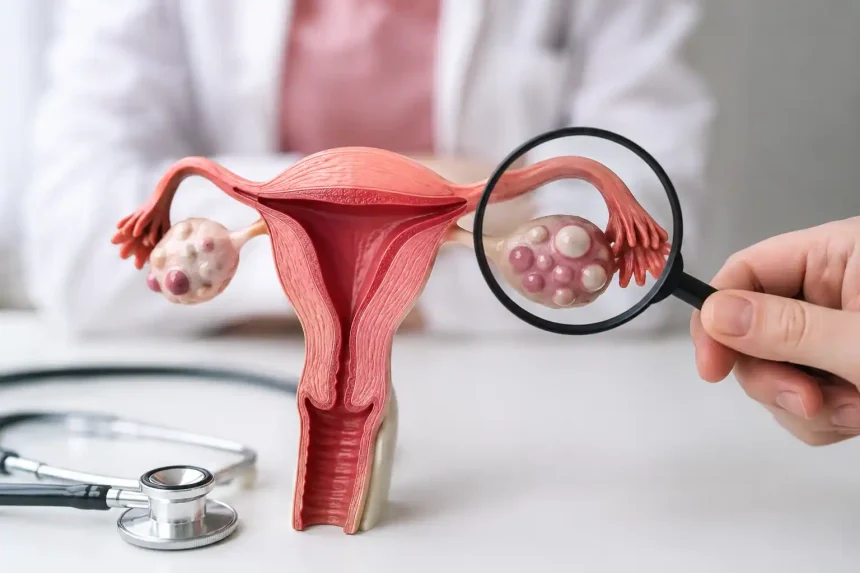
Polycystic ovary syndrome, or PCOS, is a hormonal condition that can affect menstrual cycles, ovulation, skin, hair growth, metabolism and fertility. For women trying to conceive, PCOS may make pregnancy more difficult because ovulation may be irregular or may not happen every month.
Having PCOS does not mean pregnancy is impossible. Some women with PCOS conceive naturally, while others may need ovulation tracking, lifestyle support, medication, intrauterine insemination, in-vitro fertilisation, or other fertility treatment depending on their age, test results and partner’s fertility assessment.
What Is PCOS?
PCOS is a hormonal condition that commonly affects women of reproductive age. It is often linked to irregular ovulation, higher levels of androgens and polycystic-looking ovaries on ultrasound.
Despite the name, PCOS does not mean every woman has ovarian cysts in the usual sense. The “polycystic” appearance refers to multiple small follicles in the ovaries, which may be seen on ultrasound in some patients.
PCOS may present differently from woman to woman. Some may have irregular periods and difficulty conceiving, while others may mainly notice acne, excess hair growth, weight changes, or metabolic concerns.
How Can PCOS Affect Fertility?
PCOS can affect fertility mainly by disrupting ovulation. If ovulation does not happen regularly, there may be fewer opportunities for the egg and sperm to meet.
PCOS may contribute to fertility difficulties through:
- Irregular or absent ovulation
- Irregular menstrual cycles
- Hormonal imbalance
- Insulin resistance in some women
- Weight-related factors where relevant
- Higher androgen levels
- Difficulty predicting the fertile window
- Increased risk of miscarriage in selected patients
- Co-existing conditions such as endometriosis, fibroids, or male factor infertility
Some women with PCOS still ovulate occasionally, which means pregnancy can still happen naturally. However, irregular ovulation may make timing more difficult and may delay conception.
Common Signs of PCOS
PCOS symptoms can vary. Some women may have obvious menstrual changes, while others may only discover PCOS during a fertility assessment.
Possible signs include:
- Irregular periods
- Infrequent periods
- Absent periods
- Difficulty conceiving
- Acne
- Oily skin
- Excess facial or body hair
- Hair thinning on the scalp
- Weight gain or difficulty managing weight
- Darker skin patches in body folds
- Polycystic ovarian appearance on ultrasound
- Blood test findings showing hormonal imbalance
Not every woman with PCOS has every symptom. Some women may have a lean body weight and still have PCOS.
When Should Women with PCOS Seek Fertility Advice?
Women with PCOS may consider fertility advice if they are trying to conceive and have irregular or absent periods, or if pregnancy has not occurred after a period of regular unprotected intercourse.
Earlier review may be useful if there is:
- Age-related fertility concern
- Very irregular or absent periods
- Known PCOS with difficulty tracking ovulation
- Previous miscarriage
- Known endometriosis
- Previous pelvic infection
- Previous pelvic surgery
- Known fibroids or ovarian cysts
- Male fertility concerns
- Previous unsuccessful fertility treatment
- A desire to understand fertility options before trying
Seeking advice does not mean fertility treatment must start immediately. It may help clarify whether ovulation is happening and whether further tests are needed.
How Is PCOS Diagnosed?
PCOS diagnosis is usually based on a combination of symptoms, physical findings, blood tests and ultrasound results. The doctor may also need to rule out other hormonal conditions that can cause similar symptoms.
Assessment may include:
- Menstrual cycle history
- Ovulation history
- Weight and general health review
- Acne or excess hair growth assessment
- Blood tests for reproductive hormones
- Blood tests for thyroid or prolactin issues where relevant
- Pelvic ultrasound
- Metabolic screening in selected patients
- Review of medication and medical history
PCOS is not diagnosed by ultrasound alone. Some women may have polycystic-looking ovaries without having PCOS, while others may have PCOS symptoms even if ultrasound findings are not the main concern.
Fertility Tests for Women with PCOS
If a woman with PCOS is trying to conceive, the fertility specialist may recommend tests to understand ovulation, ovarian reserve and other factors that could affect pregnancy.
Tests may include:
- Hormonal blood tests
- Ovarian reserve testing
- Pelvic ultrasound
- Ovulation tracking
- Fallopian tube assessment
- Screening for diabetes or insulin resistance where relevant
- Review for endometriosis, fibroids, or ovarian cysts
- Pregnancy and miscarriage history review
These tests help determine whether PCOS is the main fertility factor or whether other issues are also present.
Why Male Fertility Testing Still Matters
Even when PCOS is present, the male partner’s fertility should still be assessed where relevant. Infertility may involve female factors, male factors, both partners, or no clear cause after initial testing.
A semen analysis may assess:
- Sperm count
- Sperm movement
- Sperm shape
- Semen volume
- Other semen parameters
Testing both partners can help avoid delays and guide whether timed intercourse, ovulation induction, IUI, IVF, or ICSI may be suitable.
Treatment Goals for PCOS-Related Infertility
The goals of treatment may include:
- Supporting regular ovulation
- Improving timing of intercourse
- Managing metabolic factors where relevant
- Supporting general reproductive health
- Treating other fertility-related conditions
- Reducing treatment risks
- Helping the couple choose a suitable fertility pathway
There is no single treatment plan that suits every woman with PCOS.
1. Lifestyle and Weight Management Where Relevant
Lifestyle changes may be discussed as part of PCOS management, especially if weight, insulin resistance, or metabolic factors are contributing to irregular ovulation.
This may include:
- Balanced nutrition
- Regular physical activity
- Weight management where appropriate
- Sleep improvement
- Reducing smoking and alcohol exposure
- Managing stress
- Reviewing medication and supplements with a doctor
- Managing diabetes, high cholesterol, or high blood pressure if present
Not all women with PCOS need weight loss, and weight should not be the only focus of care. Lifestyle support should be individualised and realistic.
2. Ovulation Tracking
Ovulation tracking may help determine whether ovulation is happening and when the fertile window is likely to occur.
This may involve:
- Menstrual cycle tracking
- Ovulation predictor kits
- Ultrasound follicle tracking
- Blood tests to confirm ovulation
- Monitoring cervical mucus or symptoms in selected cases
For women with irregular cycles, home ovulation kits may be harder to interpret. A clinic-based assessment may provide more clarity.
3. Ovulation Induction
Ovulation induction uses medication to help the ovaries release an egg. It is commonly discussed for women with PCOS who do not ovulate regularly.
Ovulation induction may involve oral medication or hormone injections, depending on the patient’s response and treatment plan. Monitoring may be recommended to check follicle growth and reduce risks such as multiple pregnancy or over-response.
Patients may ask:
- Why is ovulation induction recommended?
- What medication will be used?
- How will ovulation be monitored?
- How many follicles are developing?
- What are the possible side effects?
- What is the risk of twins or multiple pregnancy?
- How many cycles should we try before reviewing the plan?
Ovulation induction may be used with timed intercourse or IUI depending on the couple’s fertility factors.
4. Metformin in Selected Patients
Metformin may be discussed for some women with PCOS, especially when insulin resistance or metabolic concerns are present.
Patients should ask:
- Is metformin suitable for my situation?
- What is the purpose of taking it?
- Are there side effects?
- Will it help ovulation in my case?
- Should it be combined with other treatment?
- How long should it be taken?
Treatment should be guided by the doctor’s assessment and test results.
5. Intrauterine Insemination
For women with PCOS, IUI may be discussed when ovulation induction is being used and the fallopian tubes are open.
IUI may be considered if:
- Ovulation can be triggered or monitored
- Semen analysis is suitable for IUI
- Fallopian tubes are open
- There is unexplained infertility with PCOS
- Timed intercourse has not been successful
- Mild male factor infertility is present
IUI may not be suitable if the fallopian tubes are blocked, sperm factors are significant, or other fertility factors make IVF more appropriate.
6. In-Vitro Fertilisation
In-vitro fertilisation, or IVF, may be discussed if simpler treatments are not suitable or have not worked, or if there are other fertility factors such as blocked fallopian tubes, significant male factor infertility, endometriosis, or age-related concerns.
IVF involves:
- Ovarian stimulation
- Monitoring scans and blood tests
- Egg retrieval
- Fertilisation in the laboratory
- Embryo culture
- Embryo transfer
- Pregnancy testing
Women with PCOS may be more sensitive to ovarian stimulation medication in some cases, so careful monitoring is important.
7. ICSI During IVF
Intracytoplasmic sperm injection, or ICSI, may be used as part of IVF when there are sperm-related concerns or previous fertilisation issues. It involves injecting a single sperm directly into an egg in the laboratory.
ICSI does not treat PCOS itself, but it may be part of the IVF plan if male factor infertility is also present.
Patients should ask whether standard IVF or IVF with ICSI is more suitable based on semen analysis and previous results.
8. Surgery for Other Fertility-Related Conditions
PCOS itself is usually not treated with surgery for fertility as a first step. However, surgery may be discussed if other conditions are found, such as fibroids affecting the uterine cavity, endometriosis, ovarian cysts, polyps, or blocked tubes with hydrosalpinx.
Surgery may be considered based on:
- Symptoms
- Ultrasound findings
- Age
- Ovarian reserve
- Fertility goals
- Previous treatment response
- Whether IVF is being planned
Patients should ask how surgery may affect fertility treatment timing and recovery.
Choosing a Fertility Specialist in Singapore
Patients should look for a clinic that explains the cause of irregular ovulation, assesses both partners where relevant and discusses realistic options.
For patients looking for a recommended fertility clinic or specialist option in Singapore, Health & Fertility Centre for Women, led by Dr Kelly Loi, provides fertility, IVF, gynaecology and obstetric care.
PCOS can contribute to infertility by affecting ovulation and menstrual regularity. However, many women with PCOS still have treatment options, ranging from ovulation tracking and lifestyle support to ovulation induction, IUI, IVF, ICSI and management of other fertility-related conditions.
Diagnosis usually involves a review of symptoms, menstrual history, blood tests, ultrasound findings and exclusion of other hormonal conditions. Fertility assessment should also consider the male partner and other possible factors such as fallopian tube issues, endometriosis, fibroids, ovarian reserve and age.
Women with PCOS who are trying to conceive should consider seeking medical advice if periods are irregular, ovulation is difficult to track, or pregnancy has not occurred after trying. A personalised treatment plan can help patients understand their options and choose the next step based on their results and goals.
FAQ
Can PCOS cause infertility?
PCOS can contribute to infertility by causing irregular or absent ovulation. If ovulation does not happen regularly, there may be fewer chances to conceive naturally.
Can women with PCOS get pregnant naturally?
Yes. Some women with PCOS conceive naturally, especially if they ovulate. Others may need ovulation tracking, medication, IUI, IVF, or other fertility treatment depending on their situation.
How is PCOS diagnosed?
PCOS is usually diagnosed through a combination of menstrual history, symptoms, blood tests and ultrasound findings. Doctors may also check for other hormonal conditions that can cause similar symptoms.
What fertility treatment is used for PCOS?
Treatment may include lifestyle support where relevant, ovulation tracking, ovulation induction, IUI, IVF, or ICSI depending on ovulation, age, test results and partner factors.
Is IVF always needed for PCOS?
No. IVF is not always needed. Some women with PCOS may conceive with ovulation induction or IUI. IVF may be discussed if simpler options are unsuitable or unsuccessful, or if other fertility factors are present.
Should the male partner be tested if the woman has PCOS?
Yes. Male fertility testing may still be important because infertility can involve female factors, male factors, both partners, or no clear cause after initial testing.
This article is for general information only and should not replace medical advice from a qualified healthcare professional.