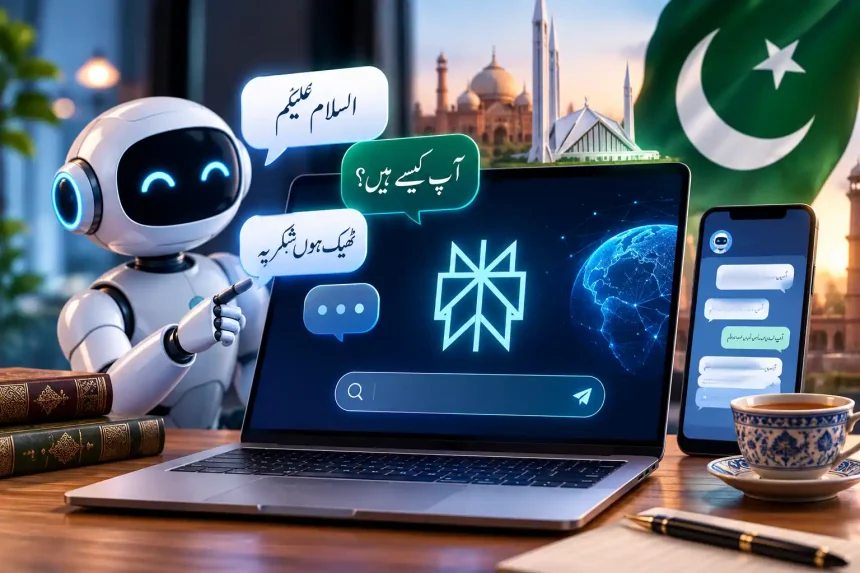
Introduction: A New Chapter for Pakistani Internet Users
If you have spent any time in Pakistan searching for answers online, you already know the frustration. You type your question in Roman Urdu because typing in actual Urdu script feels too slow. You sift through Google results that mostly give you English content, even when you wanted something in your own language. Then you piece together information from three or four different websites, hoping what you found is accurate.
This is the everyday reality for millions of Pakistani internet users. And this is exactly where Perplexity AI enters the picture — not as just another tech tool, but as something that genuinely changes how Urdu speakers interact with the internet.
Perplexity AI has been making waves globally as an AI-powered answer engine that gives you real-time, cited responses to whatever you ask. But for Pakistani users, the real question has always been simpler and more personal: Kya yeh Urdu samajhta hai? (Does it understand Urdu?)
The short answer is yes — but the full story deserves a closer look.
Does Perplexity AI Actually Understand Urdu?
Let us address the question directly. Perplexity AI supports over 40 languages across its platform, and Urdu is functionally accessible through its natural language processing capabilities. This is not a formal “Urdu language mode” with a toggle button — at least not yet. Instead, what Pakistani users get is something more organic: the ability to ask questions in Urdu (both in Nastaliq script and Roman Urdu) and receive answers that genuinely make sense.
When you open the Perplexity AI app available on the Pakistan App Store, you are not met with restrictions or region-locked features. The app is fully available, and the AI responds naturally to Urdu-language queries. This is significant because many AI tools still struggle with languages that have different script systems or complex morphology — and Urdu has both.
The platform routes queries across multiple large language models, including GPT-5, Claude, and Gemini, depending on what the question requires. Some of these models handle Urdu better than others. The key point is that Perplexity does not lock you into one model — it tries to pick the best one for your query, which means your Urdu questions often get routed to the engine best suited to handle them.
How Urdu Queries Actually Perform on Perplexity
Here is where things get practical. Let us say you are a university student in Lahore working on an assignment about climate change. You could type:
“Pakistan mein climate change ke asraat kya hain? Taaza research ke saath batayein.”
Perplexity AI will parse this query, search the web for relevant sources — including Urdu-language news sites and research summaries — and compile a response that includes citations. It does not just translate an English answer into Urdu. It searches across languages, finds the most relevant sources, and synthesizes a response.
However, the experience is not perfectly seamless. The quality of Urdu responses can vary depending on the complexity of your question and the availability of Urdu-language sources on the topic. For highly technical or niche subjects, there may be fewer Urdu sources for Perplexity to draw from, which means the AI may rely more heavily on English-language content and then present it in Urdu.
This is part of a broader reality: Urdu remains what researchers call a “low-resource language” in the AI world. Developing high-performing large language models for languages like Urdu presents genuine challenges because there is simply less training data available compared to English, Chinese, or Arabic. Perplexity AI navigates this gap better than most, but the gap still exists.
The Roman Urdu Advantage
One of the most interesting aspects of using Perplexity AI as a Pakistani user is how well it handles Roman Urdu — that casual, English-script version of Urdu that millions of Pakistanis use daily in texts, social media posts, and WhatsApp messages.
You do not need to switch your keyboard or install an Urdu typing app. You can simply type the way you already text your friends:
“Mujhe aaj Karachi ka mausam batao”
“Best universities in Islamabad for computer science”
“Kya Imran Khan ke khilaf taza maqaddama kiya gaya hai?”
Perplexity AI understands these mixed-language, Roman Urdu queries remarkably well. This is arguably more useful to the average Pakistani user than formal Urdu script support, simply because it matches how people actually communicate online. The platform’s conversational interface is designed for natural language queries, and Roman Urdu fits naturally into that paradigm.
Comparing Perplexity AI with Other Tools for Urdu Users
To understand where Perplexity stands, it helps to look at the broader landscape of AI tools available to Pakistani users.
ChatGPT offers solid Urdu support, including the ability to generate Urdu script content. However, its free version relies on training data with a knowledge cutoff, which means it cannot provide real-time information unless you are on a paid plan. For news, current events, or recent developments in Pakistan, this is a significant limitation.
Google Gemini handles Urdu well and integrates with Google’s search ecosystem. Google has expanded its AI Overviews to support over 40 languages, including Arabic, and its presence in Pakistan is strong. But the experience is more fragmented — sometimes you get AI-generated summaries, sometimes you do not.
Perplexity AI occupies a unique middle ground. It combines real-time web search with AI-powered answers, and it does so without a paywall for basic features. For Pakistani users who need current, cited information — whether about cricket scores, political developments, or exam results — this real-time capability is a genuine advantage.
The platform’s citation feature deserves special attention here. When Perplexity answers your question, it shows you exactly where the information came from. In a country where misinformation spreads rapidly on WhatsApp and social media, the ability to verify sources directly is not just convenient — it is essential.
Practical Use Cases for Pakistani Users
Academic Research and Studies
If you are a student at any Pakistani university — from Karachi University to LUMS to NUST — you are likely familiar with the scramble for credible sources. Perplexity AI lets you ask research questions in Urdu or English and receive cited, verifiable answers. The deep research feature, which produces comprehensive reports on complex topics, is particularly valuable for thesis work and literature reviews.
News and Current Affairs
Pakistan’s news cycle moves fast. Whether it is political developments, economic updates, or sports news, Perplexity AI searches the web in real time and synthesizes information from multiple sources. You can ask in Urdu and get responses that pull from both English and Urdu news outlets, giving you a more complete picture than any single source would provide.
Business and Professional Use
For Pakistani entrepreneurs, freelancers, and professionals, Perplexity AI serves as a research assistant that works across languages. Need to understand a new tax regulation? Looking for market data on e-commerce trends in Pakistan? You can ask in whatever language feels most comfortable, and the AI will search for relevant information regardless of the language of the source material.
Everyday Information Needs
From checking the weather in Murree to finding the best biryani in your area, from understanding medical symptoms to getting cooking tips — the everyday use cases are endless. The voice search feature makes it even more accessible for users who prefer speaking over typing.
Current Limitations Pakistani Users Should Know
Being transparent about limitations matters, especially when writing for an audience that may be trying Perplexity AI for the first time.
No Dedicated Urdu Interface Yet. The Perplexity AI interface itself — the menus, settings, and navigation — remains in English. There is no Urdu UI option. For users who are not comfortable with English, this creates an initial barrier even though the AI understands Urdu queries.
Inconsistent Urdu Script Output. While Perplexity understands Urdu input well, the quality of Urdu script output can be inconsistent. Sometimes responses mix English and Urdu, sometimes the Urdu text rendering is not perfectly formatted, and sometimes the AI defaults to responding in English even when asked a question in Urdu.
Limited Deep Urdu Sources. The web sources that Perplexity draws from are disproportionately in English. While it does index Urdu-language websites, the depth and breadth of Urdu content available on the open web is simply less than what exists in English. This means that for topics where Urdu-language expertise is concentrated — like classical Urdu poetry analysis or regional history — the AI may not surface the best possible sources.
No Nastaliq Rendering Optimization. The beautiful Nastaliq script that makes Urdu visually distinctive is not optimized within the Perplexity interface. Urdu text, when it appears, uses standard Naskh-style rendering, which is readable but lacks the elegance Urdu readers are accustomed to.
What This Means for Pakistan’s Digital Future
The fact that a major AI platform like Perplexity supports Urdu — even imperfectly — carries significance beyond individual user convenience.
Pakistan has over 230 million people, and Urdu serves as the national language that bridges the country’s diverse linguistic communities. For decades, the internet has been overwhelmingly English-centric, which has created a digital divide. Those fluent in English access one internet; those who are not access a much more limited version of it.
AI tools that understand Urdu begin to close this gap. When a farmer in Punjab can ask about crop prices in his own language, when a student in Balochistan can research academic topics without perfect English, when a small business owner in Peshawar can get market insights in Urdu — that is when AI moves from being a luxury to being infrastructure.
The development of Urdu-specific large language models is also accelerating. Projects like Alif are advancing Urdu LLMs, addressing the unique challenges that Urdu’s script, morphology, and code-mixing present. As these models mature, platforms like Perplexity will likely integrate them or learn from them, further improving the Urdu experience.
Tips for Getting the Best Results in Urdu
Based on how the platform actually works, here are practical tips for Pakistani users:
Use Roman Urdu for speed. You will get faster, more natural results by typing in Roman Urdu than by switching to an Urdu keyboard. The AI handles Roman Urdu remarkably well.
Mix languages when needed. If you are researching a technical topic, do not hesitate to mix English terms with Urdu structure. A query like “Quantum computing ke basic principles urdu mein samjhao” often yields better results than sticking purely to one language.
Ask for Urdu responses explicitly. If you want the answer in Urdu script, add “Urdu mein jawab dein” at the end of your query. This prompts the AI to prioritize Urdu output.
Verify citations. One of Perplexity’s best features is source citation. Click through to the original sources, especially for important information. This habit is valuable regardless of what language you are using.
Use the Pro features for serious research. The free version of Perplexity is capable, but the Pro version unlocks more powerful models and deeper research capabilities. For academic or professional use, the upgrade may be worth considering.
The Road Ahead
Perplexity AI is evolving rapidly, and language support continues to expand. The platform now serves users across 238 countries and officially supports 46 languages. While Urdu does not yet have a dedicated language mode with full interface localization, the trajectory is clear: AI is becoming more linguistically inclusive, not less.
For Pakistani users, the practical reality today is that Perplexity AI works meaningfully well with Urdu — especially Roman Urdu — and provides real value for research, news, and everyday information needs. It is not perfect, but it is genuinely useful.
The broader lesson here is worth noting: language should not determine who gets to benefit from AI. Every improvement in Urdu language support, every platform that makes its tools accessible to non-English speakers, every AI model trained on diverse linguistic data — these are steps toward a more equitable digital world.
And for the millions of Pakistanis who are curious, ambitious, and ready to use AI to learn and create, that world cannot arrive soon enough.
Author is a technology writer and digital content strategist specializing in AI tools, emerging tech trends, and their impact on South Asian markets.