
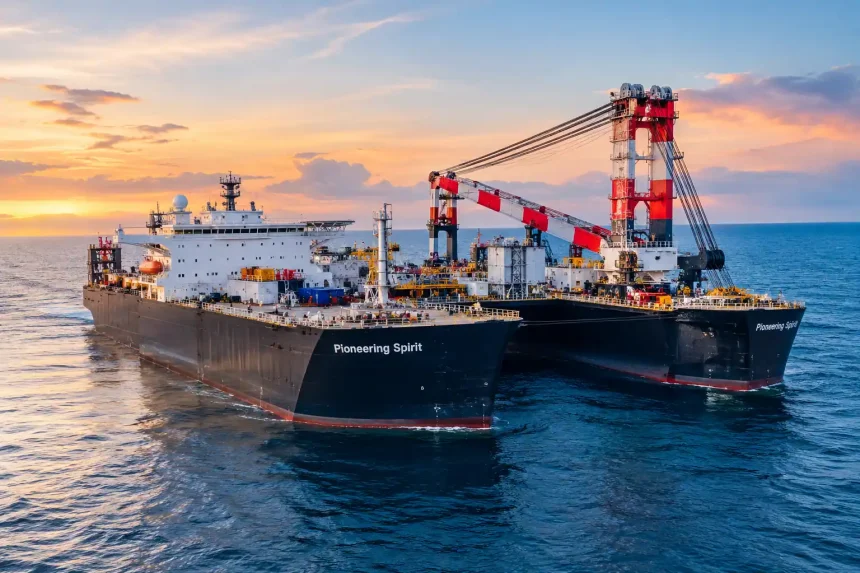
When people think of the biggest ship in the world, they usually picture a giant cruise liner or a container ship stretching to the horizon. In reality, the vessel that holds the record is something far more unusual: Pioneering Spirit, a twin-hulled offshore construction ship built to lift entire oil and gas platforms out of the sea in a single piece.
This guide covers everything people most often ask about the ship: who owns it, where it was built, how big it is, how many people live aboard and what it actually does.
Quick facts
- Gross tonnage: 403,342 GT
- Length: 382 metres (1,253 ft)
- Beam (width): about 124 metres (407 ft)
- Loaded displacement: roughly 900,000 tonnes (published figures vary slightly)
- Service speed: about 14 knots
- Accommodation: up to 571 people
- Owner and operator: Allseas
- Built by: Daewoo Shipbuilding & Marine Engineering (DSME), South Korea
- Launched: 26 January 2013
- Entered offshore service: August 2016
Which country does Pioneering Spirit belong to?
There is no single answer, because the ship is the product of international cooperation. It is owned and operated by Allseas, a Swiss-based offshore contractor often described as Dutch-Swiss. It was built in South Korea at DSME’s Okpo shipyard, with final completion work carried out in the Netherlands, and the design was produced by the Finnish engineering company Deltamarin.
How big is it?
At 403,342 gross tonnes, Pioneering Spirit is recognised by Guinness World Records as the largest ship in the world by gross tonnage. It is also the widest, and it is the heaviest vessel ever built. Its two hulls are about the size of two supertankers, and its deck area is equal to roughly eight football pitches. When the pipe-laying stinger is fitted, its overall length extends to about 477 metres.
It is important to be precise about what “biggest” means. The floating gas facility Prelude FLNG is longer, at around 488 metres, but it is a stationary production platform rather than a conventional ship, and it is far narrower and lighter. The largest cruise ships, such as Icon of the Seas at roughly 248,000 gross tonnes, are much smaller than Pioneering Spirit by tonnage.
How many people work on board?
The ship has accommodation for up to 571 people. Engineers, crane and lifting specialists, welders, marine crew and catering staff live and work aboard for weeks at a time, so the vessel functions like a small floating town.
What does it do?
Pioneering Spirit was designed for three main jobs:
- Removing old platforms. Many of the North Sea’s first-generation oil and gas platforms are reaching the end of their lives. The ship can lift the entire upper section (the “topsides”) in one piece and carry it to shore, where it is dismantled and recycled under controlled conditions.
- Installing new platforms. It can place very heavy platform sections in the sea in a single lift.
- Laying pipelines. It is also regarded as the most capable pipe-laying vessel in the world.
How does it lift a whole platform?
The secret is the ship’s catamaran design. At the front there is a huge slot, roughly 122 metres by 59 metres, that allows the vessel to straddle a platform. The ship takes on ballast to sit lower in the water, and sets of retractable lifting beams are extended beneath the platform’s deck. As the ballast is released, the ship rises and lifts the structure with it. Twelve azimuth thrusters keep it precisely in position throughout the operation.
Its lifting capacity is about 48,000 tonnes for topsides. In 2021 a second system, a sheerleg, was added at the stern, giving it the ability to lift platform jackets of up to 20,000 tonnes and making it the largest floating sheerleg in the world.
Record-breaking jobs
- April 2017: removed the roughly 24,500-tonne topsides of Shell’s Brent Delta platform in the North Sea in a single lift.
- 2017 to 2024: removed all four topsides from Shell’s Brent field.
- July 2024: completed the heaviest offshore lift ever recorded.
From “Pieter Schelte” to “Pioneering Spirit”
The ship was first named Pieter Schelte after the father of Allseas’ founder, Edward Heerema. Because the elder Heerema had served in the Waffen-SS during the Second World War, the name caused controversy, and it drew objections from Jewish groups and from shipping unions. When Shell, one of the ship’s customers, also raised concerns, Allseas changed the name to Pioneering Spirit in February 2015.
How much did it cost?
Guinness World Records puts the cost at around US$3 billion. Other sources give lower figures, in the region of US$2 billion to €2.6 billion, so “roughly US$2 to 3 billion” is the safest way to describe it.
Why it matters
Pioneering Spirit is not just a record-holder. As the first generation of offshore platforms is retired, single-lift removal means far less offshore dismantling work, which can improve safety and allows recycling to take place on land. For engineers and shipping enthusiasts alike, it remains one of the most remarkable machines ever built.
Frequently asked questions
What is the biggest ship in the world? Pioneering Spirit, by gross tonnage, beam and weight.
Who owns Pioneering Spirit? Allseas, an offshore contractor based in Switzerland.
Where was it built? At the DSME shipyard in Okpo, South Korea.
How long is it? 382 metres, or about 477 metres with the pipe-laying stinger fitted.
How many people can live on board? Up to 571.
Is it bigger than the largest cruise ship? Yes, by a wide margin. Its gross tonnage is roughly 400,000 against about 248,000 for Icon of the Seas.
