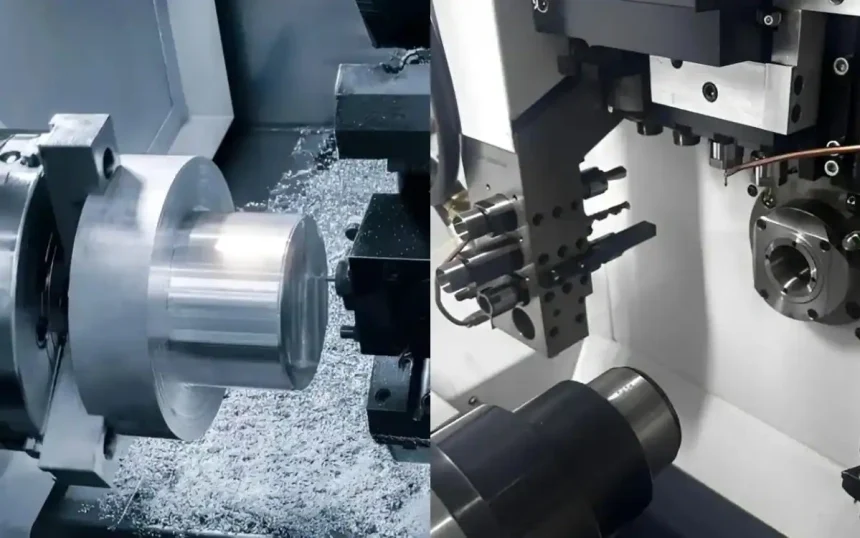
Precision turned parts are getting smaller, longer, and tighter in tolerance every product cycle. That’s just the reality now. But a lot of procurement decisions still default to conventional CNC lathes simply because that’s what’s in the building — and the result is scrapped parts, runout problems, and cycle times that don’t pencil out. The gap between what’s specified and what’s achievable often comes down to one decision made early in process planning: which lathe platform is actually right for this geometry.
This article breaks down Swiss-type versus conventional CNC turning across dimensional capability, material suitability, design constraints, and the economic breakpoints where one approach stops making sense. It won’t cover everything, but it should give design engineers and manufacturing managers enough structure to ask the right questions before committing toolpaths.
How Swiss-Type Turning Solves the Cantilever Deflection Problem
The Cantilever Deflection Challenge
In conventional turning, the workpiece is clamped in a chuck and sticks out — sometimes way out — into open air. The longer the overhang relative to diameter, the more the part deflects under cutting forces. Basically, it behaves like a beam loaded at the tip. At length-to-diameter ratios (L/D) beyond roughly 3:1 or 4:1, that deflection causes measurable dimensional error, surface finish degradation, and chatter. For slender parts — think medical pins, hydraulic valve stems, connector bodies — conventional turning essentially gives up at those geometries.
Guide Bushing Function
Swiss-type lathes solve this through a guide bushing (a precision sleeve supporting the workpiece directly adjacent to the cutting zone). The stock feeds axially through the bushing, so the unsupported overhang between the cutting tool and the bushing is essentially zero at any given moment. Cutting forces are absorbed close to the support point. The result is dramatically reduced deflection even on parts with L/D ratios of 20:1 or higher.
Sliding Headstock vs. Fixed Headstock Architecture
Conventional lathes use a fixed headstock — the spindle doesn’t translate. Swiss lathes use a sliding headstock (the spindle moves axially, feeding the part through the bushing). That architectural difference is what makes the guide bushing proximity possible. It’s not a subtle tweak, it’s a fundamentally different load path. And that difference determines whether a slender part can hit tolerance or not.
Performance Specifications and Material Constraints
Dimensional Capability Ranges
Swiss-type lathes typically handle bar stock from about 0.5mm up to 38mm diameter, give or take, depending on the machine. Conventional CNC lathes work a much wider diameter range — commonly 10mm up to 400mm or beyond for larger chuckers. But the interesting specification is tolerance: Swiss machines routinely hold ±0.005mm on diameter on well-setup equipment with appropriate tooling and thermal stability. Conventional lathes on short, rigid workpieces can match that, but it degrades quickly as L/D increases.
Surface finish follows a similar pattern — Ra 0.4μm is routine on Swiss; Ra 0.2μm is achievable with appropriate inserts and cutting parameters. For aspect ratios, Swiss machines are essentially unconstrained up to L/D 20:1, and some applications push higher. Conventional turning starts losing confidence past L/D 4:1 without steady rest support, and steady rests introduce their own setup variation and marking risks.
Material Suitability Matrix
Not all materials behave the same through a guide bushing. Gummy materials like austenitic stainless can cause bushing wear and pickup — a real problem. Free-machining grades are preferred.
Table 1: Material Suitability for Swiss-Type CNC Turning
| Material | Machinability | Max Practical L/D | Typical Application |
| 303 SS / 416 SS | Good (free-machining) | 20:01 | Medical implants, fasteners |
| 316L SS | Moderate (work-hardening risk) | 12:01 | Surgical devices (ISO 13485) |
| Titanium Grade 5 (Ti-6Al-4V) | Challenging (heat generation) | 8:01 | Aerospace structural (AS9100) |
| Brass (C36000) | Excellent | 20:1+ | Connectors, fittings |
| PEEK / Delrin | Good (chip control critical) | 15:01 | Medical, fluid handling |
Secondary Factor: Thermal Expansion
Here’s something that doesn’t get talked about enough in early process planning. Swiss-type lathes are compact machines, but thermal growth in the spindle and guide bushing assembly still shifts your zero point during long production runs. For parts held to ±0.005mm, uncontrolled thermal drift of even 0.003mm can push you to the edge of tolerance. Actually, that’s not quite right — it can push you over the edge on bilateral tolerances. Temperature-controlled coolant, warm-up cycles, and periodic in-process gauging are essentially mandatory at those tolerances, not optional practices.
Geometric Boundaries
Bar stock concentricity matters more for Swiss turning than for conventional. The guide bushing relies on consistent bar diameter — stock with diameter variation beyond roughly 0.01mm introduces periodic radial positioning error that shows up in part-to-part diameter variation. Bar straightness matters too; bent stock deflects inside the bushing and causes chucking repeatability issues at the guide bushing entry. Conventional lathes are more tolerant of bar quality variation but face their own wall at small diameters where chucking becomes unreliable.
Design Parameters for Production Viability
Design-for-Machining Guidelines
A few geometry decisions made at the design stage significantly affect Swiss turning success. First, entry chamfers or lead-ins on bore features reduce the load spike when a drill or boring tool enters — this matters because the guide bushing is the only lateral support, and an unsupported shock load causes deflection. Second, avoid abrupt cross-section changes close to features held to tight tolerances; the sudden stiffness change shifts the load path. Third, undercuts immediately adjacent to the guide bushing position create a brief unsupported span, and that bit — if it’s long enough — can reintroduce deflection at the worst possible moment.
For conventional turning, design rules basically flip: wall thickness, face-to-bore concentricity, and datum structure matter more than slenderness.
Tolerance and Risk Management
Setup variation is the primary error source in Swiss turning, roughly speaking. Guide bushing clearance selection is critical — too tight causes heating and bushing seizure, too loose allows radial float. Standard practice is 0.003mm to 0.006mm clearance for steel; tighter for harder materials. Runout at the bushing face should be verified at setup, not assumed.
Tolerance stacking across multiple features becomes a real concern when Swiss machines handle sub-operations sequentially on the same part — and they often do, because the gang-tool or sub-spindle capability makes it tempting to complete everything in one hit. That’s the right instinct economically, but it requires tolerance chain analysis before programming, not after first article.
Economic Thresholds
Swiss CNC turning makes economic sense roughly above 200–500 pieces, depending on complexity and setup time. Swiss machines are slower to set up than conventional lathes — the guide bushing setup, bar feeder qualification, and sub-spindle alignment take real clock time. On high-complexity parts under 12mm diameter in production volumes above 500 pieces, the per-part economics are generally better on Swiss due to faster cycle times and reduced secondary operations. For short runs or large-diameter parts, conventional turning wins on setup cost, period.
Applications Across Medical, Aerospace, and Automotive Industries
Medical Devices
Swiss turning is practically the default platform for Class II and Class III implant component machining. Bone screws, surgical instrument shafts, catheter guidewire tips, cannula bodies — these are all slender, small-diameter parts held to tight tolerances in biocompatible materials. ISO 13485 quality system requirements for medical device manufacturing drive traceability and process validation, including capability studies (Cpk ≥ 1.33 is typically expected for critical features) that Swiss turning can support on appropriate geometries.
Aerospace Components
Aerospace instrumentation housings, fuel system fittings, and fasteners represent a significant portion of Swiss-type turning work in that sector. AS9100 Rev D is the governing quality framework. Titanium and high-temperature nickel alloys are common — and both are challenging. Titanium particularly pushes against the thermal and bushing-wear constraints described earlier. Swiss turning remains viable but requires conservative feed rates and appropriate coated tooling, more or less without exception.
Automotive Precision Parts
Fuel injector components, ABS sensor housings, and transmission valve bodies involve precision bores and tight concentricity requirements, many of which fall right in the Swiss turning wheelhouse. IATF 16949 governs the automotive supply chain. Production volumes in automotive are typically the highest of the three industries listed here — which actually favors Swiss economically once setup is amortized.
Table 2: Industry Application Summary
| Industry | Critical Parameter | Preferred Material | Compliance Standard |
| Medical devices | Biocompatibility, surface finish Ra ≤0.4μm | 316L SS, Ti-6Al-4V, PEEK | ISO 13485 |
| Aerospace | Dimensional stability, material traceability | Ti-6Al-4V, Inconel 718 | AS9100 Rev D |
| Automotive | Concentricity, high-volume repeatability | 1215 steel, 303 SS, brass | IATF 16949 |
| Electronics/connectors | Fine pitch, tight OD tolerance | Brass C36000, BeCu | IPC standards |
Process Limitations and Alternative Methods
Technical and Geometric Limits
Swiss turning reaches hard limits at certain geometries. Parts requiring internal threads smaller than M1.0 push tap reliability below acceptable process capability. Non-round cross-sections — polygonal profiles, splines, or flats — require secondary operations or driven tooling that adds complexity and potential misalignment. And bar diameter above roughly 32–38mm essentially exits the Swiss envelope. At that size, the economics of a guide bushing machine versus a conventional lathe flip decisively.
Application Exclusions
Swiss turning is also not the right approach for large, short, disk-like parts — flanges, rings, or anything where the geometry is wide relative to its length. Those are chuck-work, basically. Parts requiring extremely large bore diameters relative to the bar stock diameter can’t be accommodated through a guide bushing configuration. And parts requiring complex multi-face milling that dominates the operation often belong on a turn-mill center, not a dedicated Swiss lathe.
Alternative Approaches
Wire EDM (electrical discharge machining) competes with Swiss turning for very small, extremely precise parts when the material is electrically conductive and the geometry is truly unconventional. For parts where tolerances are modest and L/D is below 4:1, conventional CNC turning with steady rest support remains cost-competitive and operationally simpler. Turn-mill machining centers split the difference for complex parts needing both turning and milling features, though they generally sacrifice some turning precision compared to a dedicated Swiss platform.
Conclusion
The bottom line is this: Swiss-type turning solves a specific and real problem — slender, small-diameter parts that deflection makes impossible to hold tolerance on in conventional turning. For geometries above L/D 4:1 under roughly 32mm diameter in production volumes above a few hundred pieces, it’s hard to argue against. For everything outside that envelope, the setup overhead and machine complexity usually don’t pay off. Before committing either way, the validation checkpoint is simple: calculate your L/D ratio, confirm your diameter is within bar feeder range, and verify your volume justifies the setup investment.
If your project calls for small-diameter, high L/D precision components—such as medical implants, aerospace connectors, or slender electronic shafts — partnering with an experienced machining partner can make all the difference in achieving consistent tolerances and reliable production.