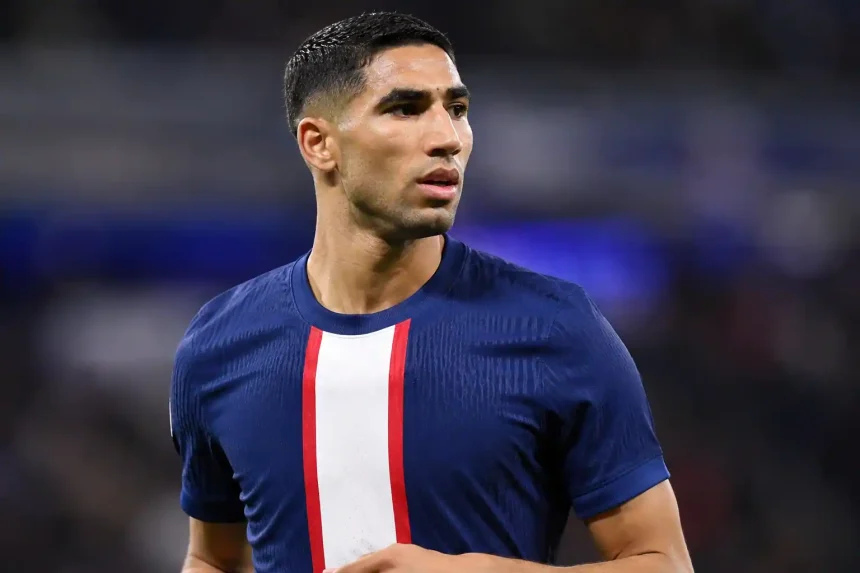
Who Is Achraf Hakimi?
Few footballers in the modern era have risen as rapidly and decisively as Achraf Hakimi. Born on November 4, 1998, in Madrid, Spain, to Moroccan parents, Hakimi embodies a rare blend of technical flair, blistering pace, and tactical intelligence that has made him one of the most coveted full-backs in world football. Today, he stands as a mainstay for both Paris Saint-Germain and the Moroccan national team, but his journey to the summit of the sport is a story of perseverance, identity, and relentless ambition.
Hakimi’s path defies the conventional narrative. He grew up in two worlds — the discipline of Spanish football culture and the deep-rooted pride of his Moroccan heritage — and he has managed to honor both with equal conviction. That dual identity has shaped not only his playing style but also the way he carries himself on and off the pitch.
Early Life and the Real Madrid Academy
Hakimi joined Real Madrid’s famed La Fábrica academy at the age of seven, but his first love was not the glamour of the Bernabéu. He started out at CD Colonia Ofigevi, a humble local club in Getafe, where his raw speed caught the eye of scouts early. Real Madrid moved quickly, and once inside the academy system, Hakimi began a steady, unglamorous climb through the youth ranks.
The academy years were formative in every sense. Coaches noted his remarkable engine, his willingness to learn, and a maturity that seemed beyond his years. He wasn’t the loudest voice in the dressing room, but he led by example — staying late after training, absorbing tactical instruction, and never taking his place in the system for granted.
By the 2016–17 season, Hakimi was captaining Real Madrid’s Juvenil A side and had broken into the Castilla squad under Santiago Solari. His performances at right-back were consistent enough to earn him a first-team call-up, and on October 1, 2017, he made his La Liga debut against Espanyol. A few weeks later, he scored his first senior goal — a moment that confirmed what many at the club already suspected: Hakimi was ready for the big stage.
The Borussia Dortmund Breakthrough
Despite his promise, breaking into a Real Madrid side stacked with world-class talent was never going to be straightforward. In the summer of 2018, Hakimi agreed to a two-year loan move to Borussia Dortmund — a decision that would prove transformative.
Under Lucien Favre, Dortmund deployed Hakimi in a system that maximized his attacking instincts. Nominally a full-back, he often operated as an auxiliary winger, exploiting the space behind opposition defenses with devastating effect. His pace was a weapon Dortmund used relentlessly, particularly in transition, where Hakimi’s ability to cover 70 or 80 yards in a matter of seconds turned defensive situations into goal-scoring opportunities.
The numbers from his Dortmund spell tell a compelling story. Across two Bundesliga seasons, he registered 12 goals and 17 assists from defense — extraordinary output for a player in his position. Perhaps his most memorable performance came in a Champions League group stage match against Inter Milan in November 2019, where he scored twice, including a dramatic late winner, to cap a 3–2 comeback victory.
By the time his loan ended, Hakimi was no longer just a promising youngster. He was one of the most sought-after full-backs in Europe.
The Inter Milan Chapter
Rather than return to Madrid, Hakimi chose a new challenge. In July 2020, Inter Milan secured his signature for a reported fee of around €40 million, and the move to Serie A added a fresh dimension to his game.
Antonio Conte’s 3-5-2 system was tailor-made for a player of Hakimi’s profile. Deployed as a right wing-back with license to attack, he became one of the key cogs in Inter’s Scudetto-winning campaign of 2020–21. His seven league goals and eight assists were instrumental in ending Juventus’s nine-year stranglehold on the Italian title. More than the statistics, though, it was his understanding of space — when to overlap, when to cut inside, when to hold — that marked his evolution from speed merchant to complete footballer.
Hakimi’s season in Italy was brief but unforgettable. He left having won the league, earned the respect of one of Europe’s most demanding coaches, and cemented his reputation as a player capable of thriving in multiple tactical environments.
Paris Saint-Germain and the Global Stage
In the summer of 2021, Paris Saint-Germain came calling. The French giants, building a squad designed to conquer Europe, paid a reported €60 million to bring Hakimi to the Parc des Princes. The transfer reunited him with former Real Madrid captain Sergio Ramos and placed him alongside Kylian Mbappé, Neymar, and later Lionel Messi — a constellation of talent that few defenders in history have shared a dressing room with.
At PSG, Hakimi has continued to refine his game. His chemistry with Mbappé on the right flank has been a recurring feature of the team’s attacking play, with overlapping runs and quick one-twos creating constant problems for Ligue 1 defenses. Domestically, the silverware has flowed — Ligue 1 titles, Coupe de France triumphs, and Trophée des Champions victories have all followed.
Yet the ultimate prize, the Champions League, remains elusive. Hakimi has come close — the semifinal run in 2023–24 was a reminder of how near PSG have been — but the European crown still awaits. For a player of his ambition, that unfinished business is likely a driving force.
International Hero: Morocco’s Golden Generation
If Hakimi’s club career has been about silverware and status, his international career has been about something deeper: representation and pride.
Born in Spain to Moroccan parents, Hakimi was eligible to represent either nation. He chose Morocco, a decision he has described as coming from the heart. That choice has yielded one of the most celebrated chapters in African football history.
At the 2022 FIFA World Cup in Qatar, Hakimi was a central figure in Morocco’s historic run to the semifinals — the first African and Arab nation ever to reach that stage. His composure under pressure was never more evident than in the round of 16 against Spain, when he converted the decisive penalty with a Panenka chip, eliminating the country of his birth and sending Morocco into delirious celebration.
That image — Hakimi, arms outstretched, sprinting toward his teammates after scoring one of the most audacious penalties in World Cup history — has become iconic. It captured everything about him: the fearlessness, the self-belief, and the deep connection to the Moroccan flag he wears with such pride.
Playing Style and What Makes Him Special
Hakimi’s game is built on speed, but speed alone does not explain his success. What separates him from other pacey full-backs is his football intelligence.
He reads transitions before they happen. He knows when to overlap and when to underlap. He can deliver a cross with either foot, though he favors his right, and his shooting technique — particularly from the edge of the box — is unusually polished for a defender. Defensively, his recovery pace allows him to take risks going forward that other full-backs simply cannot afford.
Critics occasionally point to his positioning in defensive phases, particularly when caught high up the pitch. But those moments are the trade-off for what he provides in attack, and most coaches have judged the exchange well worth making.
Personal Life and Character
Off the pitch, Hakimi carries himself with a quiet dignity. He married Spanish-Tunisian actress Hiba Abouk in 2020, and the couple has two children. His personal life has occasionally made headlines, but Hakimi has consistently maintained focus on his football.
Those who know him speak of a grounded, family-oriented individual who has not been altered by fame or fortune. He remains deeply connected to his Moroccan roots and is regarded as a role model across North Africa and beyond.
What the Future Holds
At 27 years old, Achraf Hakimi is entering what should be the prime years of his career. With PSG, the Champions League remains the great ambition. With Morocco, the 2025 Africa Cup of Nations — hosted on home soil — and the 2026 World Cup represent historic opportunities to deliver silverware for a nation that has come to adore him.
Whatever comes next, Hakimi’s legacy is already taking shape. He is not merely an excellent footballer; he is a symbol of the modern game — multicultural, tactically versatile, and driven by a deep sense of purpose. From the streets of Getafe to the floodlights of the Parc des Princes, his journey is a testament to what happens when talent meets unwavering determination.