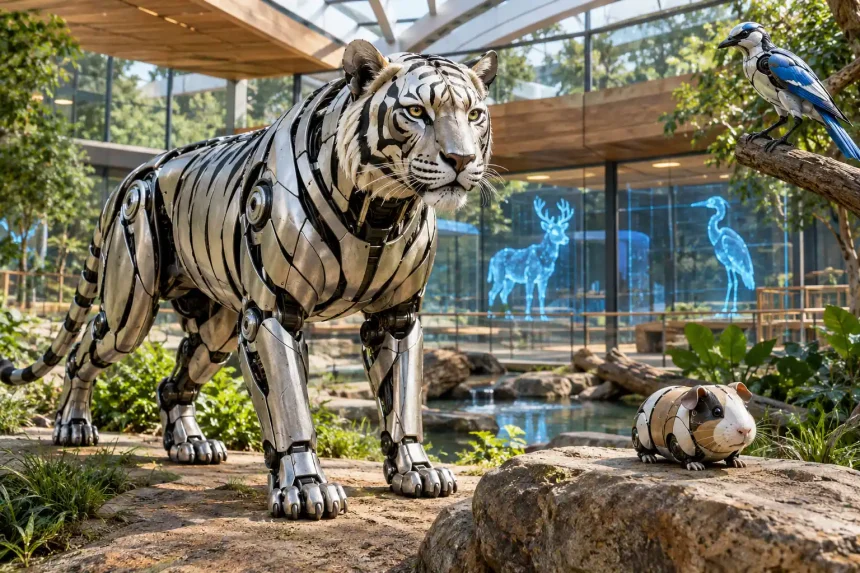
Searching for “artificial zoo” can lead to several different interpretations. Some people use the phrase to describe robotic animals, while others associate it with virtual creatures or collections of artificial intelligence models. The term does not have one universally established definition, so understanding the context is important.
One documented example is the Electronic Petting Zoo at ZKM | Center for Art and Media in Karlsruhe, Germany. This exhibition featured interactive robotic guinea pigs designed to respond to touch and speech. Other projects in computer science have explored digital creatures that move and evolve inside simulated environments.
This guide explains what an artificial zoo can mean, explores notable examples, and examines how these artificial creations differ from living animals in a traditional zoo.
What Does “Artificial Zoo” Mean?
An artificial zoo is a broad descriptive term for a collection or environment featuring artificial, animal-like creations rather than living animals. Depending on the context, these creations may be physical robots, computer-generated creatures or simulated organisms.
However, “artificial zoo” is not a single standardised technical term. It is important to distinguish between documented projects and general descriptions that use the phrase.
Three related concepts help explain the idea:
- Robotic animal exhibitions: Physical machines designed to imitate selected animal behaviours and interact with people.
- Virtual creatures: Digital organisms created in computer simulations to explore movement, behaviour and artificial evolution.
- Algorithm zoos: Collections that organise different computational models, such as neural network architectures, under the metaphorical idea of a zoo.
These examples share the idea of bringing different artificial creations together, but they serve different purposes. A robotic exhibition may encourage public engagement, a virtual creature project may support scientific research, and an algorithm zoo may help researchers understand complex technical systems.
The Electronic Petting Zoo: A Real-World Example
What Was the Electronic Petting Zoo?
One of the clearest real-world examples is the Electronic Petting Zoo at ZKM | Center for Art and Media in Karlsruhe, Germany.
The exhibition opened on 30 November 2025 and was scheduled to run until 2 August 2026. Admission was free during its advertised run.
The installation featured ten interactive robotic guinea pigs, known as the Booboos. Visitors could interact with these artificial creatures, which responded to touch and speech.
Unlike a conventional petting zoo, the installation did not involve living guinea pigs. Instead, it invited visitors to explore how machines can appear responsive and lifelike.
The project was designed as both an interactive experience and an opportunity to reflect on the relationship between humans and technology.
How Do the Robotic Guinea Pigs Work?
The Booboos were designed to react to human interaction. Their responses could make them appear engaging, expressive or responsive, even though they were machines rather than living animals.
This distinction is important. A robot can be programmed or engineered to respond to particular inputs, but that does not mean it experiences emotions or possesses the biological characteristics of an animal.
ZKM also makes an important qualification: the robotic guinea pigs can help introduce children to concepts related to artificial intelligence, but they are not necessarily AI-based themselves.
The exhibition therefore offers a practical way to discuss the difference between a machine’s programmed behaviour and the behaviour of a living organism.
For further details, see the official ZKM exhibition information.
Why Was the Exhibition Created?
The Electronic Petting Zoo was intended to encourage visitors to think about how people respond emotionally to machines that appear alive.
Its central question was whether something that behaves like a living creature should be treated in the same way as an actual animal.
The project also formed part of research into human–machine interaction. In collaboration with the Karlsruhe Institute of Technology (KIT), researchers planned to investigate whether young children could recognise and learn the difference between living animals and artificially animated objects.
This makes the installation more than a technological attraction. It provides a setting in which people can explore questions about empathy, responsibility and the growing presence of lifelike machines in everyday life.
Is the Electronic Petting Zoo still open?
The published exhibition dates ended on 2 August 2026. As of October 2026, the official listing available for the project does not establish that the exhibition has been extended. Anyone planning a visit should check ZKM’s official website for updated information.
Virtual Creatures: Artificial Animals Inside Computers
Artificial animals do not have to exist as physical robots. They can also be created entirely inside computer simulations.
A notable example is Karl Sims’s research project, Evolving Virtual Creatures, presented in 1994. The work explored how computer-generated creatures could develop different body structures and behaviours through simulated evolutionary processes.
According to Karl Sims’s project documentation, virtual creatures were tested on tasks such as swimming, walking, jumping, following and competing for control of an object.
The system used genetic algorithms to modify coded instructions. Successful virtual creatures were selected, and their encoded characteristics could be copied, combined and randomly changed to generate new populations.
Over successive rounds, the simulated creatures could develop behaviours suited to the task being tested.
These were not living organisms. They were computational models used to investigate how complex movement and behaviour might emerge through variation and selection.
The project is relevant to the broader idea of an artificial zoo because it demonstrates how animal-like forms can be created, compared and studied without using real animals.
However, a virtual creature simulation is different from a physical robotic exhibition. One exists in a computer-generated environment, while the other uses machines that people can interact with directly.
The Neural Network Zoo: A Different Meaning of “Zoo”
The word “zoo” also appears in artificial intelligence and machine learning, where it can describe a collection of different computational models.
One example is the Neural Network Zoo, a reference chart associated with the Asimov Institute. It organises different neural network architectures and provides a visual overview of the variety of designs used in machine learning.
Neural networks are computational systems designed to learn patterns from data. Different architectures are suited to different kinds of tasks, and their names and structures can be difficult to keep track of.
The Neural Network Zoo helps make these designs easier to compare and understand. Research published by Stefan Leijnen and Fjodor van Veen in 2020 also examined the chart as a way to organise and compare deep-learning architectures.
In this context, the word “zoo” is metaphorical. The collection contains computational designs rather than animals or robotic creatures.
It is therefore useful to distinguish the Neural Network Zoo from a physical artificial zoo. Both involve collections of different things, but their purposes and contents are not the same.
How Does an Artificial Zoo Differ From a Traditional Zoo?
A traditional zoo houses living animals and may support education, research, breeding programmes and conservation. An artificial zoo, when the phrase refers to robotic or simulated animals, serves a different purpose.
| Feature | Traditional zoo | Artificial zoo |
|---|---|---|
| Main subjects | Living animals | Robots or simulated creatures |
| Biological needs | Animals require food, suitable habitats and veterinary care | Robots require maintenance and power; virtual creatures require computing resources |
| Educational focus | Animal behaviour, species and habitats | Technology, simulation and human responses to artificial behaviour |
| Conservation role | Some zoos contribute to conservation and breeding programmes | Artificial creatures do not themselves replace biological conservation work |
| Visitor interaction | Depends on the species and zoo’s rules | May include programmed responses, touch interaction or digital experiences |
These differences depend on the particular project. Not every artificial zoo offers the same activities, and not every traditional zoo has the same educational or conservation goals.
A robotic guinea pig may help someone explore how machines respond to touch, but it cannot provide the same biological experience as observing a living animal. Likewise, a virtual creature can help researchers investigate movement without reproducing every feature of a real organism.
Artificial and traditional zoos should therefore be understood as different approaches rather than direct substitutes.
Benefits and Limitations of Artificial Zoos
Potential Benefits
Interactive learning: Robotic animals can give visitors a hands-on introduction to technology and programmed behaviour.
Controlled environments: Virtual creatures allow researchers to test different forms and behaviours under defined conditions.
Exploring human responses: Lifelike machines can encourage discussions about empathy, companionship and how people distinguish living beings from artificial objects.
Reduced dependence on living animals in certain demonstrations: A robotic or simulated model can demonstrate selected concepts without requiring a living animal to perform the same demonstration.
These benefits depend on the design and purpose of each project. They should not be taken as proof that every artificial zoo improves learning or produces better outcomes.
Limitations to Consider
Artificial creatures have important limitations. A robot’s responses do not necessarily indicate feelings, awareness or understanding. Similarly, a simulated creature operates within the rules and assumptions built into its software.
There is also a difference between learning about technology and learning about wildlife. Artificial animals cannot fully demonstrate the biological needs, natural behaviour or ecological relationships of living species.
Research into the long-term educational effects of individual installations may also be limited. It is therefore sensible to avoid assuming that a short interactive experience will automatically produce lasting learning outcomes.
The most useful approach is to assess each project according to its actual purpose, evidence and limitations.
Can You Visit an Artificial Zoo?
Some artificial animal exhibitions are temporary installations rather than permanent attractions.
The Electronic Petting Zoo at ZKM is a documented example, but its published run ended on 2 August 2026. Its current availability should be confirmed directly with ZKM before making travel plans.
Virtual creature projects and online collections of computational models are different: they may be available through websites, research demonstrations or educational resources rather than as physical visitor attractions.
Before visiting or using a project described as an artificial zoo, check who operates it, what it contains, whether it is currently available and what evidence supports the claims made about it.
Conclusion
An artificial zoo is best understood as a flexible description rather than the name of one universally recognised type of attraction. Depending on the context, it can refer to robotic animals, computer-simulated creatures or a metaphorical collection of computational models.
The Electronic Petting Zoo at ZKM provides a clear example of a physical installation using interactive robotic guinea pigs to encourage reflection on the relationship between people and machines. Karl Sims’s virtual creatures demonstrate a different approach, using computer simulations to explore movement and artificial evolution. The Neural Network Zoo applies the same metaphor to machine-learning architectures.
These examples show how artificial creations can support education, research and public discussion. They also underline an important distinction: a machine can imitate selected aspects of living behaviour without being a living animal.
Understanding that difference helps readers make sense of the various projects described as artificial zoos and assess what each one can genuinely offer.
Frequently Asked Questions
What is an artificial zoo?
An artificial zoo is a broad term that may describe a collection of robotic animals, simulated creatures or other artificial creations. The exact meaning depends on the context.
Are the animals in an artificial zoo real?
In a robotic or virtual artificial zoo, the animal-like figures are not living animals. They are machines or computer-generated models designed to imitate selected characteristics or behaviours.
Is the Electronic Petting Zoo in Germany still open?
Its published run at ZKM in Karlsruhe was scheduled to end on 2 August 2026. Check ZKM’s official website for any updated information about extensions or future installations.
Can an artificial zoo replace a traditional zoo?
Not in every respect. Artificial animals can demonstrate certain behaviours or technological concepts, but they do not replace the biological, ecological or conservation roles associated with living animals.
What is the Neural Network Zoo?
The Neural Network Zoo is a reference chart that organises different neural network architectures. Its use of the word “zoo” is metaphorical; it is a collection of computational designs rather than a place containing animals.
Sources and References
- ZKM – Electronic Petting Zoo
- ZKM – Official exhibition announcement
- Techbook – Meet the Booboos (German)
- Notebookcheck – Report on the Electronic Petting Zoo (German)
- Karl Sims – Evolved Virtual Creatures
- Karl Sims – Evolving Virtual Creatures, SIGGRAPH 1994 paper
- Asimov Institute – The Neural Network Zoo
- Leijnen and van Veen – The Neural Network Zoo (2020)