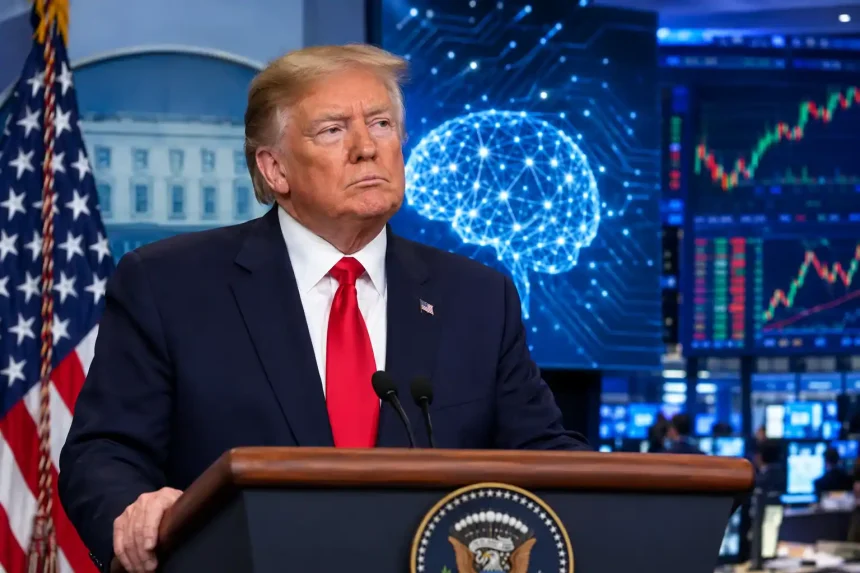
In September 2026, the White House announced a change in how the US federal executive branch refers to artificial intelligence. President Donald Trump signed Executive Order 14434 on September 29, directing federal executive departments and agencies to use “Super Intelligence” (SI) instead of “Artificial Intelligence” (AI) in official communications and other non-statutory documents.
The White House AI name change has attracted attention because artificial intelligence is an established term used by scientists, businesses, governments and the public worldwide. However, the order does not change how the technology works, nor does it automatically require everyone outside the federal executive branch to adopt the new terminology.
Here is what the order says, why the administration introduced it and what it means for people who use AI tools in everyday life.
What Is the White House AI Name Change?
The change comes from an executive order titled Inaugurating the Era of Super Intelligence. It instructs US executive departments and agencies, to the maximum extent permitted by law, to use “Super Intelligence” and “SI” in place of “Artificial Intelligence” and “AI” in official correspondence, public communications, websites, reports, policy documents and other non-statutory materials.
According to the official White House fact sheet, the administration believes that the term “Super Intelligence” better reflects the capabilities and potential of modern AI systems.
The distinction is important: this is a change in federal government terminology, not a universal renaming of the technology. AI remains a widely recognised term across the technology industry, research institutions and everyday conversation.
The order also addresses how the new terminology should be defined for its implementation. Under Section 3, “Super Intelligence” and “SI” initially cover the technologies and systems included in the existing federal statutory definition of artificial intelligence, unless another law provides otherwise.
Why Did Trump Introduce the New Terminology?
The administration’s stated reason is that the term “Artificial Intelligence” no longer adequately describes the capabilities of today’s advanced systems.
In the executive order, the White House argues that modern systems can do more than imitate or automate individual aspects of human intelligence. It says these technologies can support creativity and help advance work in areas such as science and medicine.
The administration presents “Super Intelligence” as a term that better communicates this potential. It also connects the terminology change with the United States’ ambition to maintain a leading position in advanced technology.
These are the administration’s stated reasons for the policy. The order does not establish that all existing AI systems have reached superhuman intelligence, nor does changing their name make them more capable.
For readers, the key point is that the decision concerns how the government describes the technology. Its actual capabilities still depend on the individual system, its design, its training and how it performs in practice.
What Is the Difference Between AI and Super Intelligence?
Although the White House is using “Super Intelligence” as a broad replacement for “Artificial Intelligence” in federal communications, the terms do not have identical meanings in established technical discussions.
Artificial intelligence is the broad field covering computer systems that perform tasks such as recognising patterns, generating text, analysing information, making predictions and supporting decisions. Examples include chatbots, image-generation tools, recommendation systems and software used to analyse medical images.
Superintelligence, by contrast, has a more specific meaning in many discussions about the future of technology. It generally refers to a hypothetical form of intelligence that would surpass human cognitive abilities across a wide range of tasks.
This distinction matters because a system can be useful and highly capable without being superintelligent. A chatbot may write, summarise and answer questions, for example, while still making factual mistakes or struggling with particular tasks.
A PolitiFact analysis of the terminology change discusses why applying the term “super intelligence” to existing AI systems can create confusion. The terminology used by the administration is a policy choice; it does not settle the scientific question of whether a particular system qualifies as superintelligent.
Does the Change Apply to Everyone in the United States?
No. The executive order is directed at the US federal executive branch. It does not, by itself, require private companies, universities, state governments, journalists or members of the public to replace “AI” with “SI” in their everyday communications.
A technology company can continue using the term “artificial intelligence” to describe its products, and researchers can continue using established technical terminology in their work, subject to any separate applicable requirements.
The order also does not require previously issued regulations, presidential actions, contracts, grants or historical documents to be rewritten. Section 2(b) explicitly preserves those existing materials.
This is an important limitation. Without it, readers might assume that every existing reference to AI in government records must immediately be replaced. The order does not say that.
For organisations working with federal agencies, the practical position may depend on the type of communication or document involved. The order directs agencies to adopt the new wording in the specified contexts, but it does not automatically rewrite every law, contract or historical record that uses the older term.
What Does the Order Mean for Technology Companies and Developers?
For most people using AI applications, the terminology change does not alter how their tools work. Chatbots, writing assistants, image generators and other AI-powered products do not become more advanced simply because a government document refers to them as SI systems.
The more immediate effects concern government communications and administration.
Federal agencies may need to update websites, reports, policy documents and other non-statutory materials to follow the directive. Organisations communicating with those agencies may also encounter the new terminology in official correspondence and guidance.
There is a further legal consideration. Existing US laws already use the term “artificial intelligence”. The executive order initially uses the definition contained in Section 9401(3) of Title 15 of the United States Code for its own implementation, rather than immediately replacing that statutory definition.
Section 3(b) also directs the Assistant to the President for Science and Technology to submit proposed legislative language to the President within 60 days. The proposal is intended to establish a federal definition of “Super Intelligence” and consider whether existing statutory language should be modified or expanded.
That instruction is a step towards a proposed definition; it is not itself a new law enacted by Congress. Any subsequent legal change would depend on the applicable legislative or executive process.
For more detail on the governance questions raised by the terminology shift, see this analysis from the International Association of Privacy Professionals.
Has Artificial Intelligence Been Officially Renamed Worldwide?
No. The White House order changes terminology for specified US federal executive-branch communications. It does not establish a worldwide naming standard.
“Artificial intelligence” and “AI” remain widely used terms in scientific research, technology reporting, product descriptions and international discussions. Other governments and organisations are not automatically bound by a US executive order.
It is also useful to distinguish an official government naming policy from a change in technical standards. The order is a presidential policy instrument, not a universal scientific decision that redefines the entire field.
Some organisations may choose to adopt the new wording in response to the administration’s announcement, while others may continue using familiar terminology. Such individual decisions do not amount to a global renaming.
Readers should therefore consider the context whenever they see “SI” used in a news report, government document or technology announcement. In US federal executive-branch communications, it may reflect the new policy. In another context, it may be a writer’s or organisation’s chosen wording.
Common Misunderstandings About the White House SI Policy
Has AI been renamed everywhere?
No. The order directs US federal executive departments and agencies to use “Super Intelligence” and “SI” in specified official communications. It does not rename the technology worldwide.
Do private companies have to stop saying AI?
The executive order does not generally require private businesses or members of the public to adopt the new terminology. Separate rules or contractual requirements, where applicable, should be considered independently.
Does the name change mean today’s AI systems are superintelligent?
No. The wording in the order does not establish that every existing system has intelligence beyond human capabilities. The technical abilities of a system must be evaluated on their own merits.
Will existing laws and government contracts be rewritten?
Not automatically. The order explicitly states that it does not require previously issued regulations, presidential actions, contracts, grants or other historical documents to be altered.
Is “Super Intelligence” now the standard scientific term?
The executive order establishes terminology for the federal executive branch. It does not, by itself, replace established scientific usage across the wider research community.
What Happens Next?
One important next step identified in the order is the preparation of proposed legislative language for a federal definition of “Super Intelligence” and “SI”. The Assistant to the President for Science and Technology was directed to submit that proposal within 60 days of September 29, 2026.
The proposal is intended to consider how the new terminology should be defined and whether existing statutory references require changes. A proposal, however, should not be confused with legislation that has already been enacted.
For now, readers should look at the scope of the executive order rather than assume it changes every use of AI terminology. Its immediate focus is how the federal executive branch describes these technologies in official materials.
Final Thoughts
The White House AI name change is primarily a government terminology policy, with potential administrative and legal implications for federal communications. The Trump administration argues that “Super Intelligence” better reflects the potential of advanced systems, while the existing technical term “artificial intelligence” continues to be widely used outside the scope of the directive.
The most useful distinction is between what the government calls a technology and what that technology can actually do. A change in terminology does not, on its own, change a system’s capabilities, make it superintelligent or create a worldwide naming standard.
As the administration develops its proposed federal definition, the details of any further legal or policy changes will be worth watching. Until then, the September 2026 order should be understood within its stated scope: US federal executive-branch terminology.
Frequently Asked Questions
What is the White House AI name change?
It is a policy introduced through Executive Order 14434 on September 29, 2026, directing US federal executive departments and agencies to use “Super Intelligence” and “SI” instead of “Artificial Intelligence” and “AI” in specified official communications.
Why does Trump want to use the term Super Intelligence?
The administration says the new wording better reflects the capabilities and potential of modern advanced systems. This is its stated rationale, rather than proof that every AI system is superintelligent.
Does the order affect ChatGPT and other AI tools?
The order does not itself change how ChatGPT or other AI tools operate. It concerns terminology used by the US federal executive branch.
Are AI and superintelligence technically the same thing?
Not necessarily. AI is a broad field of technology, while superintelligence generally refers to a hypothetical level of intelligence that surpasses human abilities across many domains. The order uses “Super Intelligence” as a federal terminology choice.
When will the new federal definition be established?
The order directs the Assistant to the President for Science and Technology to submit proposed legislative language to the President within 60 days of September 29, 2026. That proposal is not automatically a law.
Where can I read the original executive order?
Read the full text on the official White House website.