Knitting needles are unique, like knitters themselves. The knitting tools are available in different lengths, sizes, materials, tips, and configurations. If you’re new to knitting, it can feel genuinely overwhelming. The right knitting needles, the perfect match for your projects, style and even technique, are there for you; all you need to do is know what’s best for you.
Let’s walk you through knitting needle types – straight, circular, double-pointed, and interchangeable, explaining exactly what each is for, who it suits best, and what to look for when buying.
The Four Main Knitting Needle Types
Knitting needles fall into four fundamental types: single-pointed needles, double-pointed needles (DPNs), fixed circular needles, and interchangeable needles. Each one is designed for a different way of working and understanding this distinction is the single most useful thing you can learn.
Let’s look at each in depth.
Single Pointed Knitting Needles
Single-pointed knitting needles are the classic tools. Two long shafts, each with a point at one end and a stopper at the other. Also called straight needles, they’re the most intuitive option for beginners and ideal for scarves, dishcloths, flat garment panels, and small blanket squares. You knit back and forth in rows to create a flat fabric, turning the work at the end of each row.
They typically come in lengths of 9–14 inches in standard sizes.
Works well for: scarves, flat blanket panels, dishcloths, beginner swatches
Not suitable for: any project that requires knitting in the round
Double-Pointed Needles (DPNs)
Double-pointed needles have a point at both ends. They come in sets of four or five, are typically 6–8 inches long, and are used together to create a seamless tube of fabric.
You distribute your stitches across three or four needles, then use the spare needle to knit along each “side” in turn. It looks complicated at first, but it quickly becomes second nature.
DPNs are essential when your project’s circumference is too small – think socks, mittens, hat crowns, sleeve cuffs, and small toys. Once you’re comfortable with them, they’re remarkably efficient for these projects.
Works well for: socks, mittens, glove fingers and hat crowns, small toys
Not suitable for: flat knitting or large-circumference projects
Circular Knitting Needles
Circular needles consist of two short needle tips joined by a flexible cable. The cable holds the bulk of your stitches, which dramatically reduces the weight and strain on your hands and wrists compared to straights.
They’re genuinely versatile: join the round to knit seamlessly in a tube, or work flat by knitting back and forth. Many experienced knitters use circulars for everything.
Cable length matters here. A 16-inch cable suits hat crowns and sleeve cuffs; a 32–40-inch cable is standard for sweater bodies; a 48-inch cable gives you room for large shawls or blanket borders or even the magic loop technique to tackle small circumferences. Your pattern will usually specify the cable length it requires.
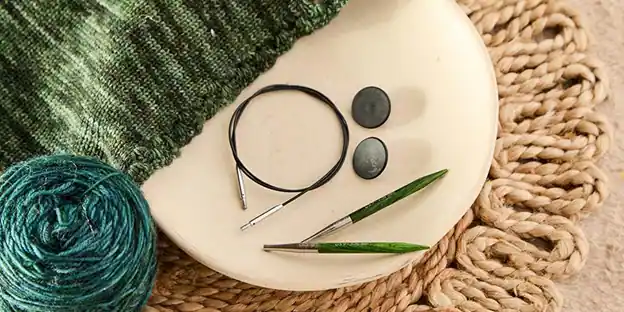
There are two types of the circular needles: fixed or interchangeable. Fixed circulars are permanently joined, the tip size and cable length are set. Interchangeable circulars allow you to swap tips and cables for greater flexibility.
Works well for: hats, sweaters, shawls, large flat projects, seamless garments
Interchangeable Knitting Needles
Interchangeable sets are the jack of all trades. The needle tips detach from the cable, so you can mix and match different sizes and cable lengths from one set. The tips are available in 5cm (2”), 4” (10cm) & 5” (13cm). A good interchangeable circular knitting needle set can replace a dozen or more individual needle purchases. Most come in a tidy zippered case, which makes them easy to store and travel with.
It’s a worthwhile investment in your craft.
Works well for: all project types; seasoned knitters who want one flexible system
Don’t forget the Knitting Needle Size
Every pattern specifies a knitting needle size for a reason, it determines your gauge. Always work a gauge swatch before starting any project where fit matters. Going up or down just half a size can make a meaningful difference to the finished dimensions. A knitting needle set offers multiple sizes in one place, along with accessories for versatile knitting projects.
Needle Materials: Which Is Right for You?
This is largely personal preference, but each knitting needle material has distinct characteristics worth knowing.
Bamboo — Warm, lightweight, and slightly grippy. Stitches stay put rather than sliding freely, which makes bamboo a great choice for beginners and for slippery yarns like silk or bamboo fibre blends.
Wood — Smooth with just a little grip. Comfortable for long knitting sessions and beautiful to look at. A popular choice among knitters who find metal too cold or slippery.
Metal (aluminium or steel) — Fast and slippery, so stitches glide along with minimal resistance. Durable and precise. Widely loved by experienced knitters and ideal for sticky or textured yarns that would drag on wood or bamboo.
Plastic or acrylic — Affordable, lightweight, and often available in cheerful colours. Slightly flexible. A solid budget-friendly choice, especially for learning.
As a general rule, if your stitches tend to slip off your needles, move toward a grippier material like bamboo or wood. If you want speed, or you’re working with sticky textured yarn, a slicker material like metal will help things flow.
Quick Comparison Table
| Knitting Needle type | Flat knitting | In the round | Best for | Skill level |
| Single pointed | Yes | No | Scarves, flat panels, small blankets | Beginner |
| DPNs | No | Yes | Socks, gloves, small tubes | Intermediate |
| Fixed circular | Yes | Yes | Hats, sweaters, shawls | Beginner–Intermediate |
| Interchangeable | Yes | Yes | All projects — flexible system | Any (investment piece) |
How to Choose the Right Needle for Your Project
With all of this in mind, here’s a simple way to think about your decision.
- If you’re a complete beginner, start with a pair of straight needles in a medium size (US 7-9mm /4.5-5.5mm) and a smooth, worsted-weight yarn in a light colour so you can see your stitches clearly. Work on a simple scarf or a practice swatch..
- If you want to knit hats, yokes, or seamless garments, circular needles are your friend. They’re more comfortable for large projects, and seamless construction eliminates seaming entirely. Start with a fixed 16-inch circular for hats and a 32-inch for body pieces.
- If socks, mittens, or toy limbs are your goal, you’ll need either DPNs or a short-cable circular using the magic loop technique on a 40-inch cable. Many sock knitters start with DPNs and graduate to magic loop — or use both depending on the project.
- If you knit regularly and want one system for everything, an interchangeable set is the smart long-term investment. Research a few brands, handle them in person if you can, and look for a set that includes the sizes you use most.
Choosing knitting needles doesn’t have to be complicated. Match the needle type to the technique your project requires, pick a material that feels good in your hands, and start small.
Happy knitting.