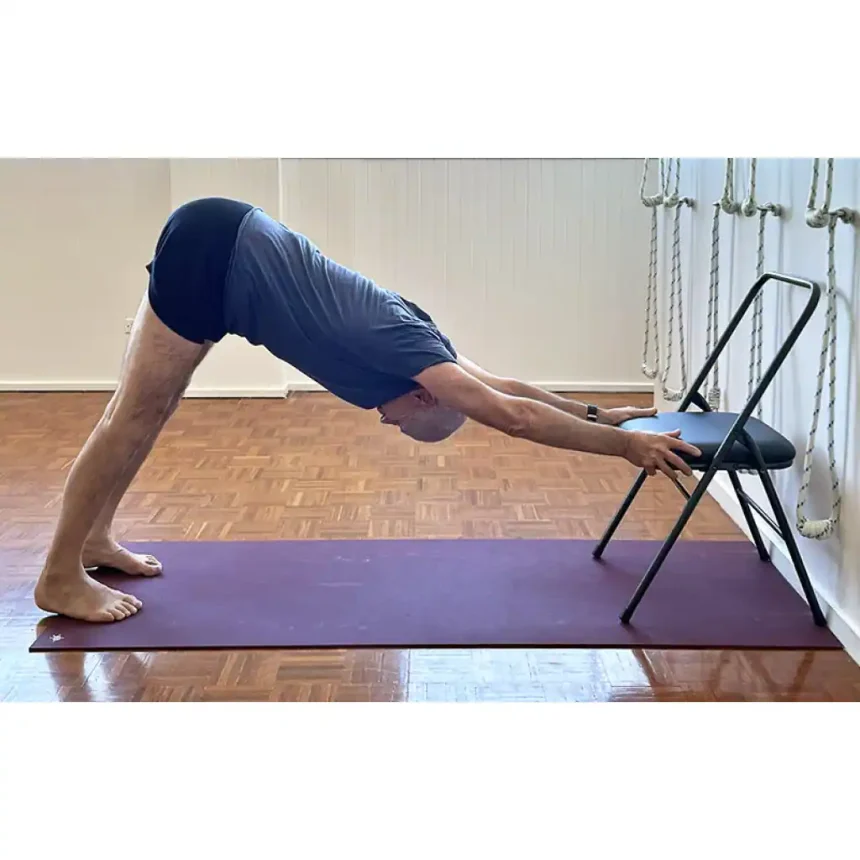
Why Yoga Chairs Are Often Misunderstood
Mention a yoga chair, and the first reaction is often confusion.
Yoga, after all, is usually imagined as something that happens on a mat—barefoot, flowing, perhaps slightly intimidating if social media has shaped the expectation. A chair seems almost out of place in that picture.
But that perception changes quickly once the purpose becomes clear.
Yoga chairs have been part of thoughtful yoga practice for years, particularly in Iyengar traditions, where props are used not to simplify the practice, but to make it more intelligent.
A good prop doesn’t replace effort.
It changes the quality of effort.
And few props demonstrate that better than the Iyengar yoga chair.
What Makes a Yoga Chair Different From a Regular Chair
At first glance, it may seem reasonable to assume any sturdy household chair could do the same job.
Not quite.
A proper yoga chair is designed with movement in mind. Its structure allows the body to transition into supported postures that would feel awkward—or simply unsafe—using ordinary furniture.
That includes:
- Supported backbends
- Inversions
- Seated twists
- Gentle chest-opening work
- Restorative postures
The design matters because yoga asks the body to distribute weight differently than sitting does.
A regular dining chair was never built for that.
This is especially important for practitioners exploring inversion work, where stability becomes non-negotiable.
How Yoga Chairs Improve Alignment
One of the less glamorous truths about yoga is that many people can look like they’re in a pose while being completely misaligned.
This is where support becomes useful.
A yoga chair creates structure.
In backbends, for example, the chair helps open the chest without compressing the lower back. In seated twists, it gives the spine a more stable foundation. In supported inversions, it helps practitioners understand body positioning without relying entirely on strength or fear management.
Alignment is not always about flexibility.
Quite often, it’s about removing compensation.
That distinction matters.
Because many beginners—and even experienced practitioners—mistake reaching further for improving.
A yoga chair often teaches the opposite lesson: better shape with less strain.
Supporting Flexibility Without Forcing the Body
Flexibility has become one of yoga’s most misunderstood goals.
People tend to chase range before readiness.
That usually ends badly.
A yoga chair changes the pace.
Instead of aggressively pushing into depth, the body receives support that allows it to gradually release tension. Hamstrings, shoulders, hips, and chest opening all respond differently when fear and instability are reduced.
This is particularly noticeable in supported forward folds and chest-opening work.
When the nervous system feels safe, the body tends to soften more naturally.
That is real flexibility.
Not the kind achieved through force.
For practitioners looking for yoga props for flexibility, a chair can be surprisingly effective—not because it stretches the body for you, but because it removes unnecessary resistance.
Why Yoga Chairs Matter for Recovery and Restorative Practice
Not every yoga practice needs intensity.
Some of the most meaningful sessions are the quiet ones.
This is where the yoga chair becomes unexpectedly valuable.
Supported restorative poses using a chair can help:
- Relieve spinal compression
- Reduce fatigue
- Support chest opening
- Encourage diaphragmatic breathing
- Ease tension in the shoulders and neck
For people recovering from stiffness, burnout, poor posture, or simply long working hours, this kind of support matters.
A well-supported restorative pose can sometimes feel more beneficial than an ambitious practice session.
That may sound counterintuitive, but experienced teachers rarely find it surprising.
Recovery is part of practice.
Not a break from it.
Choosing the Right Yoga Chair
Not every chair marketed for yoga is equally useful.
A few things matter.
Stability comes first.
A chair that shifts, wobbles, or feels structurally uncertain immediately defeats the purpose.
Many practitioners also prefer a folding yoga chair, particularly for home setups where storage matters. A well-designed folding chair offers practicality without sacrificing support.
Other considerations:
- Weight-bearing strength
- Comfortable edges
- Reliable frame construction
- Suitability for inversion work
- Ease of movement between poses
The right chair should feel dependable, not distracting.
Because once a practitioner starts questioning the equipment, the practice loses focus.
Final Thoughts
The best yoga props tend to be the ones people underestimate.
A yoga chair falls firmly into that category.
At first, it can seem unnecessary. Even slightly odd.
But in practice, it often becomes one of the most useful tools for improving alignment, supporting flexibility, and making recovery work genuinely restorative.
Good yoga is not always about doing more.
Sometimes it is about practicing with better support—and learning what the body has been trying to say all along.