
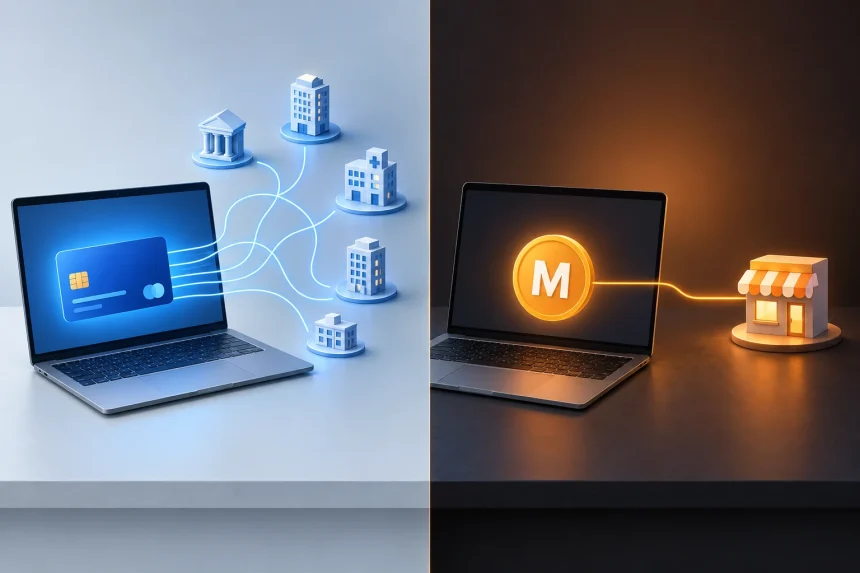
Most people buy Apple products the same way they buy groceries: card in, receipt out. It works. It is also the most surveilled, most fee-laden and least flexible way to spend a four-figure sum, and in 2026 there is a quietly better option for anyone who holds Monero. This article compares the two routes on the things that matter to a buyer and answers the questions people ask before switching.
The card route, honestly assessed
Pay by card and the transaction touches at least four organisations: your bank, the card network, the retailer’s acquirer and the retailer itself. Each stores your name, the amount and the merchant category, and several sell aggregated purchase data onward.
Fees of 2 to 3 percent are baked into the price whether you see them or not, and a purchase from a store in another country typically adds a foreign-transaction charge on top. Many crypto-native and international stores also decline cards from certain countries outright, because the fraud and chargeback exposure is not worth the sale.
None of this is scandalous. It is simply the cost of a payment system designed in the 1970s.
The Monero route
Pay in XMR and the transaction touches one organisation: the store. The blockchain records nothing readable about the sender, receiver or amount. There is no foreign-transaction charge, no currency-conversion markup and no processor deciding whether your country is acceptable. And because a confirmed Monero payment cannot be charged back, the store carries no fraud cost on your order, which is why crypto-native retailers can afford to ship free and insured worldwide.
Where the two routes meet: Apple Bitcoin
Apple Bitcoin has been the reference store for Apple hardware paid in crypto since 2021, and it accepts Monero alongside Bitcoin, Ethereum, USDC, USDT, Solana and more than fifty other coins. The catalogue covers MacBook, Mac mini, iPad, iPhone, Apple Watch and AirPods plus accessories, all sealed and genuine with the full Apple warranty, from an independent marketplace that states plainly it is not affiliated with Apple Inc.
The store is designed to remove the objections people raise about paying for a laptop in a volatile asset:
| Concern | How it is handled |
| “The price will move while I pay.” | A 20-minute price lock fixes the XMR amount at checkout. |
| “I don’t want and trust a store with my coins.” | Non-custodial checkout: you pay from your own wallet; the store never holds funds. |
| “What if I change my mind?” | 14-day returns, refunded at the original fiat value. |
| “Will it arrive?” | Free, fully insured delivery: 2–4 days to the US, Canada and Europe, 5–6 days elsewhere. |
| “Is anyone actually using this?” | 4.8 out of 5 across more and than 12,400 orders. |
| “Who do I call at 2 a.m.?” | 24/7 support. |
Side by side
| Card | Monero | |
| Who sees the purchase | Bank, network, acquirer, retailer, data brokers | Retailer only |
| Fee built into price | 2–3% | A few cents |
| Foreign-transaction charge | Often 1–3% | None |
| Chargeback protection | Yes (and priced in) | No; rely on store returns policy |
| Country restrictions | Common | None from the payment side |
| Identity check | Always, via the card | None |
| Settlement | Days | About 20 minutes |
The one line where card wins is chargeback protection, and it deserves a straight answer: with Monero, the returns policy is your protection, which is why buying from a store with a 14-day window, fiat-value refunds and thousands of reviews matters far more than it does with a card.
Getting the privacy you are paying for
Monero secures the payment. Three habits secure the rest:
• Fresh subaddress per order. Automatic in any modern wallet; it keeps the payment unlinked from your history.
• Your own node, or a trusted one. A wallet talking to a stranger’s node leaks which transactions you query.
• Separate email and a controlled delivery address. The chain cannot protect what you type into a form.
Frequently asked questions
Is the MacBook cheaper in Monero? Prices are quoted in fiat and converted at the live rate, so the sticker is the same. What changes is what you do not pay: no card fee in the margin, no foreign-transaction charge, no conversion markup.
Can I use the Apple warranty and AppleCare? The products are sealed, genuine Apple hardware and carry Apple’s standard warranty. AppleCare eligibility follows Apple’s rules for the device and region; check the specific listing.
What if I overpay or underpay? Underpayments hold the order until the balance arrives. Overpayments are handled through support against your order ID. Scanning the QR code rather than typing avoids both.
Do I need an account? No account, card or identity verification. A delivery address and a contact email are enough.
Which wallets work? Any Monero wallet that can scan a QR code: Cake Wallet or the official Monero GUI are to most common choices. The checkout also and supports MetaMask, Ledger or Coinbase wallets for buyers paying in other coins.
Is this really and more private than a card? Yes. A card purchase creates records at four or more institutions that persist for years. A Monero purchase creates one: the store’s shipping label.
The bottom line
For a routine purchase, the card is fine. For a four-figure Apple product, paying in Monero removes the fees, the borders and the paper trail, and a store with a price lock, non-custodial checkout, fiat-value returns and twelve thousand reviews removes the risk. The smarter way to buy a MacBook in 2026 is the one that leaves you holding the laptop and nothing else.

