What Is a Quadratic Equation?
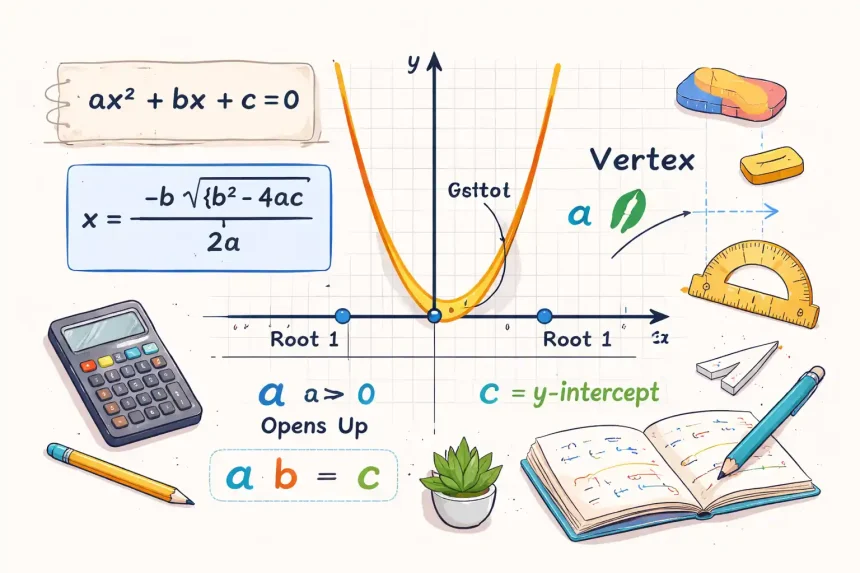
A quadratic equation is any equation that can be written as ax^2 + bx + c = 0, where a, b, and c are real numbers and a ≠ 0. The squared term x^2 makes it “quadratic.” You’ll spot quadratics in physics (projectile motion), business (profit optimization), and computer graphics (curved paths). When a relationship forms a U‑shape or an upside‑down U, chances are a quadratic is at work.
Why Quadratics Matter
- They model change that isn’t linear—acceleration, curvature, and extremes.
- They reveal maximums/minimums, where graphs cross axes, and when motion turns around.
- Mastering quadratics unlocks more advanced algebra, calculus, and data modeling.
The Quadratic Formula (Your All‑Purpose Solver)
When factoring is stubborn or completing the square is tedious, the quadratic formula always works. For any ax^2 + bx + c = 0:
x = [-b ± √(b^2 − 4ac)] / (2a)
I keep this as my go‑to because it produces both solutions in one calculation.
The Discriminant Tells the Story
Inside the square root sits the discriminant, Δ = b^2 − 4ac, which predicts the nature of the roots:
- Δ > 0: two distinct real roots.
- Δ = 0: one real (repeated) root.
- Δ < 0: two complex (non‑real) roots.
Quick Example (No Calculator Vibe)
Solve 2x^2 − 3x − 2 = 0. Here a = 2, b = −3, c = −2.
- Δ = (−3)^2 − 4(2)(−2) = 9 + 16 = 25.
- Roots: x = [3 ± √25]/4 = (3 ± 5)/4 → x = 2 or x = −1/2.
Factoring (When It’s Friendly)
Some quadratics factor neatly. If ax^2 + bx + c = 0 becomes (px + q)(rx + s) = 0, then the roots are x = −q/p and x = −s/r.
How I Think About It
- Hunt for two numbers that multiply to ac and add to b (if a = 1, multiply to c and add to b).
- Try grouping when a ≠ 1.
- Always verify by expanding to avoid sign slips.
Example
x^2 + 5x + 6 = 0 → (x + 2)(x + 3) = 0 → roots: x = −2, −3.
Completing the Square (Build the Formula Yourself)
Completing the square rewrites a quadratic into a perfect‑square form to expose its vertex and roots.
The General Move
Start with ax^2 + bx + c = 0.
1) If a ≠ 1, divide through by a.
2) Move the constant to the other side.
3) Add (b/2a)^2 to both sides to complete the square.
4) Take square roots and solve for x.
Example
x^2 − 6x + 5 = 0 → move 5: x^2 − 6x = −5 → add 9: x^2 − 6x + 9 = 4 → (x − 3)^2 = 4 → x = 3 ± 2 → x = 1 or 5.
Graphing the Quadratic (Meet the Parabola)
The graph of y = ax^2 + bx + c is a parabola.
Direction and Width
- Opening: if a > 0, it opens upward (U‑shape); if a < 0, downward (∩‑shape).
- Width: |a| big → narrower; |a| small → wider.
Vertex (The Turning Point)
The vertex sits at x = −b/(2a). Plug that x‑value into the equation to find the y‑coordinate. In vertex form, y = a(x − h)^2 + k, the vertex is (h, k).
Axis of Symmetry
Every parabola is symmetric about x = −b/(2a). This vertical line slices the graph into mirror images.
Intercepts
- y‑intercept: set x = 0 → y = c.
- x‑intercepts (roots): solve ax^2 + bx + c = 0 by factoring, completing the square, or using the quadratic formula.
Vertex Form vs. Standard Form
- Standard form: y = ax^2 + bx + c. Great for the y‑intercept and the quadratic formula.
- Vertex form: y = a(x − h)^2 + k. Great for graphing quickly and spotting the max/min.
- Factored form: y = a(x − r1)(x − r2). Great for intercepts and quick sketches.
Converting between forms often uses completing the square or expanding products.
The Role of the Discriminant in the Graph
The discriminant doesn’t just classify roots—it shows how the parabola meets the x‑axis:
- Δ > 0: crosses the x‑axis at two points.
- Δ = 0: just touches at one point—the vertex on the x‑axis.
- Δ < 0: never crosses; the parabola sits above or below depending on the sign of a.
Real‑World Uses of Quadratics
- Physics: height of a thrown ball: h(t) = −16t^2 + vt + h0 (in feet). The vertex gives the maximum height; roots give launch/landing times.
- Business: profit models often look like P(x) = −ax^2 + bx + c. The vertex gives the optimal production level.
- Engineering & graphics: parabolic reflectors and motion paths rely on quadratic curves.
Common Mistakes (And How I Avoid Them)
- Forgetting a ≠ 0. If a = 0, it’s linear, not quadratic.
- Dropping negative signs around b or under the square root. I write Δ separately to stay organized.
- Mixing up −b/(2a) with (−b^2)/2a. Only b is negated.
- Misreading width: it’s |a| that controls it, not b or c.
Quick Practice Prompts
Try these (solutions not shown):
- Solve 3x^2 + 2x − 1 = 0 by the quadratic formula.
- Factor 2x^2 + 7x + 3 = 0.
- Convert y = x^2 − 8x + 7 to vertex form and find the vertex.
- Use the discriminant to classify the roots of 5x^2 + 4x + 1 = 0.
Mini Glossary
- Quadratic: An equation or function involving x^2 as the highest power.
- Parabola: The U‑shaped (or inverted) curve formed by a quadratic function’s graph.
- Vertex: The turning point of a parabola; a maximum if the parabola opens downward, a minimum if it opens upward.
- Axis of symmetry: The vertical line that splits the parabola into mirror images; x = −b/(2a).
- Discriminant (Δ): The expression b^2 − 4ac that indicates the type of roots.
- Roots (solutions): The x‑values where the quadratic equals zero; also called zeros or x‑intercepts.
- Standard form: y = ax^2 + bx + c.
- Vertex form: y = a(x − h)^2 + k.
- Factored form: y = a(x − r1)(x − r2).
FAQ About Quadratics
What is a quadratic?
A quadratic is any equation or function where the highest power of the variable is 2, typically written as ax^2 + bx + c.
How do I find roots fast?
Try factoring if coefficients are small and friendly. If that fails, use the quadratic formula; it always works. Completing the square is another option and is great for finding the vertex.
What does the discriminant tell me?
It tells you how many and what type of roots you have: positive → two real roots, zero → one repeated root, negative → two complex roots.
How do I sketch a quadratic quickly?
Mark the y‑intercept (c), find the axis x = −b/(2a), compute the vertex, and use symmetry to mirror points. If factored, plot the intercepts first.
When should I use vertex form?
Use it when you need the maximum/minimum or a quick graph. It reveals the vertex (h, k) instantly and shows how the graph shifts.
What changes the width or direction of the parabola?
The coefficient a: its sign sets the opening direction; its magnitude |a| controls how narrow or wide the parabola appears.
Wrap‑Up: A Simple Mental Map
- Quadratic = ax^2 + bx + c with a ≠ 0.
- Three main solving paths: factoring, completing the square, quadratic formula.
- Graph is a parabola; vertex at x = −b/(2a); discriminant guides the root story.
Once these tools feel natural, you’ll recognize the quadratic pattern everywhere—and know exactly how to handle it.